 Kazi Emdadul Haq: The world closely observed President Putin’s recent visit to India, particularly his promise of “uninterrupted” oil supply—a direct rebuke of Western pressure on New Delhi. India’s official narrative, reiterated by External Affairs Minister Jaishankar and media commentators, champions the nation’s sovereign right to secure Russian oil, highlighting the EU’s purchases of Russian oil as justification.
Yet, this discourse sidesteps a crucial reality: India has strategically leveraged the U.S.-led embargo not merely to sustain, but to dramatically expand its crude imports from Russia, fundamentally regaining its economy after the COVID-19. This article will briefly analyse the facts of Indian oil purchase from Russia.
Since the controversy began over India buying cheap Russian oil, the Indian government, its media, and many of its strategists have repeatedly defended the decision. They continued this stance even under strong pressure from Western countries, who argued that such purchases helped sustain Putin’s economy and allowed Russia to continue its war in Ukraine.
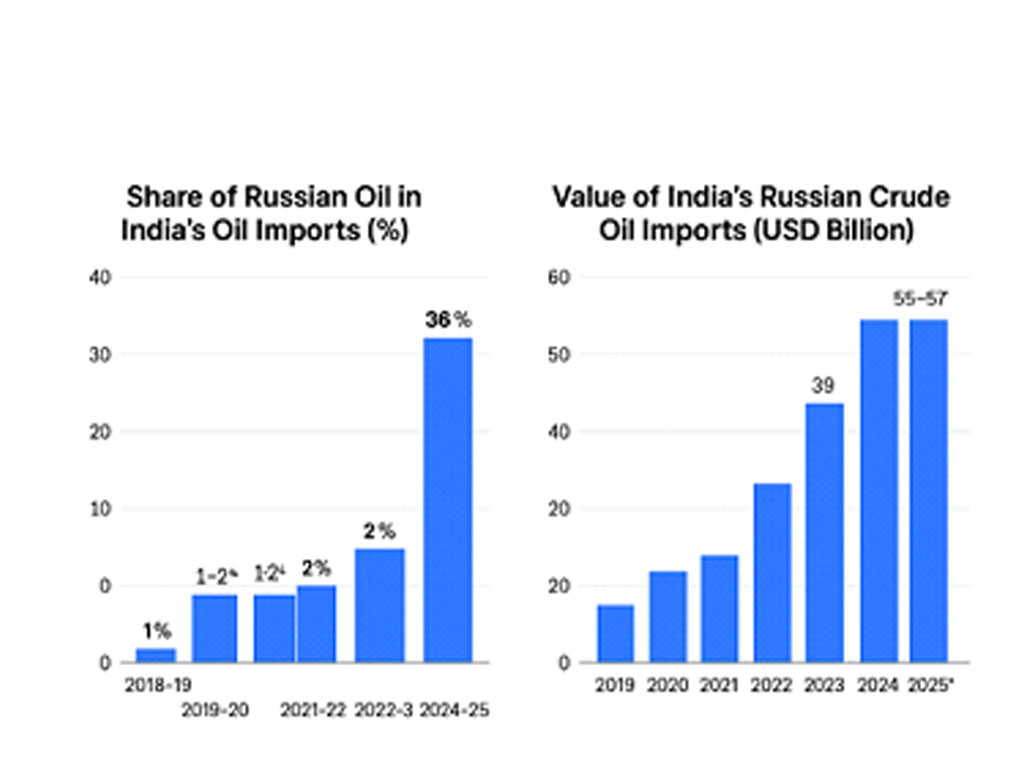
 (Chart created by author using compiled data (2025) from publicly available trade data reported by the Financial Times, Reuters, Economic Times, and Government of India Petroleum Import Statistics (2019-2025)).
Before the Ukraine War( 2022), Russia was a minor supplier; its share in India’s crude imports was about 1–2%. After the invasion of Ukraine (24 Feb 2022), the USA imposed sanctions on Russian oil companies. Russia announced offering large discounts on crude oil. India stepped in as European buyers walked away. Russian oil’s share in India’s crude imports jumped to about 21–22% in FY 2022–23.
By 2024–25, Russia’s share peaked at around 35–40% of India’s oil imports. One analysis finds the Russian share rose from 1% in 2018-19 to 35.8% (by volume) in 2024-25, and that Indian crude imports from Russia increased about 20-fold during that time.
According to a report by the Centre for Research on Energy and Clean Air (CREA), from the start of the Ukraine war (Feb 2022) up to March 2025, India purchased about USD 222 billion of fossil fuel from Russia, out of which for crude oil is USD121 billion. India always sourced its oil from Middle East. After the US sanctions, Russia heavily discounted the oil, and India jumped in for the Russian oil without any care for the Ukraine War.
According to the Russia Fossil Tracker (CREA), Russia earned about €958 billion in fossil fuel exports (crude oil + petroleum products + gas + coal) since February 2022. Of that, 68 % was from oil, which equals roughly USD 700 billion. Of course, China remains the largest Russian oil importer.
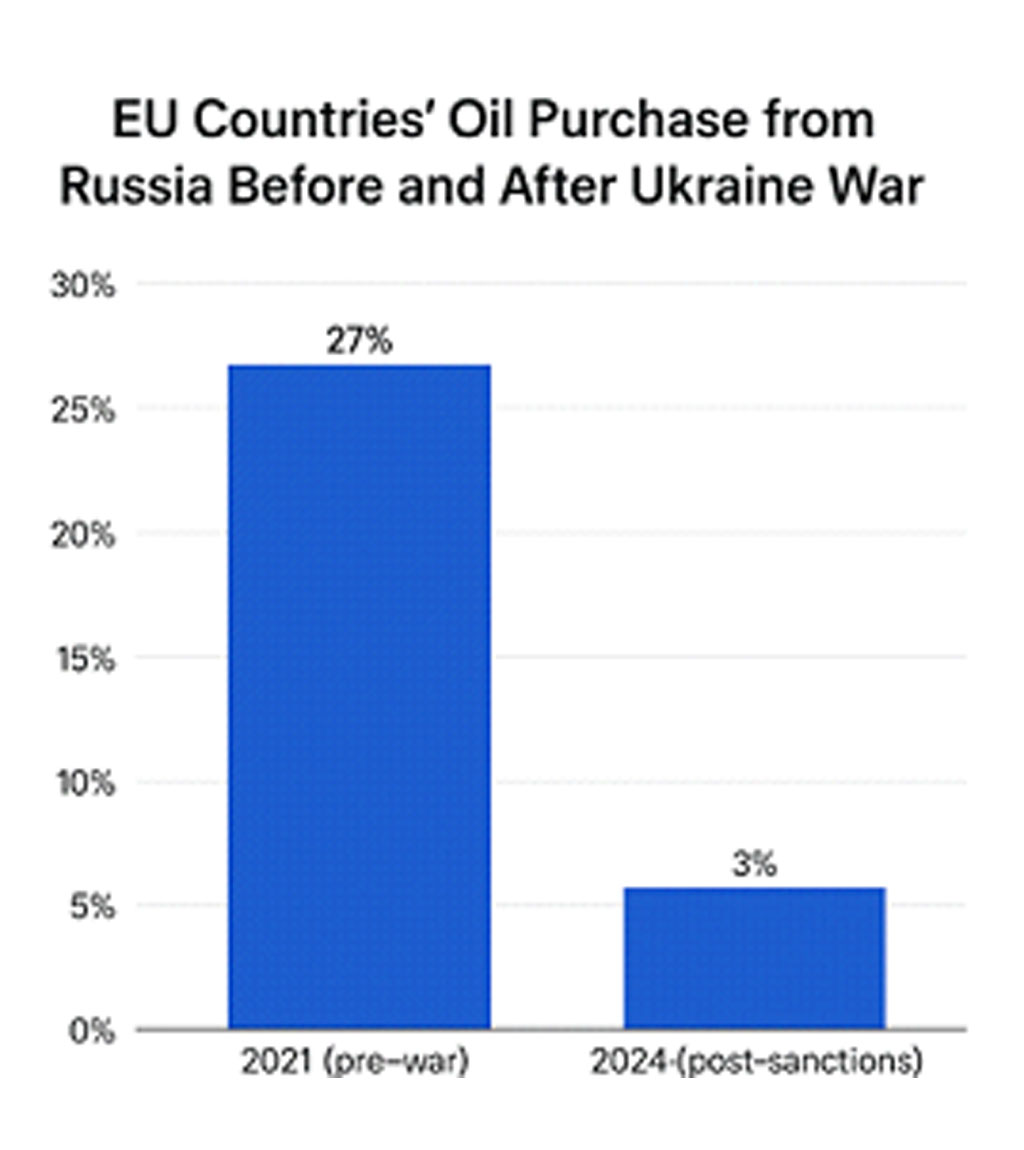
Indian social media often justifies India’s large purchases of Russian oil by citing the fact that EU countries still buy from Russia. However, the chart clearly shows that this claim is misleading. The EU’s oil imports from Russia have fallen to around 3% in 2024, compared to the levels before the war.
Despite this, many well-known Indian commentators and strategists continue to repeat the same narrative, presenting a twisted version of the facts. Some even claim that the United States is still buying Russian oil, which is also untrue.
India has been trying to benefit from the oil embargo while still keeping strong trade relations with Western countries. This kind of approach is contradictory, and it is unlikely to be accepted by the West, especially the United States.
As a result, senior members of the Biden administration were criticising Modi for continuing to buy Russian oil. Some also commented that history would not forget India buying cheap Russian oil, making Putin’s war machinery sustain the prolonged Ukraine War. Consequently, even after the change of US regime, what we observe now is that Trump began criticising Modi and went on to impose a 50% tariff on Indian goods.
India, like any other nation, has the sovereign right to make its own trade decisions and work with whichever countries it chooses. For many years, India has maintained business relationships with both the East and the West. India has long been a trusted friend of Russia, and it also relies heavily on Russian military equipment.
After the sanctions were introduced, Western countries collectively agreed to stop buying Russian oil and began sourcing their supplies elsewhere. India, conversely, chose a different path and adopted a clever strategy regarding the purchase of Russian oil. This strategy boosted India’s economy and helped Russia maintain its prolonged war effort in Ukraine. In reality, India benefited directly from the oil embargo imposed by the United States, turning the situation into an economic opportunity.
However, this approach did not sit well with Western countries. India began to appear as an outlier, and its explanations to the world were often unclear or based on misleading comparisons, such as quoting outdated or twisted figures about the EU’s oil purchases from Russia.
India is a large and formidable country, and a major regional power, if not a future superpower. A nation of this size is expected to act in a way that earns the trust of people around the world if it hopes to be accepted as a rising global leader. So far, India’s foreign policy has often appeared unclear to many Western strategists and has remained highly controversial among its neighbouring countries.
At present, it seems that neither Western countries nor India’s neighbours fully trust India. Indian politicians — both from the government and the opposition — often portray neighbouring countries as hostile, which further damages regional trust. It may also be possible that India’s foreign policy is not designed to build trust in the region, perhaps with the expectation that gaining American support will allow India to act as a guardian power in South Asia.
Perhaps India believed it could get away with all its skewed strategy of cheap Russian oil purchase, thinking it could successfully balance both the East and the West. But once again, India’s strategic calculation has not worked out.
Modi may have assumed that if his old friend Trump returned to power, he would be able to manage the situation easily. But, lo and behold, after Trump won a second term, their personal friendship has become noticeably strained rather than strengthened.
In response to Putin’s offer, India appears far more cautious this time. Perhaps, Modi may be worried about Trump’s tariffs. The tariffs Trump has already imposed have not delivered the results he hoped for under his Make America Great Again (MAGA) agenda, and Trump is clearly unhappy about that. Since India is an easier target than China, there is a real possibility that Trump could impose even more tariffs on Indian goods. He may even take other strategic steps to pressure or isolate India further.