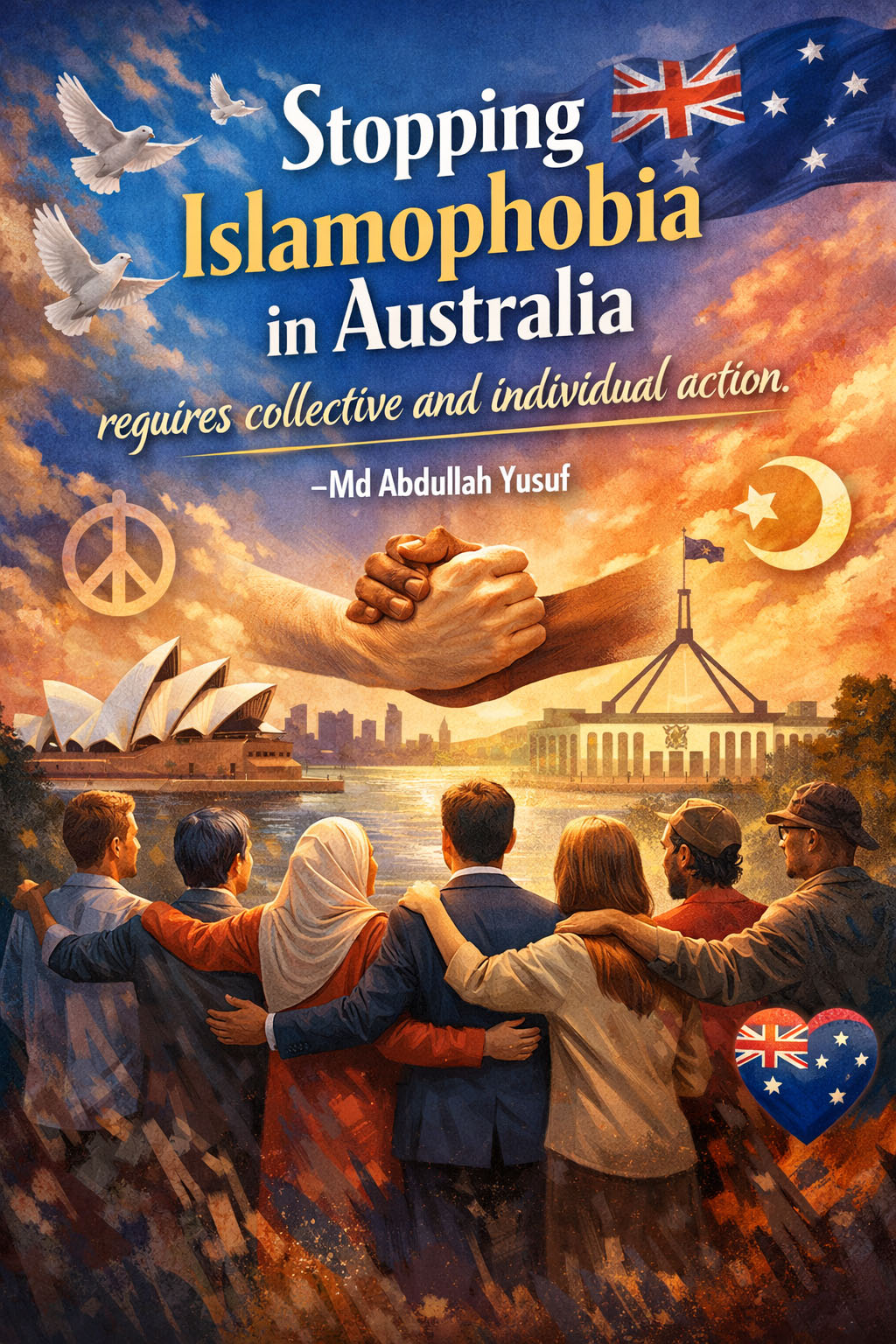
 -Md Abdullah Yusuf: Stopping Islamophobia in Australia requires both collective action and individual responsibility. Change happens when institutions, communities, and everyday people act together. Islamophobia is not only an issue affecting Muslims; it threatens Australia’s core values of fairness, multiculturalism, and social cohesion.
Australia is home to people of many faiths and backgrounds, and Muslims have long been an integral part of the nation’s social, economic, political and cultural life. Yet incidents of discrimination, verbal abuse, online hate, and physical attacks against Muslims continue to occur. These acts are often fuelled by misinformation, fear, and irresponsible public narratives that unfairly associate an entire faith with extremism.
At the collective level, leadership matters. Governments, political leaders, and public institutions must take a clear and consistent stand against Islamophobia and all forms of racism. Anti-discrimination and hate-crime laws must be properly enforced, and reporting mechanisms should be accessible and trusted by victims. Schools and universities also have a critical role to play by promoting accurate education about Islam, Australian Muslim history, and respect for diversity. Education that builds critical thinking and media literacy can help young Australians challenge stereotypes before they take root.
The media carries a special responsibility. Sensationalist reporting and careless language can deepen fear and division. Ethical journalism that avoids generalisations and presents balanced, fact-based coverage is essential in shaping public understanding. Positive stories of Muslim contributions to Australian society deserve greater visibility.
Community engagement is equally vital. Interfaith dialogue, open community events, and grassroots initiatives help break down barriers and humanise differences. When people meet, talk, and work together, fear is replaced by understanding. Local councils, faith groups, and civil society organisations can foster these connections and create safe spaces for dialogue.
Individual responsibility, however, is just as important. Every Australian has a role in challenging Islamophobia in daily life. Speaking out against stereotypes, correcting misinformation, and refusing to tolerate hateful language can make a real difference. Educating oneself from credible sources, rather than relying on social media myths, helps build informed opinions. Simple acts of solidarity supporting a colleague, neighbour, or stranger facing discrimination send a powerful message that hatred is not acceptable.
Ultimately, Islamophobia undermines the unity and safety of the entire nation. An Australia that is just, inclusive, and secure for Muslims is an Australia that is stronger for everyone. Ending Islamophobia requires commitment at every level of society, guided by respect, truth, and our shared humanity.
Collectively (as a society, communities, and institutions)
- Strong leadership & clear laws
- Governments and political leaders must clearly condemn Islamophobia and all forms of racism.
- Enforce anti-discrimination and hate-crime laws consistently and transparently.
- Education from early ages
- Schools should teach accurate, balanced education about Islam, Australian Muslim history, and cultural diversity.
- Include anti-racism and media-literacy programs to counter stereotypes.
- Responsible media & public discourse
- Media outlets should avoid sensationalism and unfairly linking Islam with extremism.
- Promote ethical journalism and hold outlets accountable for misinformation.
- Community dialogue & interfaith work
- Support interfaith programs between Muslims, Christians, Jews, Hindus, Buddhists, and others.
- Encourage community events, open mosque days, and shared civic activities.
- Support victims & reporting systems
- Strengthen reporting mechanisms for Islamophobic incidents.
- Provide legal, mental-health, and community support for victims.
Individually (what each person can do)
- Challenge stereotypes
- Question misinformation when you hear it—politely but firmly.
- Don’t stay silent when someone spreads Islamophobic remarks.
- Educate yourself
- Learn about Islam from credible sources, not social media myths.
- Understand the difference between religion, culture, and politics.
- Be an active ally
- Stand with Muslim colleagues, neighbours, and classmates when they face discrimination.
- Report hate speech or abuse when you witness it.
- Use respectful language
- Avoid generalisations about Muslims or any group.
- Words shape attitudes—choose them carefully.
- Build real relationships
- Personal interaction breaks fear faster than debates.
- Friendship and everyday respect are powerful tools against prejudice.
Bottom line
Australian politicians have a vital and unequivocal role to play in confronting Islamophobia. Community media and social media platforms also carry a shared responsibility to actively challenge hatred, misinformation, and discrimination.
The Australian government must step up and speak out loudly and clearly against Islamophobia, backed by strong and enforceable laws. Any politician who promotes hatred or incites discrimination against any religion should be held fully accountable removed from Parliament and barred from participating in government activities.
Islamophobia is not just a Muslim issue it is an Australian issue. A fair, safe, and inclusive Australia depends on respect, truth, and shared humanity. Ending hatred starts with policy, but it succeeds through people.
There must be zero tolerance for religious hatred in a democratic and multicultural society like Australia