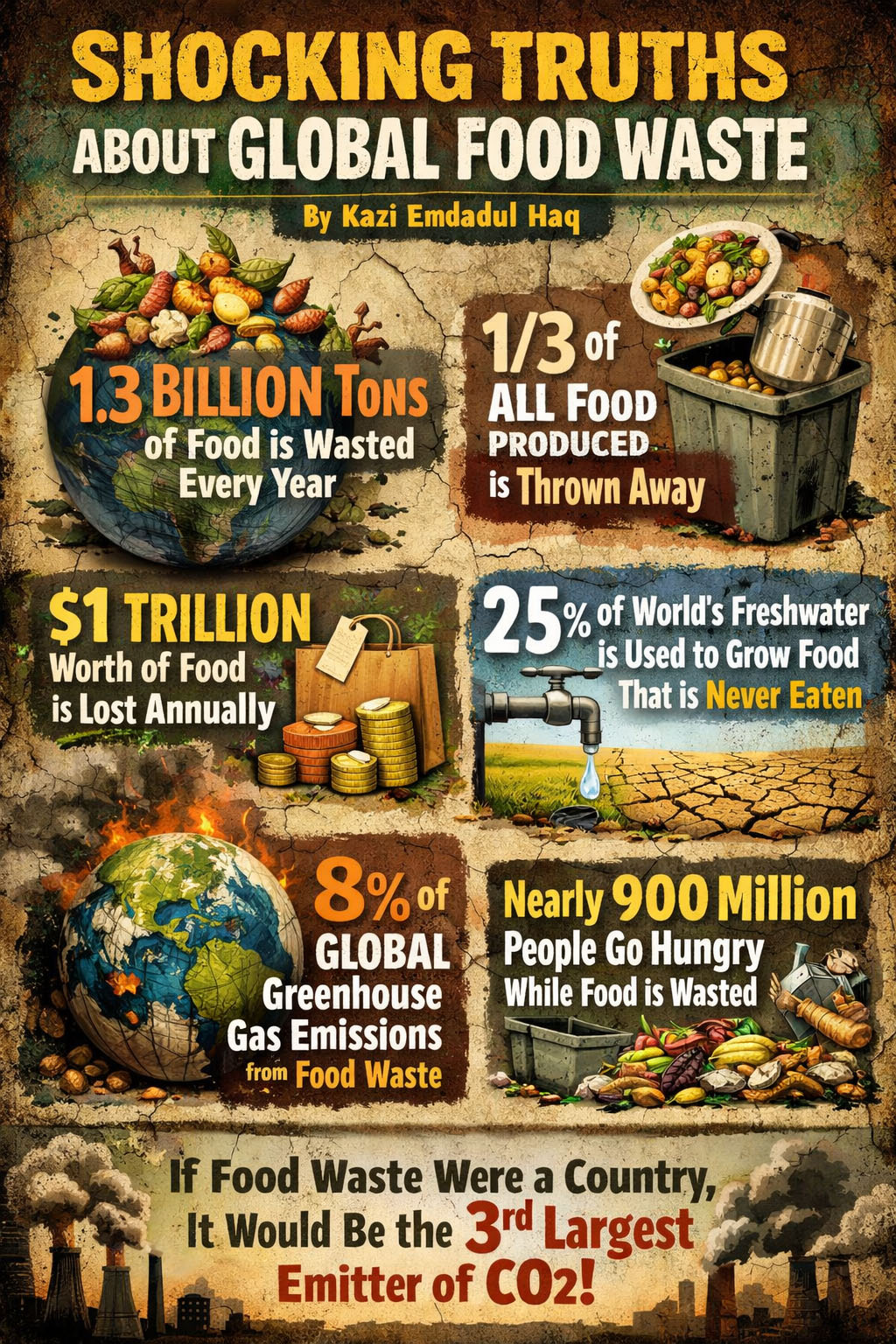
 Kazi Emdadul Haq: It is a shocking and heartbreaking truth that the food wasted each year by the world’s wealthiest nations could feed about 2.1 billion of our planet’s poorest people. This means almost 700 million people (8.5 percent of the global population live in extreme poverty – on less than $2.15 per day) could be fed many times over, without changing a single meal in a rich household—if only that surplus reached them. For Muslims, this tragedy cuts even deeper: Saudi Arabia, supposedly idol of Muslim countries and the Custodian of the Holy Kaba, wastes more food per person than the United States, while Holy scripture commands all not to waste. This leaves us with a painful question: why can’t the world’s privileged stop this excess, and why can’t we turn our abundance into hope for those in need?
Let’s start with some hard-to-hear facts. The basic truth is that the world loses roughly US$1 trillion worth of food every year—from the farm to our plates. This phenomenon occurs in both wealthy and developing countries. According to the UN, this wasted food equals over one billion meals every single day —more than enough to feed every hungry person on the planet.
Looking just at developed countries, a U.S. nonprofit called ReFED found that the value of uneaten and thrown-away food reached about $384 billion. Of that, about $339 billion came from food that was simply wasted.
It estimates the economic value of surplus and wasted food in developed countries, especially: Globally, about 1.6 billion tonnes of food is wasted annually, roughly one third of all food produced. According to the UN, households account for ~60% and food services (restaurants, hotels, catering) around 28%.
(“Westerners” / Developed Countries: Quantifying waste specifically by wealthy people isn’t straightforward, but data shows high-income countries generally waste large amounts at the consumer level, especially through overbuying, oversized portions, and restaurant plate waste — common behaviours in affluent societies.)
Let’s see how many poor people of the world could be fed with the wasted food cost of $384 billion. According to the World Bank, around 700 million people (8.5 percent of the global population) live in extreme poverty(< $2.15/day) and around 2.3 billion people live in severe food insecurity.
To model how many people that sum could feed, we need a cost estimate for feeding someone minimally:
| Daily Cost | Annual Cost | People Fed with $384 B: |
| $1/day | ~$365/year | ~1.05 billion people |
| $0.75/day | ~$274/year | ~1.40 billion people |
| $0.50/day | ~$182/year | ~2.11 billion people |
In terms of simple interpretation, With $384 billion of food waste value:
- We could theoretically feed almost all of the world’s undernourished (700M) people more than once over at $1/day.
- At very basic food costs (~$0.50/day), we could feed most of the 2.3 billion people who are moderately or severely food insecure for a year.
- We could also theoretically cover a large share of the ~2.6 billion people who cannot afford a healthy diet.
- Even among the ~700 million in extreme poverty, the funding could feed them comfortably and still have a surplus.
(Important notes: These numbers are estimates and comparisons)
Now let’s see the food waste in some rich countries. For the purpose of understanding, I have taken some developed countries to compare their food waste. Let’s see the per capita food waste from the chart below:
(Note: the chart is created by the author, taking data from different sources)

The chart shows that Australia has the highest total amount of food waste, which I will explain later. But when we look at waste per person, Saudi Arabia tops the list, while Japan wastes the least. This shows that Japanese people are the most careful in the world about not wasting food, even though Japan is one of the richest countries.
In terms of total value, the USA wastes more food than any other country in dollar terms.
I’ve included Saudi Arabia in this comparison to highlight a difficult truth: despite the Holy Quran’s clear instruction not to waste, Saudi Arabia has one of the highest levels of food waste per person in the world.
The above gives us the overall idea of worldwide food waste, although it’s not straightforward to calculate. However, we may consider it as an estimated value.
Before we dive into details, we should have a brief idea about the definition of food waste. Food waste generally means uneaten food, starting from production, including unsold surplus food, to dumping.
Food that is produced but never eaten requires enormous resources to grow, harvest, transport, cool, cook and dispose of.
Food waste happens in various stages of the supply chain (from production to dumping). The first stage is the Production level, or the farm where food grows. Low market prices or high harvest costs, including labour shortage, make it for the farmers not profitable and leave the unharvested food in the fields.
Next comes the Manufacturers at the processing stage, where the manufacturers discard huge food items during processing and packaging. Then comes the Retailer’s level, where the food waste is due to lack of freshness (expiry date, unsold, etc).
The final stage of food waste is Food Services (restaurants, fast food shops and homes). This is where Saudi Arabia is champion.
(To be continued)