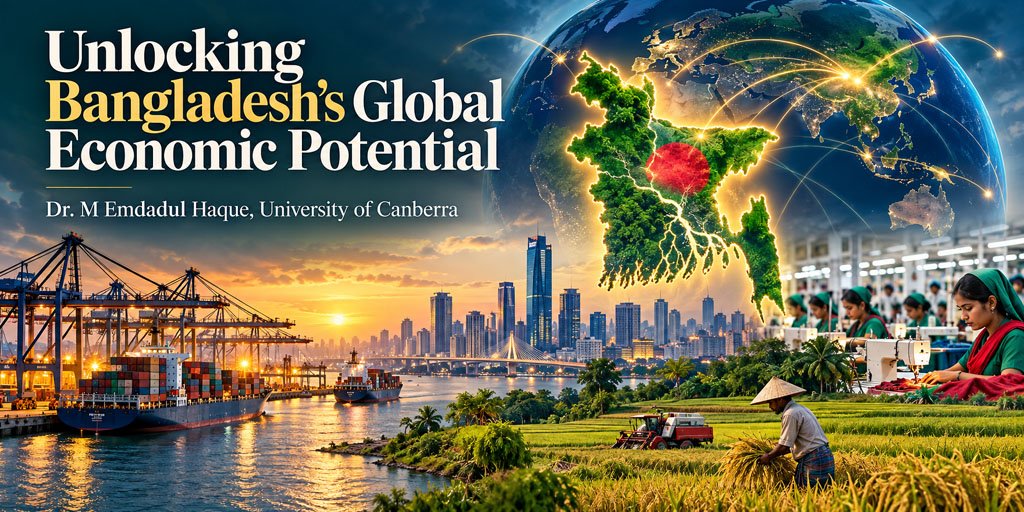
 Dr. M Emdadul Haque: Bangladesh showed some success in using international trade to transform its economy. The ready-made garment, remittances, and export-oriented manufacturing have generated employment, foreign exchange, economic and social progress. However, the next stage of Bangladesh’s development requires a much broader ambition. The proposed extension of LDC graduation preparation period should not be viewed simply as additional time before graduation; it should be used as a three-year window for deep structural transformation. (UN Transcripts). The recent IMF assessment identifies banking-sector weaknesses and the need to deepen capital markets so that domestic savings can be channelled into productive long-term investment, while the World Bank continues to identify low FDI, financial-sector weaknesses and subdued private investment as major constraints. (IMF eLibrary) Bangladesh therefore needs to move beyond the traditional concept of “export promotion” towards a comprehensive strategy of international trade, investment, finance and economic diplomacy. The country should seek not only to export garments, pharmaceuticals, leather, agricultural products and other goods, but also to attract foreign direct investment, multinational corporations, international banks, private equity, portfolio investment, technology partnerships, and regional trade headquarters. It should develop itself as a location where international companies can invest, manufacture, finance, manage regional operations and connect with Asian, Islamic, and global markets.
The Asian Development Bank’s 2025 investment-policy roadmap similarly calls for modernising Bangladesh’s investment framework, improving investment promotion and facilitation, strengthening economic zones and creating a more responsible and predictable business environment. (Asian Development Bank)
A New International Economic Architecture
The country should consider establishing a powerful International Trade, Capital and Investment Authority, or alternatively transforming the existing institutional structures of **Foreign Ministry, Commerce Ministry, and BIDA** into a Ministry of International Trade and Economic Diplomacy. The important issue, however, is not the name; it is the functions and institutional authority. Such an institution should bring together international trade negotiations, FTA strategy, FDI promotion, investment facilitation, commercial diplomacy, export finance, market intelligence and international business development. Bangladesh’s overseas missions should have professionally trained Economic and Commercial Diplomats whose responsibilities extend beyond traditional diplomatic activities. They should actively identify foreign investors, multinational companies, international buyers, technology partners, infrastructure investors, sovereign wealth funds, pension funds, security/stock exchange and financial institutions. They should monitor foreign markets, identify non-tariff barriers, support Bangladeshi companies entering overseas markets and help negotiate commercial opportunities.
Australia’s experience provides a useful institutional model. Australia’s Department of Foreign Affairs and Trade (DFAT) explicitly treats economic and commercial diplomacy as a core part of national economic policy, with five areas including investment promotion, addressing non-tariff barriers, business facilitation, the rules-based trading system and science and technology links. **DFAT works with Austrade and Export Finance Australia** rather than attempting to perform every function through one ministry. (DFAT). Bangladesh could adapt this approach to its own circumstances.
1. Build a National FDI and International Investment Programme
The country needs to treat FDI attraction as a national economic project, rather than simply asking foreign companies to invest in economic zones. A specialised investment promotion system should identify 50–100 multinational corporations in sectors such as pharmaceuticals, electronics, electrical equipment, automobiles and components, renewable energy, ICT, fintech, logistics, food processing, medical technology, engineering and advanced manufacturing and develop individual investment proposals for them.
Investment promotion should extend to cross-border mergers and acquisitions. Bangladesh companies should be encouraged and assisted to acquire foreign companies, brands, technology and distribution networks where economically viable, while foreign companies should be able to acquire or partner with Bangladeshi firms under transparent competition and national-security rules. The objective should be to move from: How can Bangladesh get a factory? to:
“How can Bangladesh become part of a multinational corporation’s global production, finance, technology and supply-chain strategy?”
2. Develop as an International Financial Centre
Bangladesh should not depend almost entirely on commercial banks for business finance. A modern economy requires a deep ecosystem of banks, investment banks, bond markets, equity markets, private equity, venture capital, pension funds, insurance, asset management and development finance.
The government and private sectors should therefore, implement a Capital Market Deepening Programme covering like:
– government Treasury and corporate bond markets;
– infrastructure and green bonds;
– Sukuk and other Shariah-compliant instruments;
– mortgage and infrastructure-backed securities where appropriate;
– private equity and venture capital;
– foreign institutional investment;
– investment funds and pension funds;
– stronger market-making and primary-dealer systems;
– reliable credit ratings and disclosure;
– derivatives and foreign-exchange risk-management instruments;
– improved corporate governance and minority-shareholder protection.
This is consistent with the IMF’s current assessment that cleaning up the banking sector and deepening capital markets are essential to channel savings into long-term investment and reduce resource misallocation. (IMF eLibrary)
3. Bangladesh Export-Import and International Finance Institution
It needs an institution with functions similar in principle to an Export-Import Bank or development-oriented export-finance agency. It could provide or guarantee:
– export credit;
– buyer’s credit;
– supplier’s credit;
– letters of credit and trade guarantees;
– political-risk insurance;
– working-capital guarantees;
– project finance;
– infrastructure finance;
– guarantees for SMEs entering global supply chains;
– financing for Bangladeshi companies acquiring overseas businesses.
Australia’s Export Finance Australia provides loans, bonds and guarantees when commercial banks cannot fully support an export transaction. (DFAT) Bangladesh could develop a carefully governed institution with similar functions, while avoiding politically directed lending and maintaining professional credit assessment.
4. International Finance a Core Business Skill
Universities, Bangladesh Bank, financial institutions and professional bodies should establish specialised training in multinational financial management and Practical Research Innovations. The country needs expertise in:
international capital budgeting → exchange-rate risk → multinational cash management → transfer pricing → international taxation → trade finance → syndicated loans → Eurobonds → sovereign and corporate bonds → equity financing → cross-border M&A → project finance → derivatives → international commercial law.
If a Bangladeshi company considers establishing a factory in Vietnam or acquiring a company in Malaysia, the decision should not be based simply on the factory’s expected profit. It should evaluate country risk, exchange rates, tax rates, financing costs, remittance of profits, double-taxation treaties, political risk, capital controls, transfer pricing, financing currency and the parent company’s consolidated cash flows. This is the type of sophisticated multinational capital budgeting that Bangladesh’s future corporations will increasingly require.
5. Reform Trade Finance and International Banking
Bangladesh should diversify its understanding of international finance beyond foreign exchange reserves and bank deposits. It requires modern trade-finance architecture including: letters of credit, documentary collections, open-account trade, factoring, forfaiting, supply-chain finance, bank guarantees, export credit, receivables finance and electronic trade documentation.
Bangladeshi banks should be encouraged to develop stronger international correspondent-banking networks and modern treasury operations. Multinational corporations operating in Bangladesh should be able to use sophisticated cash pooling, liquidity management and foreign-exchange hedging arrangements within a clear regulatory framework.
6. Why can’t Bangladesh sign a Free Trade Agreement (FTA) with any country.
It should negotiate FTAs Strategically—Not Symbolically. It should develop a professional FTA Negotiation Unit staffed by economists, lawyers, trade specialists, customs experts, industry representatives and international-finance specialists. The question should not simply be “Can Bangladesh sign an FTA?” but: Which agreement creates the greatest long-term access to markets, investment, technology and global value chains, and what reforms must Bangladesh undertake before signing it?
The country should examine commercially meaningful agreements with selected partners in stages, including Japan, the United Kingdom, the European Union, India, China, Pakistan, ASEAN economies, Australia and other strategically important markets, based on detailed sector-by-sector impact assessments.
India demonstrates that an economy can move from extensive protection and inward-looking policies towards much greater international integration during the time of **Dr. Manmohan Singh**. Following the 1991 balance-of-payments crisis, India progressively reduced trade barriers, liberalised international payments, encouraged FDI and portfolio investment, modernised securities-market regulation and gradually opened parts of its capital account. (IMF eLibrary) India’s subsequent network of trade agreements also illustrates that FTA policy can become part of a broader strategy of economic integration; WTO records show India’s agreements with, among others, Japan, Australia, Singapore, Malaysia and EFTA. (RTA-IS). There are hundreds of Indian CEOs now around the globe, controlling world trade and finance. Bangladesh should study India’s experience carefully—not copy it mechanically, but understand how trade reform, financial reform, industrial policy, FDI and institutional reform were connected.
7. Learning Different Lessons from Different Countries
Bangladesh does not need to copy one country. It can take different lessons from different successful models:
Country
Potential lesson for Bangladesh
Australia
Economic and commercial diplomacy; FTA negotiation; investment promotion; export finance; overseas commercial networks
India
Post-1991 trade, FDI, financial-market and capital-account reforms
Japan
Long-term industrial investment, technology transfer, infrastructure and corporate supply-chain integration
United Kingdom
International financial services, commercial law, arbitration, professional services and global capital markets
United States
Deep equity and bond markets, venture capital, investment banking, corporate finance and financial innovation
China
Special economic zones, manufacturing supply chains, infrastructure, FDI attraction, currency strengthening, and integration into global production networks
Singapore/Malaysia
International banking, regional headquarters, logistics, arbitration, taxation and business-friendly investment administration
India/Pakistan
Regional trade agreements and preferential trade arrangements demonstrate that South Asian countries can pursue bilateral and regional market access despite domestic political and economic constraints, defence sector strengthening, and trade.
The lesson from these countries is not that Bangladesh should liberalise everything immediately. Rather, openness should be accompanied by strong regulation, competition policy, financial supervision, taxation, corporate governance and domestic productive capacity.
8. International Tax and Commercial Law Must Become a Development Priority
International business cannot flourish without predictable law. Bangladesh should develop a specialist framework for international commercial law, investment law, arbitration, insolvency, cross-border M&A, taxation, transfer pricing, double-taxation agreements and intellectual-property protection.
A foreign investor should be able to answer, before investing:
Can I enter? Can I own? Can I finance? Can I repatriate profits? How will I be taxed? What happens if there is a dispute? Can I enforce a contract? Can I sell the investment? Can I acquire another company? Can I hedge my currency exposure? Is there a policy consistency? If these questions cannot be answered clearly and predictably, tax incentives alone will not create sustainable FDI.
9. Turn Economic Diplomacy into a Measurable Performance System
Bangladesh’s embassies should have annual economic targets—not crude numerical targets alone, but measurable outcomes such as:
FDI leads generated;
investment projects facilitated;
new export markets identified;
foreign buyers introduced to Bangladeshi companies;
non-tariff barriers resolved;
technology partnerships developed;
international financing mobilised;
multinational supply-chain opportunities secured;
FTA opportunities identified;
Bangladeshi companies assisted in overseas expansion.
This would transform economic diplomacy from a largely representational activity into a professional international business-development network. Australia’s DFAT model is particularly relevant because its overseas posts combine diplomatic networks with economic and commercial intelligence and work with domestic agencies such as Austrade and Export Finance Australia. (DFAT)
The additional preparation period for LDC graduation should therefore, be used for a clearly measurable programme like: Institutional Reform, Deepening government and corporate markets for Capital and Investment, Global Integration
Conclude priority trade agreements where economically justified; expand commercial diplomacy; facilitate cross-border M&A; develop regional headquarters and global-service centres; integrate Bangladeshi firms into multinational supply chains; promote Bangladesh as an international investment and business destination.
The fundamental change is therefore conceptual.
Bangladesh should move: from goods exports → to goods + services + capital + international business development
from attracting factories → to attracting multinational value chains
from commercial banking → to a complete international financial system
from traditional diplomacy → to economic and commercial diplomacy
from receiving Foreign Aid and FDI → to both receiving and generating international investment
from domestic capital markets → to internationally connected bond and equity markets
from isolated ministries → to coordinated international economic policy.
Bangladesh’s next challenge is to develop the institutional and financial capacity to mobilise international capital, technology, knowledge and markets. The country should aim to become
*A globally connected economy where international companies invest, Bangladeshi companies expand abroad, global capital participates in domestic markets, international finance supports productive investment, and economic diplomacy actively connects Bangladesh with the world’s markets, technologies and financial institutions. That is the transition from “Made in Bangladesh” to “Invest in Bangladesh, Finance in Bangladesh, Trade through Bangladesh and Build Global Bangladesh.”
India’s post-1991 experience was not simply a story of signing FTAs. Its internationalisation was part of a much broader reform package involving trade, FDI, financial markets, payments, industrial licensing, banking supervision and securities-market regulation. (IMF eLibrary) That is probably the most important lesson for Bangladesh: FTAs alone will not transform the economy; institutional, financial and legal reforms must make Bangladesh attractive and capable of participating in international business.
The WTO reports that Bangladesh joined the Investment Facilitation for Development (IFD) Agreement in 2026, bringing the agreement’s parties to 129. This gives Bangladesh an immediate international framework through which it can improve investment transparency and facilitation. (wto.org) That would fit very well as one of the concrete programmes in a future policy paper.
–From Export Promotion to International Trade, Capital, Finance and Economic Diplomacy.