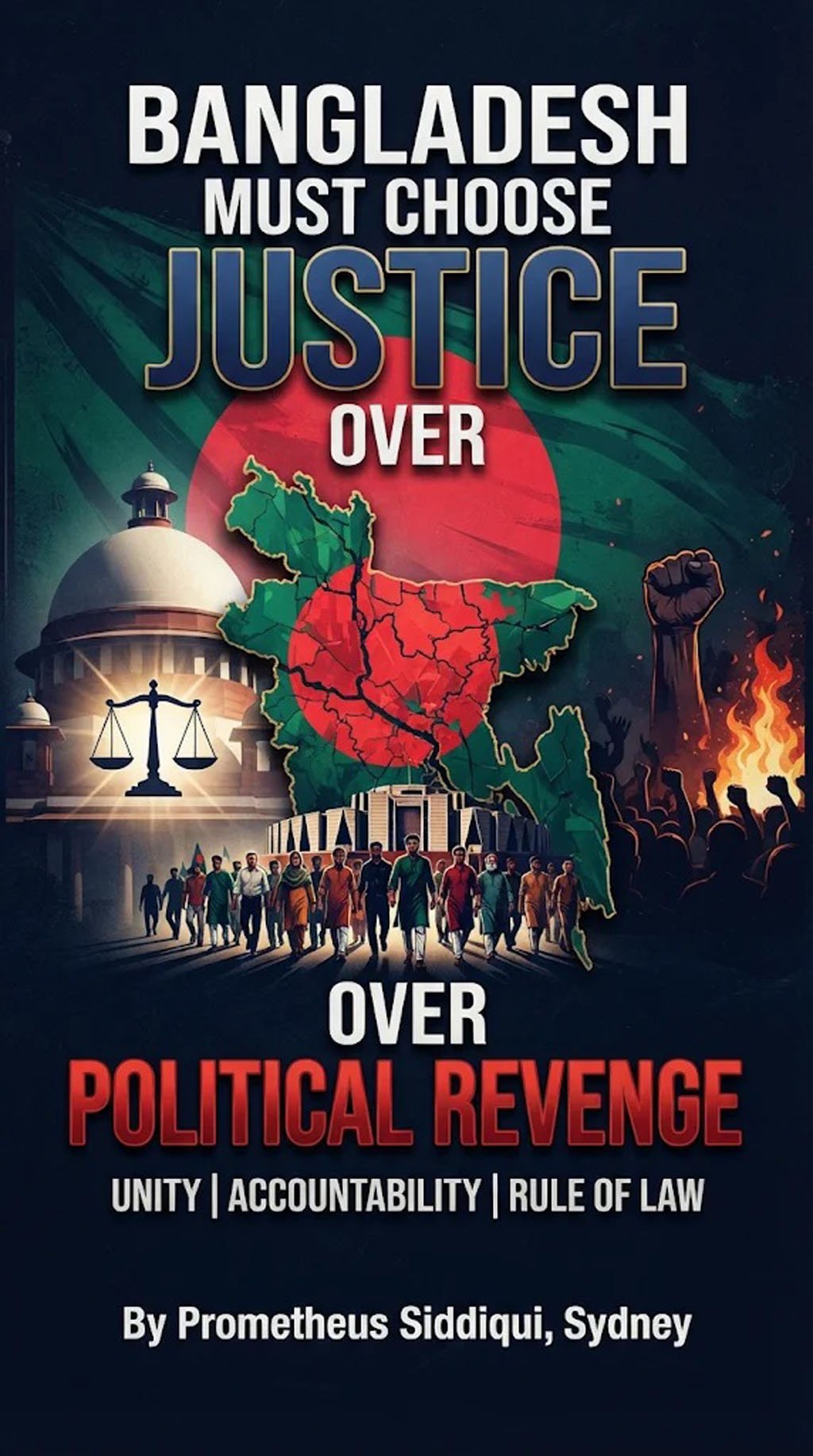
By Prometheus Siddiqui, Sydney: Bangladesh did not endure the bloodshed of 2024 to settle its political arguments with fire. I condemn the attack on Nobel Peace Prize laureate and former chief adviser Professor Muhammad Yunus’s ancestral home, and the attacks on Grameen Bank. Police extinguished the house fire on 18 November. By the following evening, the bank reported 72 branches and offices attacked or targeted in arson attempts over ten days. Every perpetrator must face justice.
Grameen’s 10.7 million members, overwhelmingly women, have livelihoods and financial security at stake. Sheikh Hasina’s government expanded state control over the bank in 2013. Attacking it today threatens people whose savings, businesses and children’s opportunities depend on reliable financial services. Protecting Professor Muhammad Yunus and Grameen should unite people across political differences.
In my view, these attacks reveal a struggle over whether losing power also means losing impunity. Attacks on institutions associated with the transition can intimidate citizens, disrupt livelihoods and weaken confidence in government. Their apparent political logic is to make accountability more costly than accommodation. Bangladesh must resist that calculation.
Police blame Awami League supporters for the wider unrest; the party’s activities remain banned. Home Minister Salahuddin Ahmed has accused leaders abroad of inciting arson. Those allegations demand an independent investigation into who ordered, financed and executed the violence. Investigators must also examine any evidence of assistance within government or security agencies. Neither overseas residence nor former office should shield a person from responsibility. Equally, criminal responsibility must be proved individually.
Hasina’s flight to India on 5 August 2024 ended her 15 years fascist rule in office. Dismantling the habits and institutions of authoritarianism takes longer. As a Bangladeshi-born Australian citizen, I was among those who opposed repression long before that day. The uprising grew from accumulated grievances and years of resistance, including by people whose voices were suppressed.
The human cost demands more than ceremonial remembrance. The UN estimates that up to 1,400 people were killed between 1 July and 15 August 2024, and documented systematic repression by the former government, security services and violent Awami League elements. Bangladesh’s disappearance inquiry subsequently verified 1,569 complaints as enforced disappearances. Behind those figures are families entitled to truth, accountability and reparation.
That record helps explain the depth of public anger. It cannot excuse attacks on Awami League supporters, which the UN also documented. Their victims deserve justice too. Claims of retaliation provide no defence for burning homes or banks. Constitutional freedoms protect peaceful expression and assembly; self-defence cannot become a licence to settle political scores. A democratic state must protect people even when their politics are unpopular.
On 17 November 2025, Bangladesh’s International Crimes Tribunal convicted Hasina in absentia of crimes against humanity, sentencing her and former home minister Asaduzzaman Khan Kamal to death.
If Hasina genuinely wants to return, she can contact the Bangladesh High Commission in New Delhi to seek arrangements for her lawful return and surrender, in coordination with the Indian and Bangladeshi authorities. Her lawyers have already approached the mission seeking documents; Dhaka has insisted on extradition. The passport dispute provides no justification for violence committed in her name.
Bangladesh’s government must secure threatened homes and institutions, preserve evidence, protect witnesses and publish credible investigation updates. Prosecutions must reach organisers and financiers wherever the evidence leads. Police reform, judicial independence and protection against arbitrary detention are essential to prevent another cycle of repression. Victims need functioning institutions that can deliver justice without political permission.
The international community must come together in defence of Bangladesh’s people and their right to justice. The United Nations, Australia, the United Kingdom, the European Union and the United States should support independent investigations, witness protection and trial monitoring. Countries hosting former political leaders should cooperate with lawful requests to trace suspected financing of violence and preserve evidence of criminal incitement. India should engage constructively on Hasina’s return, observing legal and human rights safeguards. International cooperation must protect peaceful political speech while confronting the organisation of violence.
The economic consequences belong in this debate. The World Bank projects growth of just 3.4 per cent in the 2026–27 financial year and warns of persistent inflation and weak investment. Banking, energy and revenue reforms remain urgent. Political violence compounds those challenges by threatening livelihoods and confidence. Economic recovery requires public safety and institutions whose decisions cannot be overturned through intimidation.
Bangladesh now faces a choice that reaches beyond party allegiance. Will we defend democratic accountability, or tolerate retribution whenever it advances our preferred politics? Silence has already cost too much. We owe the July uprising’s martyrs, the disappeared and every innocent victim a country where power answers to law. Those of us who spoke against authoritarianism must keep speaking. Remaining on the right side of history means defending the same freedoms and demanding the same accountability, whoever holds power.