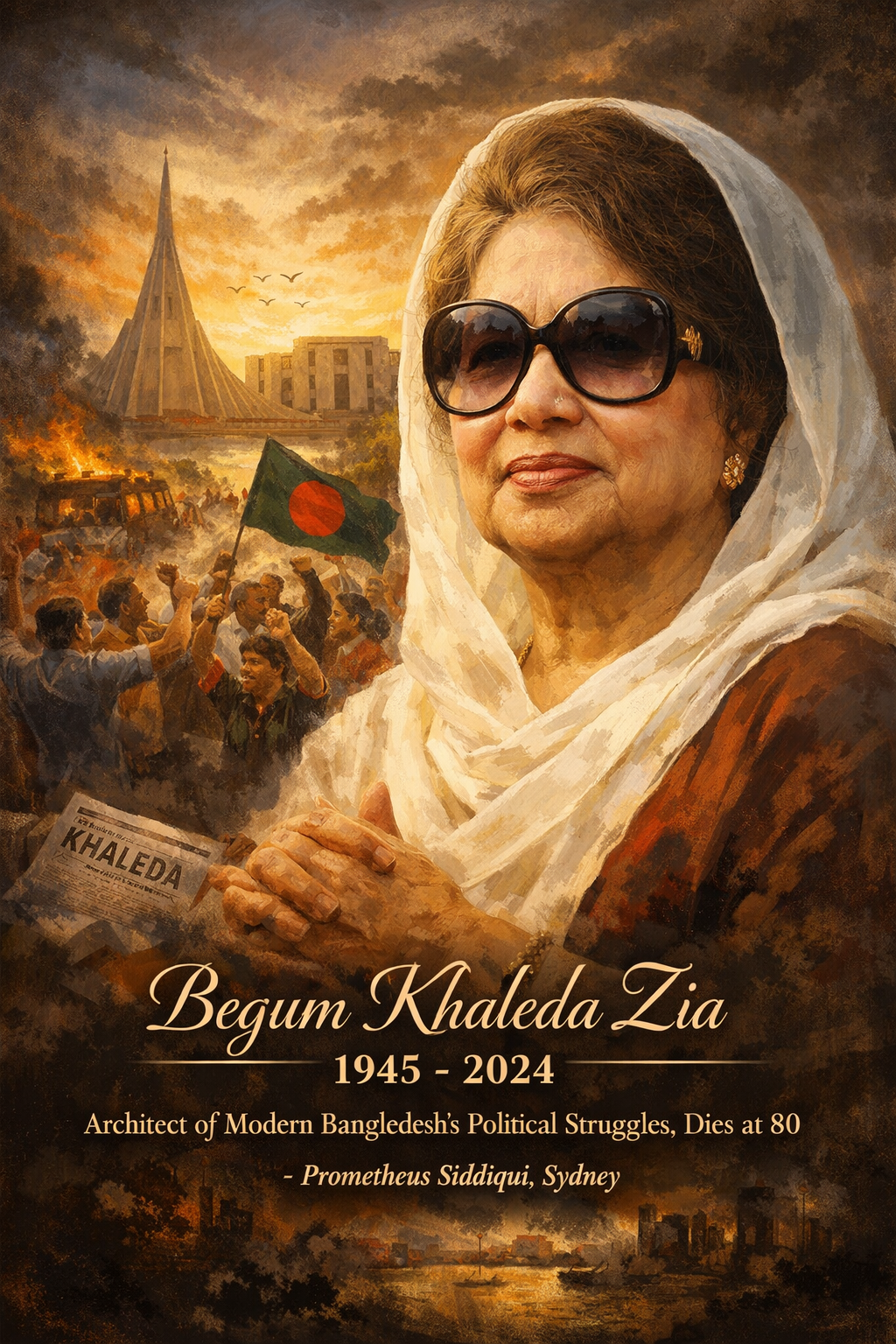
 Prometheus Siddiqui: Begum Khaleda Zia, one of the most consequential figures in Bangladesh’s political history and a central actor in its long struggle to consolidate democracy, died on the morning of 30 December 2025 at the age of 80. She passed away at Evercare Hospital in Dhaka after years of complex health complications, including chronic liver, kidney, and cardiac conditions. Her death has prompted a wave of reflection across Bangladesh and among its global diaspora, marking the end of an era shaped by confrontation, resilience, and unfinished democratic ambition.
Unlike many of her contemporaries, Begum Khaleda Zia did not emerge from an established political lineage. Born in 1945 Begum Khaleda Zia lived largely outside public life until the assassination of her husband, President Ziaur Rahman, in May 1981. Ziaur Rahman, a decorated military officer and a key figure of the 1971 Liberation War, had founded the Bangladesh Nationalist Party (BNP) and served as president from 1977 until his death. His martyrdom thrust Begum Khaleda Zia into national politics at a moment of profound instability. Forsaking private life, she assumed leadership within the BNP and became one of the principal figures opposing military rule during a decisive chapter in Bangladesh’s post-independence evolution.
https://www.instagram.com/p/DS_JNmEEnAQ/
Her ascent culminated in the parliamentary elections of 1991, widely regarded by domestic and international observers as the first freest, fairest, and most broadly accepted in the country’s history. The BNP’s victory followed nearly a decade of mass mobilisation against successive military regimes. Khaleda Zia became the second Muslim woman globally to be elected head of government. The moment carried significance not only for Bangladesh, but for the broader world.
https://www.linkedin.com/feed/?trk=404_page
Begum Khaleda Zia served two non-consecutive terms as prime minister, from 1991 to 1996 and again from 2001 to 2006. During these periods, her governments oversaw important shifts in economic policy and governance. Working closely with her long-serving finance minister, Saifur Rahman, her administrations advanced a reform agenda that reduced the state’s direct role in commercial activity. State-owned enterprises were privatised, a nationwide Value Added Tax system was introduced, and banking sector reforms were implemented. These measures, politically risky at the time, signalled Bangladesh’s most decisive move toward integration with the global economy and helped underpin the country’s steady growth in subsequent decades.
Her record in office, however, was contested. The 2001–2006 period, in particular, drew criticism over governance failures, political violence, and allegations of corruption. Numerous legal cases were filed against her and senior BNP figures in the years that followed. Many of these proceedings became deeply politicised, particularly during periods of authoritarian rule (January 6, 2009, to August 5, 2024), with critics and supporters alike questioning the independence of judicial institutions. In late 2024, Khaleda Zia and her elder son, Tarique Rahman, were acquitted in key graft cases that had shadowed the party for more than a decade.
Her rivalry with the former prime minister of the subsequent authoritarian era defined much of Bangladesh’s political discourse in the 2000s and 2010s. Begum Khaleda Zia was frequently subjected to sustained personal and character attacks in official rhetoric and public media. Yet even amid intense hostility, she largely refrained from responding in kind. She avoided personal vilification of her principal political rival, choosing instead to contest power through elections, institutions, and opposition politics. For many observers, this restraint reflected a discipline and resolve that stood in contrast to the increasingly personalised nature of Bangladesh’s political culture.
https://www.facebook.com/suprovat.sydney
Despite repeated opportunities to leave Bangladesh during periods of repression, including explicit offers of safe exit from a military-backed government in 2008, Begum Khaleda Zia chose to remain. She endured detention, political isolation, and deteriorating health rather than abandon her party or her supporters and her country. She also resisted using personal tragedy as political currency. The assassination of her husband, the death of her younger son and the long exile of her elder son were never leveraged for electoral advantage.
Even without holding office or a parliamentary seat in her later years, Khaleda Zia retained considerable popular recognition. In a political system where influence often wanes once power is lost; the respect she commanded reflected a deeper moral authority rooted in endurance rather than incumbency.
In the turbulent lead-up to Bangladesh’s 2026 national transition, she placed her trust in the interim government led by Nobel Peace Laureate Professor Muhammad Yunus, endorsing his mandate to oversee free and fair elections and support democratic renewal.
https://www.facebook.com/suprovatpage
Bangladesh now mourns not only a former prime minister, but the loss of a political guardian. Her legacy will remain central to debates over democracy, governance and leadership as the nation seeks a stable and inclusive future.
Prometheus Siddiqui, Sydney, Australia, 30 December 2025