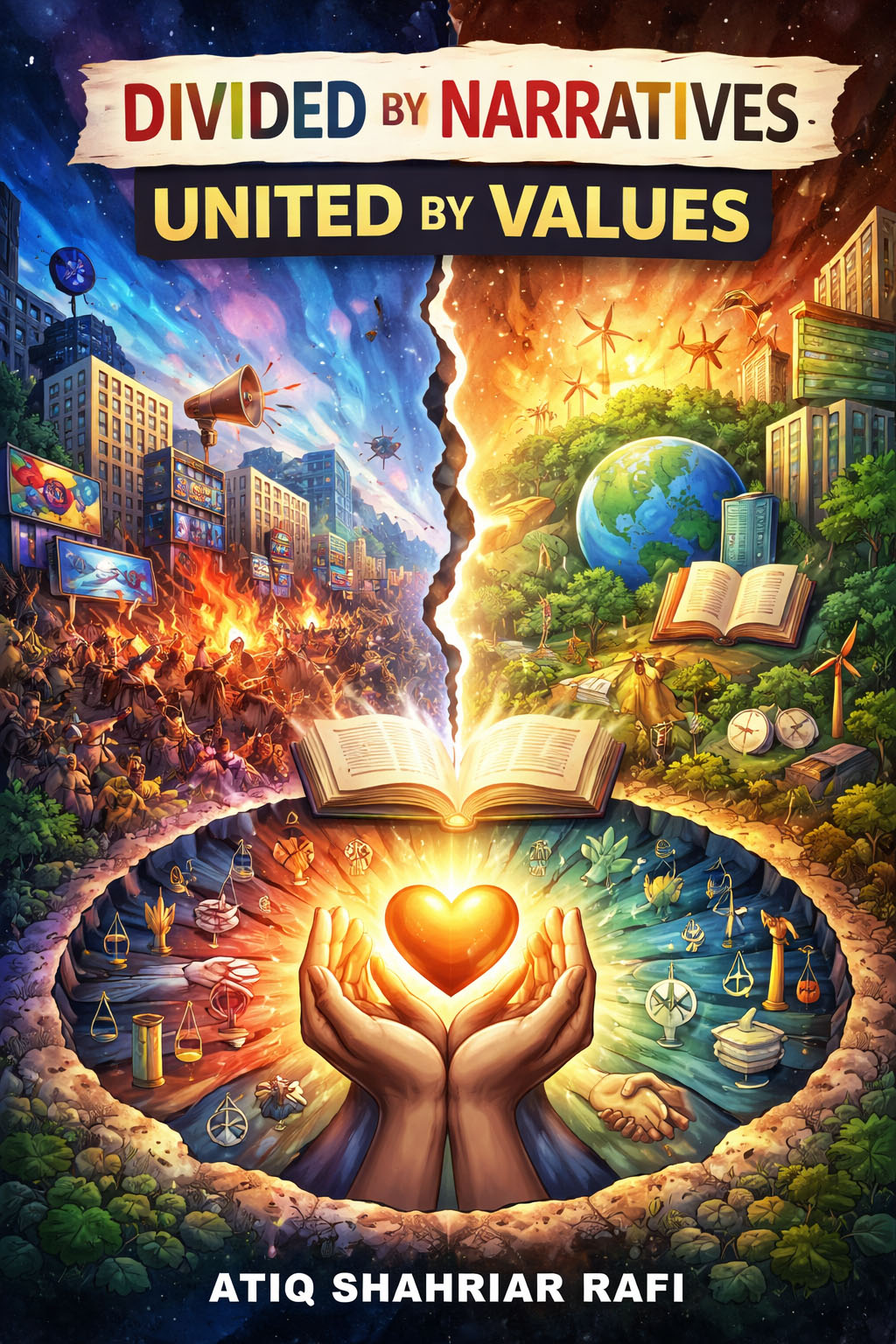
 Atiq Shahriar Rafi: We often see the world as divided. People are separated by religion, race, nationality, language, gender, politics, and many other labels. But these divisions are not natural. They are created over time, often to control people rather than to help them live better lives.
At the core, human beings are very similar. If two people grow up in the same situation and face the same problems, they will likely act in similar ways. Most differences in behaviour come from how someone is raised, what they are taught, and the environment around them. People are shaped by their culture, family, and experiences. That is why judging others based on their country or culture is unfair.
History reminds us that the majority is not always right. Socrates was executed for questioning accepted beliefs. Galileo was punished for presenting scientific facts that challenged powerful ideas of his time. Today, both are respected. In their own time, they were silenced. This shows that popular opinion can be wrong, sometimes for a very long time.
As we look back, we also learn that much of history is not fully accurate. Many stories were shaped by those in power. Even today, misinformation and twisted news are common. Media narratives are often built to serve political goals, boost public image, or make money. In many cases, these stories are driven by personal benefit, not truth or ideology.
This creates a serious problem. Most people actually share the same core values. Yet misinformation makes them fight each other, believing they are on opposite sides. People argue, hate, and divide themselves, even though they want the same things. The conflict is not natural. It is manufactured.
A fair society must treat everyone equally, regardless of sexuality, gender identity, beliefs, morals, or political views. People have the right to think differently. Being the majority does not give anyone the right to silence or oppress others.
We should never force anyone to live the way we do. Every person has the right to choose their own path, values, and way of life, as long as they are not harming others. What feels right, normal, or moral to one group may not feel the same to another, and that does not make either side superior. Forcing beliefs, lifestyles, or opinions on others does not create understanding. It creates resentment and fear. A healthy society is built on freedom of choice, mutual respect, and the acceptance that different ways of living can exist side by side.
If there is one lesson worth carrying forward, it is this: division may be convenient for those who seek control, but unity rooted in empathy is the only foundation for a just world. We do not need to erase our differences. We need to stop using them as weapons.
The point is simple: when we stop questioning each other and start questioning the narratives that divide us, the illusion of conflict begins to fade. Unity does not require sameness. It requires empathy, critical thinking, and the courage to ask who benefits from keeping us apart.