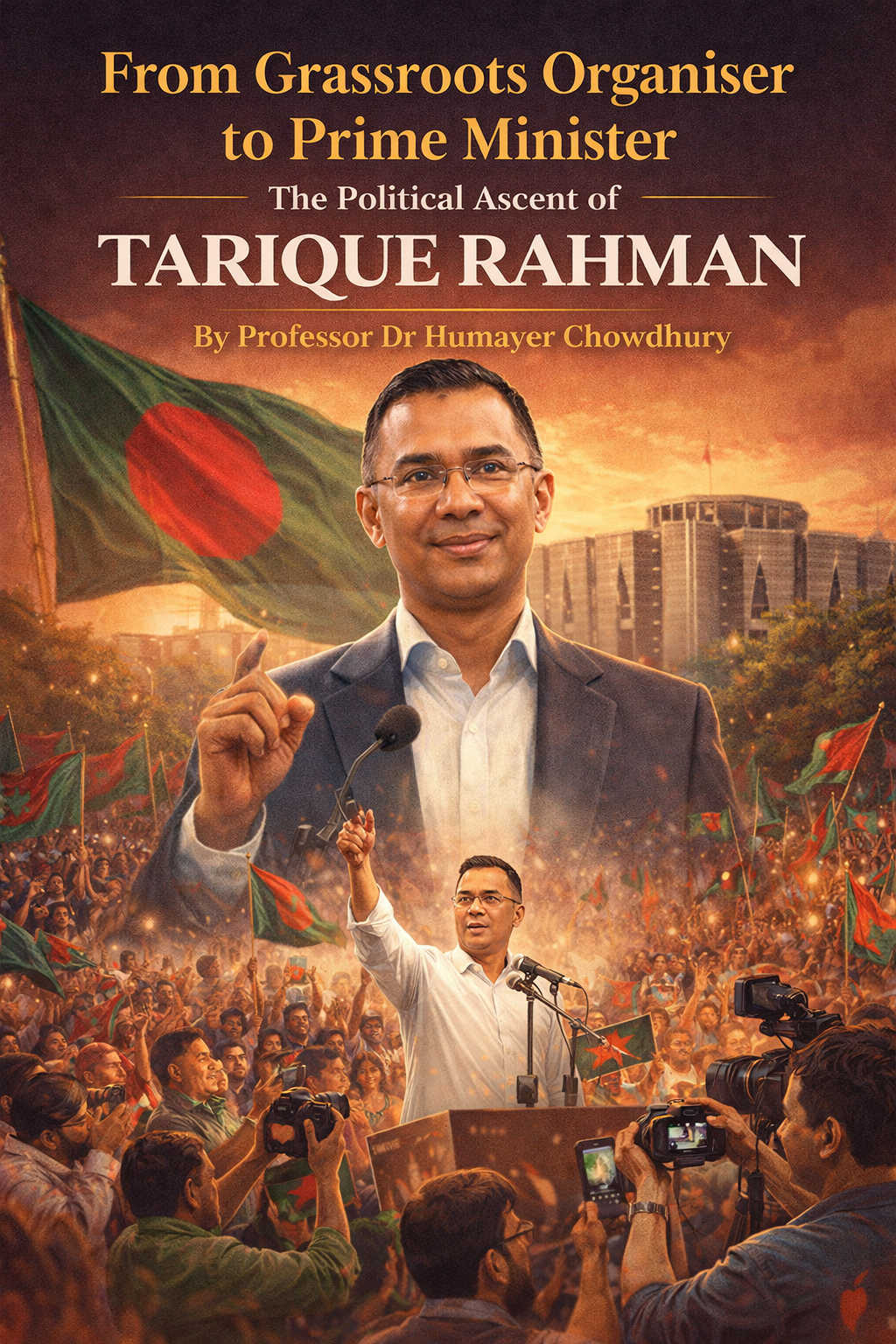
 By Professor Dr Humayer Chowdhury, Sydney Australia: The Bangladesh Nationalist Party has secured a landslide victory in the Bangladesh national election, marking a decisive moment in the nation’s democratic journey. Tarique Rahman has officially been sworn in as the Prime Minister of Bangladesh.
Heartfelt congratulations to Prime Minister Tarique Rahman and his newly appointed cabinet ministers. Wishing them success and a prosperous tenure.
The political journey of Tarique Rahman has entered a historic new chapter. After years of political struggle, organisational rebuilding, and leadership from abroad, his return to Bangladesh and the subsequent landslide victory of the Bangladesh Nationalist Party (BNP) in the national election have marked a defining moment in the country’s democratic evolution. With an absolute majority in parliament, Tarique Rahman has assumed the office of Prime Minister—an achievement shaped by perseverance, strategy, and deep-rooted political engagement.
Leadership Attributes Behind the Victory –
Several attributes have defined Tarique Rahman’s political capacity:
- Organizational Vision
A Journey Rooted in Grassroots Politics
Tarique Rahman’s rise did not begin in the corridors of executive power, but within the organisational framework of the BNP at the grassroots level.
Drawing inspiration from the legacy of his father, Shahid President Ziaur Rahman, the declarer of independence and founder of the BNP, and guided by the political experience of his mother, Deshnetri Begum Khaleda Zia, Tarique Rahman combined inherited political philosophy with a modern organisational outlook. Over time, he developed a reputation as a strategist capable of coordinating large-scale political movements and maintaining party cohesion during challenging periods.
His years abroad, though politically restrictive, were not years of disengagement. Through digital platforms and remote leadership, he continued to direct party strategy, call for institutional reforms, and advocate for democratic accountability. These efforts contributed to maintaining BNP’s relevance in a highly competitive political environment, particularly in its long-standing rivalry with the autocrat Awami regime.
As a young political organiser, he focused on strengthening local committees, energising youth activists, and expanding party networks beyond traditional strongholds. His engagement with the party’s student and youth wings created a generation of politically active supporters who would later become vital to the BNP’s mobilisation efforts. This structural strengthening proved critical in translating public support into electoral success.
- Resilience Under Pressure
Facing legal and political obstacles over the years, he maintained visibility and messaging consistency. His ability to sustain party morale during difficult times earned loyalty within party ranks.
- Strategic Communication
By leveraging technology and engaging directly with young voters, he expanded the BNP’s appeal among first-time voters and urban middle classes, positioning the party as forward-looking rather than solely legacy-driven.
- Coalition-Building Capacity
The landslide victory also reflected successful alliances with like-minded political and civic groups, broadening BNP’s support base across ideological and regional lines.
Governing with Responsibility:
As Prime Minister, Tarique Rahman’s leadership will be measured not only by political rhetoric but by tangible improvements in the daily lives of citizens. Several priority areas demand immediate and sustained attention such as:
- Law & Order situation –
To get Bangladesh’s law and order back on the right track, Tarique Rahman would need a multi-layered approach combining enforcement, institutions, and social measures such as:
Strengthen law enforcement by modernising police with training, technology, and rapid-response units, while ensuring accountability. Improve justice by fast-tracking cases and making courts accessible. Address crime roots through jobs, youth programs, and community conflict mediation. Legal reforms include stricter laws against violence, cybercrime, and trafficking, with independent oversight. Build public trust with politically neutral enforcement and awareness campaigns.
- Strengthening Democratic Institutions –
Ensuring the independence of the judiciary, reinforcing parliamentary oversight, and safeguarding electoral integrity will be foundational to restoring public confidence. Transparent governance mechanisms and anti-corruption reforms will be critical to institutional stability.
- Economic Stability and Job Creation –
Bangladesh’s economy must focus on employment generation, inflation control, and industrial diversification. Expanding support for small and medium enterprises, promoting foreign investment, and investing in technological innovation can create sustainable growth. Special emphasis should be placed on youth employment and skills development.
- Social Welfare and Poverty Reduction –
Targeted social safety nets, improved rural development programs, and inclusive growth policies can reduce inequality. Strengthening healthcare infrastructure and ensuring affordable medical services remain urgent national priorities.
- Glorifying sacrifices of July24 Martyrs – Prime Minister Tarique Rahman should honor the July uprising martyrs and disabled youths through meaningful action, not just tribute.
He should ensure financial support, healthcare, rehabilitation, education, and employment opportunities for the injured and the families of the fallen. A national day of remembrance and official recognition would preserve their legacy.
He should also pursue all lawful and diplomatic avenues to return Sheikh Hasina to Bangladesh to face the consequences of the sentence imposed by the International Criminal Court, ensuring that justice is upheld and accountability is fully enforced.
- Education Reform and Digital Advancement –
Modernizing curricula, investing in teacher training, and expanding digital access will prepare Bangladesh’s youth for a competitive global economy. A knowledge-based development strategy can help transition the country toward higher-value industries.
- Infrastructure and Climate Resilience –
Given Bangladesh’s vulnerability to climate change, investments in flood control, coastal protection, and sustainable urban planning are essential. Infrastructure expansion must be aligned with environmental sustainability.
- National Unity and Political Reconciliation –
After years of intense political polarisation, fostering dialogue across party lines and encouraging inclusive governance will be vital. A leadership style that prioritises consensus-building can reduce tensions and strengthen national cohesion.
- Stability, Transparency, and Results-Driven Governance –
For Tarique Rahman to implement these priorities in Bangladesh, he would need to focus on institutional reform and practical action. Controlling inflation, widening the tax base through digital systems, supporting SMEs, ensuring energy stability, and expanding vocational training can strengthen the economy and create youth employment. Regular briefings, transparent data publication, and citizen forums would build public trust. Setting clear targets for ministries, empowering independent audits, and publishing annual progress reports would ensure accountability and turn policy promises into measurable results.
- Stretegic relations with neighbouring countries, particularly with India –
Prime Minister Tarique Rahman should prioritise engaging India firmly yet diplomatically, demanding Bangladesh’s rightful treatment as a sovereign and independent nation. Relations must be grounded in equality, mutual respect, and shared interests. India, as a regional power, should honor fair agreements like the Ganges Water Sharing Treaty and ensure humane border conduct through its Border Security Force. Strong Bangladesh–India relations can only thrive on dignity, non-interference, and genuine partnership rather than dominance.
- Revitalising the South Asia Regional Cooperation (SAARC) Platform for Stronger Regional Unity –
Tarique Rahman can take bold initiative to revive the SAARC forum, advancing the original vision of his father, Shahid President Ziaur Rahman, for stronger regional cooperation. By reactivating SAARC, he can promote meaningful collaboration among South Asian nations in trade, education, disaster management, and other key areas of shared progress.
If Prime Minister Tarique Rahman is to uphold the credibility of his electoral mandate, his 31-point reform agenda must move from campaign rhetoric to structured, measurable implementation. Election promises especially transformative ones such as the Family Card and Farmers Card initiatives—create high public expectations. The way he prioritises, sequences, and monitors these reforms will determine both public trust and long-term political stability.
Below is a strategic approach he could adopt:
- Convert the 31 Points into a Time-Bound Action Plan –
Break the reform agenda into short-term (100 days), medium-term (2–3 years), and long-term (5 years) targets. Assign ministries clear responsibilities and publish a transparent roadmap so citizens can track progress.
- Family Card Initiative: Targeted Social Protection –
Implement the digital Family Card that he promised for to deliver subsidies efficiently. Use a centralised database to identify low-income households, integrate food, healthcare, and essential subsidies, and minimise duplication with biometric or digital verification. Ensure fiscal sustainability through feasibility studies and phased benefit rollout, prioritising vulnerable families. Independent monitoring and public grievance mechanisms will ensure transparency and accountability.
- Farmers Card Initiative: Strengthening Agriculture –
Support rural economies with direct input subsidies, easier access to low-interest credit, and fair price procurement. Digitise crop pricing, expand storage and cold-chain infrastructure, and promote mechanisation and climate resilient techniques. These measures aim to empower farmers, reduce rural poverty, and enhance food security.
- Institutional Reform and Governance –
The 31-point agenda includes governance reforms that has been ratified through recent national referendum, for strengthening public institutions and accountability.
Conclusion:
For Bangladesh Nationalist Party under the leadership of Tarique Rahman, the real test begins after electoral victory. The 31 reform points—especially the Family Card and Farmers Card initiatives—must be implemented with fiscal discipline, institutional transparency, and long-term economic planning.
If approached strategically, these reforms could not only fulfill electoral promises but also strengthen social welfare, empower rural communities, and enhance democratic governance in Bangladesh.