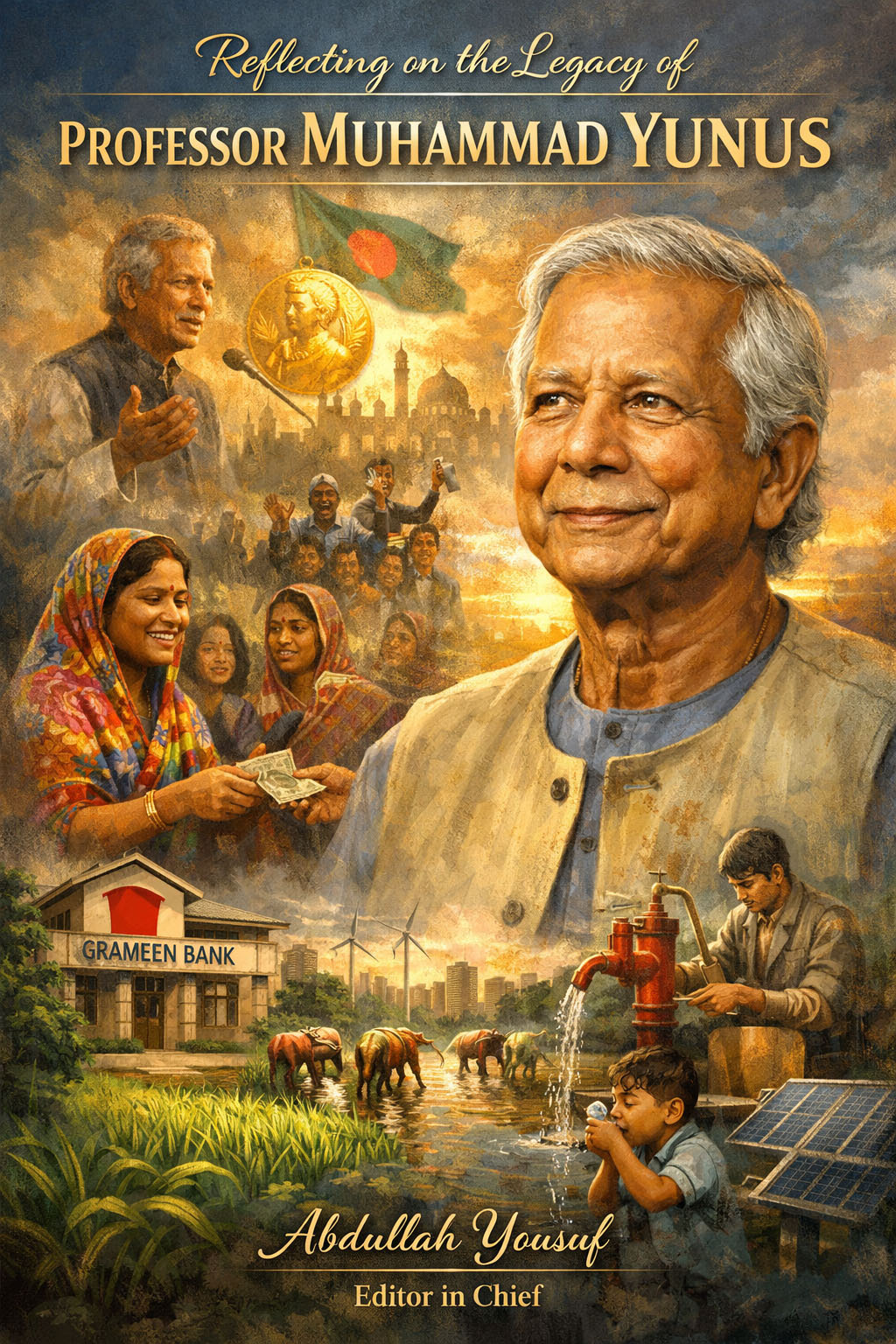
 Abdullah Yousuf (Editor in Chief): The recent departure of Professor Muhammad Yunus from the Bangladeshi political landscape marks the end of a pivotal chapter in South Asian history. Following the successful oversight of the national elections, Yunus’s transition away from the helm of governance leaves the nation and the region contemplating the void left by a leader of global stature.
A Leader beyond Borders:
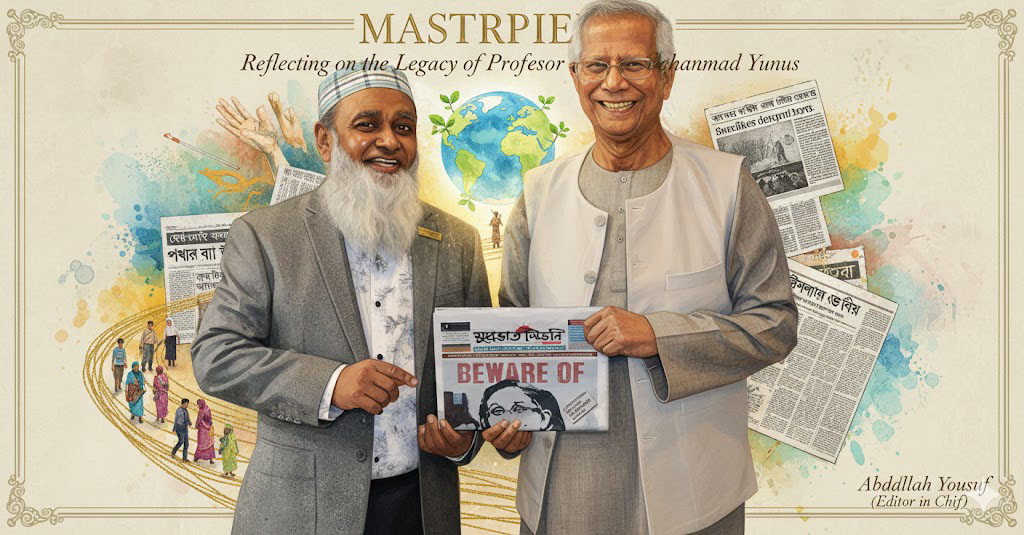
It is rare to find a figure who transitions so seamlessly from the world of academia and grassroots activism to the pinnacle of global statesmanship. Describing Professor Muhammad Yunus as a “Masterpiece” captures the unique, almost singular role he has played in shaping modern Bangladesh.
Professor Yunus was never merely a local figure. As a Nobel Peace Prize laureate and the pioneer of microfinance, his influence stretched from the village of Jabra to the halls of the United Nations. His leadership during the interim period was characterized by a rare “Global-first” approach, leveraging his deep-rooted relationships with world leaders to stabilize Bangladesh’s standing on the international stage.
Unlike traditional career politicians, Yunus brought the “Yunus Way” to governance:
Economic Diplomacy: Using his prestige to secure international trust and financial stability.
Pragmatic Statecraft: He possessed a keen ability to identify the nation’s true allies and detractors, treating them with a calculated balance of diplomacy and firm resolve.
Inspiration for Youth: His presence provided a sense of dignity and hope to a generation seeking a modern, transparent Bangladesh.
The Geopolitical Ripple Effect:
It is no secret that Yunus’s rapid ascent and his seamless rapport with the West created a shift in regional dynamics. In the complex theatre of South Asian politics, a leader who can command the attention of the White House and the European Union simultaneously is a powerful asset and, to some neighboring observers, a source of strategic concern.
While some might interpret regional friction as “jealousy,” it is perhaps more accurately described as a recognition of Yunus’s unique soft power. His ability to bypass traditional bureaucratic hurdles and speak directly to the world’s most influential stakeholders set a benchmark that few in the region could match.
We are optimistic that the BNP will appoint a globally renowned and capable leader like Dr. Yunus to the position of President.
The people of the country are immensely proud that Bangladesh is no longer just an import-dependent nation but is now advancing toward the export of “critical technologies.” By facilitating the exchange of essential goods and boosting exports with various countries worldwide, he has steered the nation’s foreign exchange reserves toward a robust position.
A prime example is the domestic production of Night Vision Devices through technology transfer from Greece’s THEON Group. The Bangladesh Machine Tools Factory (BMTF), managed by the Army, is now manufacturing state-of-the-art monocular and binocular night vision devices within its own facilities. This achievement was recently showcased at the World Defense Show 2026 held in Saudi Arabia. These advanced tools are currently being utilized by the Bangladesh Armed Forces and Special Forces.
The extraordinary feats he has achieved in the short span of just 18 months are beyond words. He has accomplished what remained unachievable over the past 50 years. We have nothing but profound admiration (and perhaps a sense of missed opportunity) for someone of his stature.
 The Road Ahead
The “Yunus Era” of governance may have been brief, but its impact on the Bangladeshi consciousness is permanent. He demonstrated that leadership is not just about holding power, but about the successful execution of a mandate and knowing when to gracefully step aside.
The nation now faces the challenge of maintaining the momentum he built. While he may have left his official post, the blueprint he provided for a modern, globally-connected Bangladesh remains.
“To me, he wasn’t just a Nobel laureate; he was the bridge between our local struggles and the world’s solutions.”
The extent to which Dr. Muhammad Yunus is a blessing for Bangladesh is becoming increasingly evident with time. Although many diplomatic and developmental initiatives are meant to remain behind the scenes, in this modern era of information technology, such successes cannot stay hidden. Perhaps his most “masterpiece” quality was his approach to power. In a region where leaders often cling to their positions, his willingness to complete his mission—overseeing a successful election—and then step away is a profound statement. It reinforces the idea that true leadership is about service, not survival.