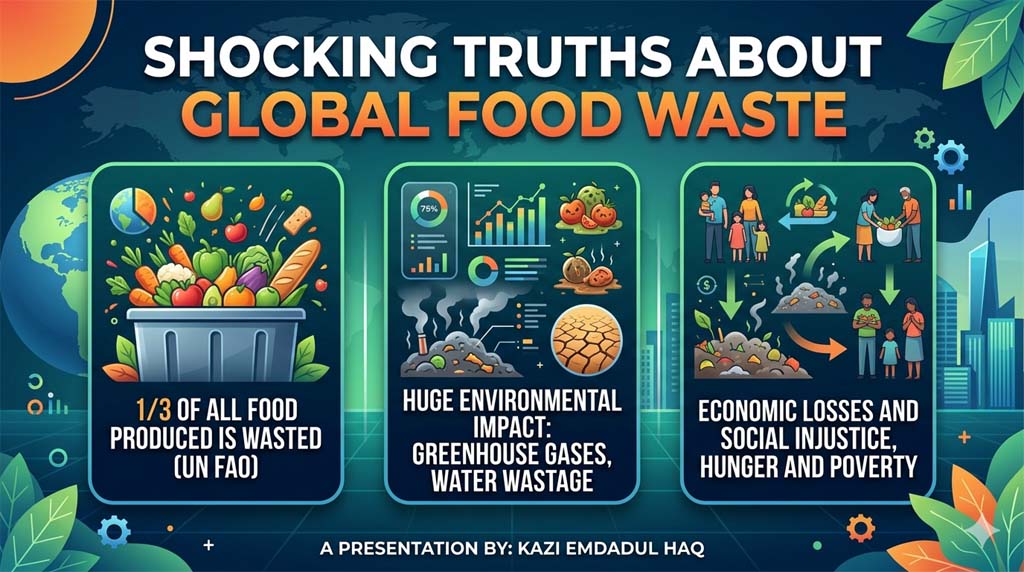
Kazi emdadul Haq: (Last part: Continued from previous part) Food waste, especially at the plate, is common not only in wealthy Middle Eastern nations, but it is also prevalent in Western society. Australia is no less. Other than a few conscious nations like Scandinavian countries, plate food waste is highly common. They ordered food beyond their capacity, which they can eat at restaurants. If it is cultural norms for Saudi Arabia, why should Westerners waste food at restaurants also need to be analysed.
Common academic points are available to discuss this waste among the people of developed countries. Some are discussed below:
- Richness: Possibly, richness compared to less affluent people is the main reason to order what they like. When food is cheaper compared to their earnings, they don’t bother people in some remote corners of countries who go hungry.
- Lifestyle/Freedom: Freedom is embedded in Western society. They like to order as they wish.
- Business Interest: Restaurants, hotels, pubs always try to push for more sell for more profit without the consequences of food waste.
- Social status: Sometimes, people with social status show their wealth or are descended from a wealthy society, they order more food than they can consume and then end up as waste.
- Low Awareness of Impact: Possibly, the wealthy people are not at all aware of food waste and don’t care about the millions of hungry people in the world.
The above points are also self-contradictory. Despite being known for their awareness in areas like health, education, sustainability, and human rights, many Western societies show a striking blind spot when it comes to food waste. This contradiction is difficult to ignore.
On one hand, values like honesty, responsibility, and environmental care are taught in schools and homes. Yet, when it comes to food — a fundamental human need — waste is often normalised. Children are raised to be truthful and law-abiding, but the ethical and environmental impact of throwing away food receives far less attention.
Food waste has serious environmental impacts because when food is produced, transported, and then thrown away, all the resources used to produce that food are also wasted.
When food waste goes to a landfill, it decomposes without oxygen and produces methane gas. Methane is about 25–28 times more powerful than carbon dioxide at trapping heat in the atmosphere. Food waste is responsible for about 8–10% of global greenhouse gas emissions. If food waste were a country, it would be the third-largest emitter of greenhouse gases after China and the United States.
It may be said that food waste seems embedded as a chronic social behaviour, not viewed as an offence, nor met with accountability. Over-ordering at restaurants, excessive portion sizes, and overbuying at supermarkets are accepted habits, rarely questioned — even in a time when millions around the world go hungry.
This disconnect points to a deeper systemic issue: food waste awareness is not treated as a serious priority at the institutional or governmental level. Unlike anti-smoking campaigns or recycling enforcement, food waste reduction lacks consistent policy, penalties, or cultural pressure.
Let’s come to Australia. Australia’s total food waste is high in the world. However, this is not the individual’s fault. Australia produces roughly three times the food they consume. Whereas Australia has only 26 million people. Example: If 7.6 million tonnes of food are wasted nationally, and the population is 26 million, we get roughly 292 kg per person/year — even though most people didn’t waste that much individually. In the case of Australia, food is wasted at the Production and Manufacturing level.
Australia’s food service waste of 70–100 kg per person remains significant, yet is a notable improvement compared to many EU nations. This largely stems from a generous dining culture where ordering more than can be eaten is common—a habit that persists even in its multicultural society. Note that Australia is a multicultural society, with migrants mostly from developing countries, and they can’t afford to waste food.
However, Australia leads globally in recycling and recovering this waste, showing a commendable commitment to turning a cultural challenge into an environmental solution. Countries like South Korea have mandatory separation and collection of food waste, effectively reducing food going to landfill. Like South Korea, NSW, Australia is also introducing a statewide mandate: by 2030, Food Organics and Garden Organics (FOGO) recycling.
Figure: Food Waste Composting by Country
From the chart, it is highly disappointing that the world’s largest economic and most powerful country, like the United States, wastes more food and very little recovery (pie chart). Reliable food waste data for Saudi Arabia is not available. However, by 2040, Saudi Arabia has an ambitious plan to divert 90 per cent of all its waste streams away from landfills. Most top restaurants in NSW are coming up with smart new ways to stop wasting food.
For example, a leading restaurant in Sydney, Elements Bar & Grill, has started a two-stage process of fat collection from leftover meat. First, they collect the fat using different techniques, then, instead of throwing the rest away, they dry the leftover meat, turn it into powder, and use it to make various types of sauces. Bone is also used as a menu item. This way, practically nothing goes to waste.
In conclusion, food waste has become a normal part of life in many wealthy societies, but this should not be accepted. Wasting food is not a sign of status, culture, or prestige. It is highly unethical, especially when millions of people around the world still suffer from hunger. Although religious and moral teachings speak against food waste, these messages often remain in words only and are not followed in daily life.
To reduce food waste, children should be taught from an early age about its harmful effects on people, society, and the environment. Schools should include this topic in education so that good habits can be built from childhood. At the same time, governments should introduce stronger rules to control food waste and make sure they are properly enforced.
Function centres, cafes, restaurants, and other food businesses should be placed under strict food waste regulations. Local authorities should put up visible signs in public places and food venues to show that wasting food is a serious social wrong and should be treated like an offence against society. Government officers should also regularly visit function centres and other large food venues to check how much food is being wasted and whether proper food recovery systems are being followed.
Food composting and food recovery programs also need much stronger support from the government. These efforts should be organised in a proper and institutional way, with support from schools, local councils, and community groups. Safe leftover food should be collected and given to people in need wherever possible, while the rest should be used for compost and other useful purposes. In this way, society can move toward a culture of responsibility, respect, and care, rather than waste.
One extra improvement would be to encourage public awareness campaigns through media, schools, and community programs so that people understand that saving food is both a moral duty and a social responsibility.