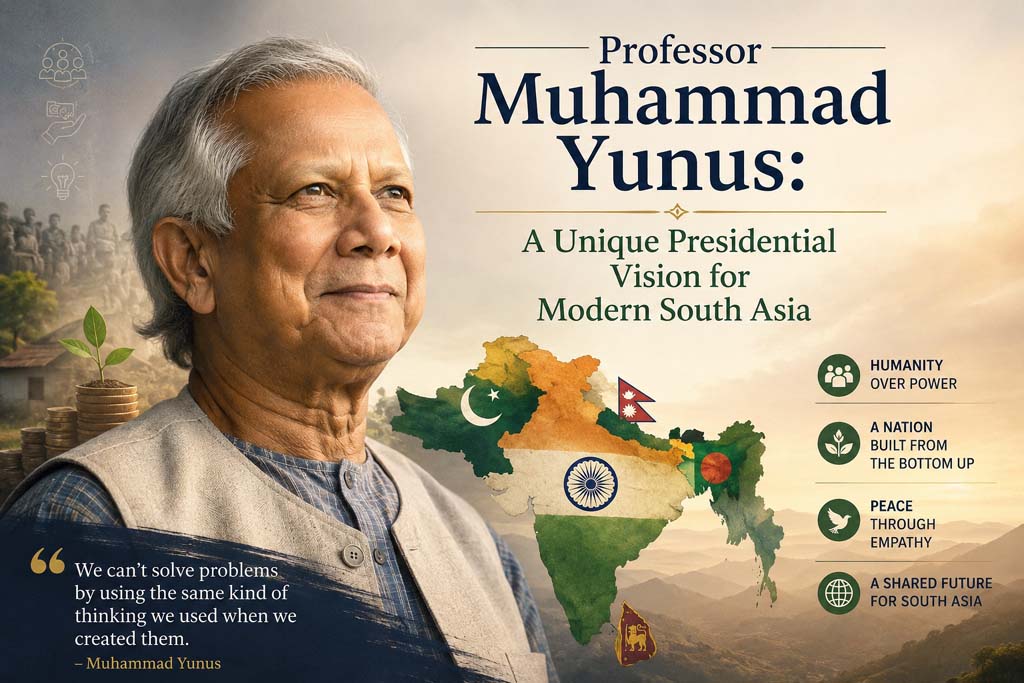
Suprovat Sydeny: South Asia is a region deeply defined by its contradictions. It is a vibrant cradle of ancient civilizations and a global hub of rapid economic growth; yet, it remains heavily burdened by deep-rooted systemic poverty, political polarization, and fragile democratic institutions. For decades, the dominant political archetype in the region has been the dynastic politician, the hyper-nationalist populist, or the bureaucratic technocrat. However, the historic turbulence of recent years has proven that these old models are increasingly ill-equipped to handle the aspirations of a young, digitally connected, and socially conscious generation.
As South Asia searches for a stabilizing framework grounded in transparency, equity, and moral authority, one name stands out far above traditional political circles: Professor Muhammad Yunus.
The Nobel Peace Prize laureate, globally celebrated as the “banker to the poor,” recently transitioned from an economic pioneer into an active statesman. Following the historic July Uprising in 2024, Prof. Muhammad Yunus stepped up to serve as the Chief Adviser of Bangladesh’s interim government. His successful tenure concluded in February 2026, after he masterfully stabilized a volatile nation and oversaw free, fair general elections.
Looking ahead, evaluating Prof. Yunus not just as a temporary leader but as a blueprint for the ideal South Asian head of state reveals why he is the most suitable presidential figure in the modern history of the region.
- A Legacy of Moral Authority over Partisan Politics
The most paralysing disease within South Asian governance is toxic hyper-partisanship. From Dhaka to Islamabad, Colombo to New Delhi, politics is frequently treated as a zero-sum game fueled by generational vendettas and dynastic loyalty. In this chaotic ecosystem, the presidency often designed to be an objective, unifying office frequently becomes a tool for partisan manipulation.
Professor Yunus represents a complete break from this cycle. His primary asset is an unmatched global and domestic moral authority. When he took the oath as Chief Adviser in August 2024, he did not do so at the behest of a political machine, but rather at the urgent request of student leaders and a civil society desperate for an untainted arbiter.
Traditional South Asian Leadership VS. The Yunus gov.Model
———————————— ——————-
- Dynastic or partisan loyalty • Merit-based, civil-society driven
- Zero-sum political warfare • Consensus building & inclusivity
- Top-down, elite-serving economy • Bottom-up, grassroots social business
Prof. Yunus’s entire life has been dedicated to people-centric development rather than seeking personal power. This allows him to look past the bitter rivalries of entrenched political factions. A true South Asian president must serve as the conscience of the nation. Prof. Yunus embodies this rare standard, offering a calm, unifying presence capable of speaking directly to the citizens rather than just appealing to a political base.
- Proven Crisis Management and Constitutional Stewardship
It is easy to theorize about clean governance, but Prof. Yunus has tested his principles in one of the most high-stakes political cauldrons in modern history. The post-uprising landscape of Bangladesh in late 2024 was fraught with institutional collapse, economic uncertainty, and civil unrest.
During his 18-month administration, Prof. Yunus proved that an academic and humanitarian could wield state executive power with remarkable precision. His administration initiated the July Charter, a landmark consensus signed by 30 disparate political parties that laid out structural roadmaps for constitutional, administrative, and electoral reforms. Under his guidance, Bangladesh introduced:
- A proposed bicameral parliament to balance legislative power.
- Sweeping legal and judicial system reforms including digital legal aid.
- Enhanced institutional independence for human rights bodies and law enforcement.
Crucially, Prof. Yunus resisted the temptation to hold onto power indefinitely. By organizing and overseeing the general elections of February 12, 2026, and gracefully handing over authority to the newly elected government on February 17, he set a monumental precedent for South Asia. He demonstrated that true leadership lies in building strong institutions, honoring the democratic process, and knowing exactly when to step aside. This rare blend of constitutional stewardship makes him an ideal model for a presidency centered on upholding the rule of law.
- Redefining Economics from the Bottom Up
For decades, South Asian economic policies have favoured top-down growth, which often enriches corporate elites while leaving vast rural populations behind in informal, precarious economies.
Professor Yunus fundamentally revolutionized this dynamic. By founding the Grameen Bank and pioneering the concepts of microcredit and social business, he proved that the poorest segments of society particularly marginalized women are highly creditworthy and entrepreneurial when given the opportunity. His conviction that “poverty is not created by the poor; it is created by the system” completely flipped traditional economic philosophy on its head.
“Poverty is the absence of all human rights. The frustrations, hostility and anger generated by abject poverty cannot sustain peace in any society.” – Professor Muhammad Yunus
A presidential figure who views macroeconomics through the lens of human dignity is exactly what South Asia needs. The region is currently grappling with severe youth unemployment, climate-driven displacement, and yawning inequality gaps. Prof. Yunus’s philosophy of a “Three Zero” world: Zero Net Carbon Emissions, Zero Wealth Concentration, and Zero Unemployment, offers a visionary yet practical framework. His approach balances the realities of free-market economics with the moral obligation of social responsibility.
- A Visionary for Regional Connectivity and Sovereignty
South Asia remains one of the least economically integrated regions in the world, largely due to historical conflicts and geopolitical posturing. The South Asian Association for Regional Cooperation (SAARC) has been stuck in a state of political paralysis for years.
In his farewell address to the nation in February 2026, Professor Yunus articulated a sophisticated, forward-looking foreign policy vision that resonates across the entire subcontinent. He declared that his administration had successfully restored three fundamental pillars: sovereignty, national interests, and dignity, proving that a smaller South Asian nation does not have to accept a submissive foreign policy.
Simultaneously, Prof. Yunus is a passionate advocate for regional synergy. He has consistently championed the economic potential of the Bay of Bengal and broader regional cooperation encompassing Nepal, Bhutan, Bangladesh, and India. Because he enjoys immense respect on the global stage, holding the Nobel Peace Prize, the Presidential Medal of Freedom, and the Congressional Gold Medal, he possesses the unique diplomatic leverage required to act as a bridge-builder. He is uniquely positioned to foster multilateral dialogues on shared regional crises, from melting Himalayan glaciers to maritime trade efficiency.
+————————————————————————–
| THE YUNUS PRESIDENCY BLUEPRINT |
+————————————+————————————-
| Institutional Reform | De-escalating partisan polarization |
| | through consensus-driven governance. |
+————————————+————————————-
| Grassroots Economic Vision | Prioritizing microfinance, youth |
| |innovation, and social business model
+————————————+————————————-
| Diplomatic Equilibrium | Asserting national dignity while
- Countering the Critiques: The Case for the Statesman-Philosopher
Despite his global renown, Prof. Yunus has faced his share of criticisms, primarily from old-guard politicians who viewed his civil-society platform as a threat to traditional party machinery. Skeptics have historically argued that microfinance carries high interest rates, or that an academic lacks the ruthless instincts necessary to survive the rough-and-tumble nature of South Asian politics.
However, his performance between 2024 and 2026 thoroughly debunked these arguments. He faced political hostility and legally dubious trials under the previous autocratic regime with immense dignity, and later managed a highly volatile state transition without resorting to authoritarian crackdowns.
Prof. Yunus proved that a leader does not need to be ruthless to be effective; they simply need to be principled. His style of governance replaces backroom political deals with institutional transparency. For a region tired of political theater and fractured governance, his calm, philosophical approach to leadership is a necessary antidote.
Conclusion: A Legacy for the Future of South Asia
The history of South Asia is filled with leaders who won power through charisma or inheritance, only to leave behind highly polarized societies and weakened state institutions. Professor Muhammad Yunus represents a completely different path: the leader who derives authority from lifelong service, intellectual innovation, and an unwavering commitment to human dignity.
His recent leadership of Bangladesh’s interim government demonstrated that his vision is not just an academic theory, it is a highly effective crisis-management model. By stabilizing his country, implementing deep structural reforms, and voluntarily returning power to democratic institutions in early 2026, he set a standard of political integrity that is exceedingly rare in South Asian history.
As the nations of the subcontinent navigate the complex challenges of the 21st century, the need for heads of state who transcend partisan divides is more urgent than ever. Whether serving formally as a president or acting as a global elder statesman, Professor Muhammad Yunus stands out as the most suitable, inspiring, and necessary leadership archetype in contemporary South Asian history. He reminds the world that true statesmanship is measured not by how much power a leader accumulates, but by how effectively they empower the most vulnerable.
We believe he possesses exceptional leadership ability and strong administrative capacity. With his vision, skills, and determination, he could manage national governance effectively even at a large and complex scale. His capability suggests he could oversee the development and administration of multiple countries simultaneously, ensuring stability and progress. Any nation led by him would be fortunate to have such committed leadership at its helm. Bangladeshi citizens deserve, more than ever, a capable and responsible leader to take on the highest office of the state and guide the nation forward with vision, integrity, and effective governance.