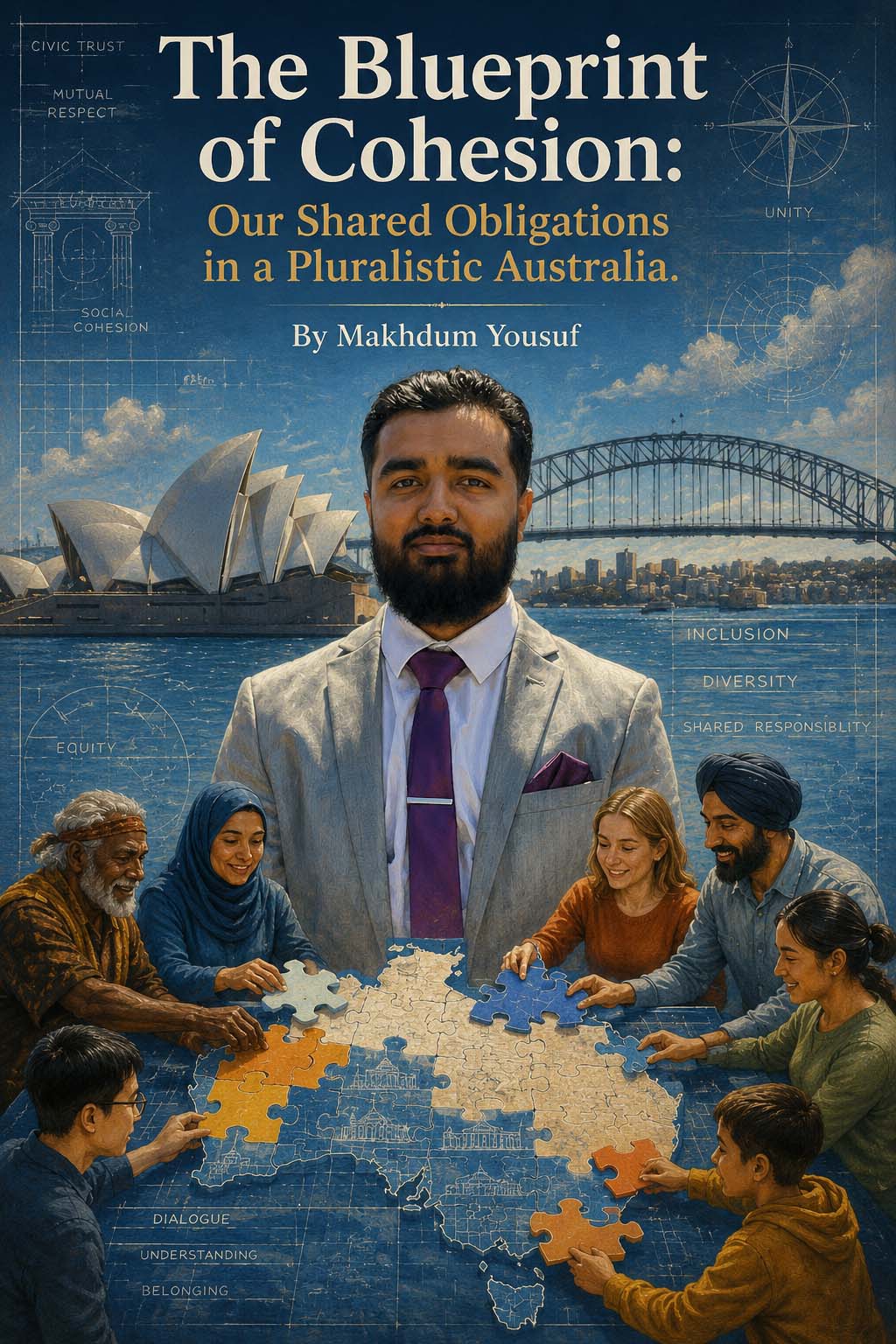
 By Makhdum Yousuf: On the global stage, Australia is frequently celebrated as a premier example of a successful pluralistic society. This reputation is backed by solid data: roughly half of the nation’s populace was either born overseas or has an immediate parent who immigrated. A simple stroll through our major metropolitan centres or expanding regional towns reveals a rich tapestry of international dialects, varied faiths, diverse cuisines, and distinct accents. However, a harmonious, multi-ethnic society is neither an accidental milestone nor an indestructible reality. Instead, it operates as a continuous endeavour a complex social structure that demands constant preservation and care. For far too long, the public discourse has treated cultural diversity as something to be passively observed through an annual schedule of food stalls and folklore exhibitions. True pluralism, conversely, functions as a demanding, reciprocal agreement. Thriving within a diverse Australia requires us to embrace a strict set of personal and collective civic obligations.
Our fundamental duty as participants in this varied society begins with a total transformation in how we conceptualize social integration. Genuine national harmony requires us to look far beyond basic “tolerance.” Tolerance is a remarkably low benchmark; it implies a hesitant endurance of differing groups, allowing people to live alongside one another without ever genuinely interacting. Our actual obligation is to replace passive coexistence with active, mutual engagement. This approach requires recognizing that every resident who calls this continent home possesses an equal right to shape the nation’s identity, while simultaneously bearing an equivalent duty to protect the democratic framework that permits this freedom. It challenges us to view our demographic diversity not as a collection of isolated, parallel subcultures, but as a deeply cooperative network united by a shared civic reality.
Defending the Secular Democratic Contract
At the absolute foundation of this civic duty lies an unwavering allegiance to the Australian Constitution, parliamentary governance, and the rule of law. When people from various corners of the globe decide to settle in Australia, they enter into a profound social compact. This arrangement guarantees extraordinary liberties—including freedom of speech, freedom of worship, and freedom of assembly—but it simultaneously demands an absolute commitment to the secular, democratic institutions that protect those specific liberties.
Consequently, while heritage and religious practices are deeply respected and legally protected, they can never take precedence over the foundational legislation of the Commonwealth. In the Australian context, gender equality is an absolute, non-negotiable legal and ethical standard. The right of every individual to determine their own destiny, entirely free from community coercion, is definitive. As active participants in a multi-ethnic society, we possess an explicit duty to uphold these principles within our respective cultural environments. We must actively ensure that heritage preservation is never weaponised to validate the mistreatment of women, the exclusion of minorities, or the restriction of individual freedoms. The law of the land serves as the great equalizer; it forms the common foundation upon which every single community must stand in unison.
Additionally, this shared democratic framework requires a mutual commitment to English as our primary national language. Communication is the foundational currency of social capital. While preserving ancestral languages is incredibly valuable broadening our collective intellect and strengthening our international economic partnerships English functions as our indispensable bridge. It remains the language of our legal systems, our legislative assemblies, our corporate environments, and our public squares. Providing all citizens, particularly newly arrived migrants, with the necessary resources and motivation to master English is not an attempt to erase their past, but rather an investment in their future. It equips everyone to engage fully with democratic institutions, lobby for their fundamental rights, and participate in the broader cultural dialogue of the nation.
First Nations Primacy: The Foundation of Our Diversity
A major oversight in modern commentary regarding Australian multiculturalism is the ongoing habit of separating Indigenous history from the broader cultural conversation. True pluralism cannot be discussed without directly confronting the historical foundation upon which it rests. Modern Australian diversity unfolds entirely upon the unceded traditional lands of the oldest continuous living culture on the planet. For newly arrived migrants, displaced refugees, and individuals of multi-generational Anglo-Celtic ancestry alike, our collective responsibility is to deeply comprehend and revere this truth.
For many new citizens, the intricate history of British colonization, systemic dispossession, and the ongoing path toward national reconciliation can initially feel unfamiliar. Therefore, the duty falls upon established community networks, educational institutions, and cultural leaders to bridge this educational divide. We are obligated to weave First Nations viewpoints directly into the core of the Australian multicultural narrative. True societal inclusion means understanding that our duty to this continent did not commence when our families landed at an airport or a harbour; it involves stepping directly into an ancient custody and participating in the vital, ongoing process of national healing. We must actively listen to, learn from, and walk alongside Aboriginal and Torres Strait Islander peoples as the rightful, foundational pillar of our national identity.
The Principle of Reciprocal Respect
Within a diverse democracy, personal freedoms are inherently tied to collective duties. The privilege to observe one’s faith or honor one’s heritage carries an identical obligation to protect the right of your neighbour to do the exact same even, and perhaps especially, when their worldview or lifestyle directly contradicts your own values. This dynamic represents the core of reciprocal respect, serving as the primary shield against sectarian hostility.
We can see globally how rapidly diverse societies can splinter when international disputes are dragged into local neighbourhoods. As residents of the Australian community, we have a profound duty to safeguard our suburbs as domains of safety, rather than letting them become proxy battlegrounds for international geopolitical conflicts. This does not mean individuals must sever emotional connections to their countries of origin or disregard global human rights crises. It does mean, however, that the expression of those political grievances must never threaten the safety, honor, and peace of our fellow Australians. When we permit international animosities to fuel local discrimination whether through antisemitism, Islamophobia, or anti-Asian hostility—we fail in our most basic civic duty to the people around us.
Practising active citizenship within a multi-ethnic setting also requires us to directly confront our personal, unexamined biases. It demands a conscious, deliberate effort to venture outside of our cultural comfort zones. It is incredibly easy to withdraw into familiar cultural enclaves—residing in specific areas, purchasing from familiar merchants, and interacting solely with people who share our exact appearance, language, and worldview. While these close-knit communities provide vital emotional security and mutual aid, relying on them exclusively fosters cultural isolation. Our shared duty is to build bridges rather than walls. This involves taking part in local municipal initiatives, joining intercultural dialogues, volunteering for mainstream civic organizations, and establishing environments where different groups can cooperate on shared community challenges.
The Multigenerational Compact of Welcome
Every historical wave of immigration to Australia has encountered its own distinct hardships, institutional barriers, and social skepticism. From the post-WWII European laborers who built our national infrastructure, to the Southeast Asian refugees who revitalized our cultural landscape during the late twentieth century, to the African, Middle Eastern, and South Asian diasporas powering our modern economy each demographic has had to earn its position in society. This shared history establishes a multigenerational obligation.
Those who have successfully crossed the difficult path of resettlement and achieved financial and social stability in Australia are duty-bound to extend that same supportive hand to the newest waves of arrivals. The task of cultivating a welcoming society does not lie solely with government departments or settlement firms. It manifests in the daily behavior of ordinary individuals. It is seen when a local employer offers a newly arrived refugee their very first Australian professional opportunity; when an educator volunteers extra hours to mentor a student mastering English; or when a homeowner takes the time to introduce the subtleties of local neighborhood life to a newly arrived family next door. By proactively easing the integration of others, we solidify the peace and economic health of the entire nation.
Conclusion: A United Tomorrow
In the final analysis, Australian multiculturalism should not be perceived as a rigid, static state of affairs, but rather as an active verb a continuous process of national construction. It is a framework that thrives when its participants recognize that while our distinct backgrounds constitute our cultural wealth, our shared values constitute our foundational strength. The ultimate objective of a diverse nation is not to construct an isolated mosaic of independent tiles that never connect, but to spin an intricate, durable tapestry where individual threads are permanently interwoven.
Our ultimate responsibility as members of this expansive community is to nurture a profound, unifying dedication to Australia’s collective future. We honor the rich traditions that have migrated from every corner of the globe to take root in this soil. Yet, our fundamental civic allegiance must always belong right here, to this land and to the diverse populace that inhabits it. By harmonizing our cultural identity with our democratic responsibilities, by matching our freedom of speech with a commitment to mutual respect, and by anchoring our diversity within an authentic respect for First Nations history, we fulfil our true civic purpose. We ensure that Australia remains not merely an assortment of disparate subcultures, but a unified, equitable, and harmonious nation where every individual genuinely belongs.
- Institutional Loyalty: An absolute dedication to the secular democratic system, the rule of law, and gender equality must always take precedence over conflicting cultural customs.
- Beyond Tolerance: Citizens must proactively build cross-cultural relationships and actively dismantle social and physical cultural enclaves.
- Indigenous Alignment: Comprehending First Nations history and genuinely contributing to national reconciliation is a core duty of all modern diverse communities.
- Active Welcome: Established immigrants and multi-generational citizens alike have an obligation to proactively aid in the social and economic integration of newly arrived residents.