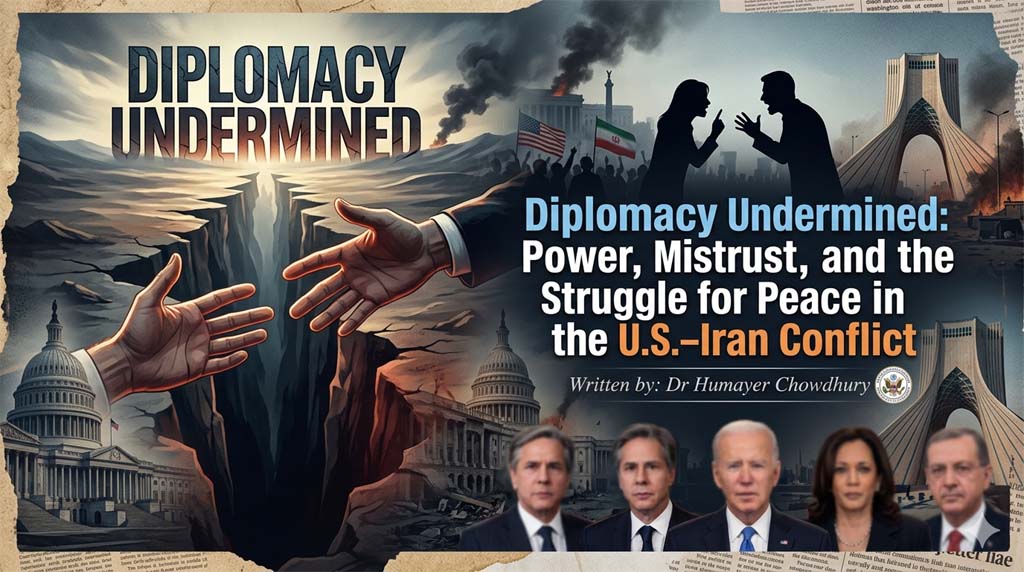
Written by: Dr Humayer Chowdhury Sydney Australia: The conflict initiated by the United States and its close ally Israel against Iran has been widely viewed by many global observers as unnecessary and difficult to justify. At a time when a diplomatic process was already underway—facilitated by the Oman—the sudden escalation into military action raised serious concerns about the commitment to peaceful conflict resolution.
Launching strikes during an active negotiation phase undermines trust, weakens diplomatic credibility, and increases the risk of prolonged instability. Moreover, the absence of clear authorisation or consensus from the United Nations further intensified criticism, as global governance mechanisms are designed precisely to prevent such escalations and encourage dialogue over confrontation.
In contrast, renewed diplomatic efforts—reportedly supported by Pakistan—reflect the continued importance of negotiation as the most viable path forward. Constructive engagement, mutual respect, and adherence to international norms are essential to de-escalate tensions and prevent further humanitarian and geopolitical consequences.
Ultimately, sustainable peace cannot be achieved through unilateral force. It requires consistent dialogue, balanced compromises, and a genuine willingness from all parties to prioritise global stability over strategic dominance.
Strategic preparation:
Before the negotiations began in Pakistan, Iran proved that it came to the table from a position of strength—not desperation, the Iranians showed remarkable strategic thinking.
First, Iran did not want the ceasefire. Although some media outlets and journalists initially claimed otherwise, later even The New York Times reported that the Iranians were not interested in a ceasefire. It was Donald Trump who requested Pakistan to persuade Iran to agree.
Second, despite nuclear threats, Iran did not agree to a ceasefire immediately. They set conditions: only if Trump publicly committed to negotiating based on Iran’s 10-point demands would they agree to talks. Eventually, Trump agreed upon.
And third, initially, Israel ignored the ceasefire agreement and continued heavy attacks Lebanon on the first day. However, because Iran had ensured Lebanon was explicitly included in the wording, they were later able to take a stronger position. Iran remained firm throughout. Eventually, the U.S. had to accept these demands. Under pressure, Israel was compelled to stop attacks in Lebanon and engage with the Lebanese government.
Deadlock in negotiations:
However, the negotiations between the USA and Iran failed mainly due to major disagreements and lack of trust. Both countries have demonstrated stubborn attitudes that contributed to the failure of negotiations. The U.S. has often pursued a “maximum pressure” strategy, combining diplomacy with threats of force, which reduces space for compromise. The United States demanded that Iran stop its nuclear program and limit uranium enrichment, but Iran refused, saying it has the right to develop nuclear energy. Both sides also accused each other of making unreasonable demands. Iran has refused to fully accept limits on its nuclear program and has linked negotiations to broader demands such as sanctions relief, regional influence, and economic compensation. This mutual rigidity has created a cycle of mistrust, where neither side is willing to take the first step toward compromise.
Overview:
The conflict between the United States and Iran has deteriorated over time due to deep-rooted political, military, and ideological differences. One of the central issues has been Iran’s nuclear program. While Iran insists that its nuclear activities are for peaceful purposes, the U.S. believes that Iran seeks to develop nuclear weapons capability, which it considers a serious global threat.
From the U.S. perspective, its actions—including sanctions, military pressure, and strict negotiation demands—are justified as necessary to prevent nuclear proliferation and maintain global security. American leaders have insisted that Iran must significantly limit or completely halt uranium enrichment and reduce its regional military influence. However, this approach has often appeared aggressive and inflexible, especially when combined with military strikes and economic blockades, which have escalated tensions instead of resolving them.
The re-election of such a polarising insane figure to lead the United States highlights a profound moment in global politics. Despite earlier rhetoric opposing war, his actions suggest deeper involvement in international conflicts—sometimes in ways that appear to bypass global opinion and institutions like the United Nations. In close coordination with Israel’s leadership under a alleged war criminal, the situation reflects a complex and troubling dynamic that continues to shape geopolitical tensions. This is simply America facing the results of its own decisions. As Abraham Lincoln is often quoted, you can’t deceive everyone forever. People may have been swayed for a time, but that doesn’t last indefinitely. The alliance between the United States and Israel raises a deeper question of influence—whether power flows primarily from Washington to Tel Aviv, or in the opposite direction.
From Iran’s perspective, the U.S. has acted unfairly and inconsistently. The U.S. withdrawal from the Joint Comprehensive Plan of Action in 2018 damaged trust and made Iran skeptical about future agreements. Iran views its nuclear program as a sovereign right and sees U.S. demands—such as zero enrichment and broader restrictions—as unrealistic and politically motivated. Moreover, Iran has criticised the U.S. for changing demands during negotiations and using military force instead of diplomacy.
Reconciliation:
To settle the conflict for the betterment of the world, both sides need a more balanced and cooperative approach. First, they should return to a structured agreement similar to the Joint Comprehensive Plan of Action, with updated terms. Iran could agree to strict international inspections and limited enrichment levels, while the U.S. could provide phased sanctions relief and security assurances. Second, both sides must avoid extreme positions—such as total dismantling of nuclear programs or complete refusal to negotiate—and instead adopt gradual, step-by-step compromises.
Additionally, reducing military actions and focusing on diplomacy is essential. Military strikes may delay nuclear development but cannot eliminate the underlying issue and often create long-term instability. Confidence-building measures, such as transparency, communication, and respect for international law, are also crucial.
Conclusions:
The deterioration of the U.S.–Iran conflict is the result of mistrust, rigid demands, and escalating actions from both sides. A peaceful resolution is only possible if both countries move away from confrontation and toward realistic compromise, prioritising global stability and human well-being over political dominance. All parties should set aside rigidity and approach the situation with calm and reason. A mutual compromise is essential to address the ongoing global crises and to manage the growing risks of economic instability, particularly in the oil markets.