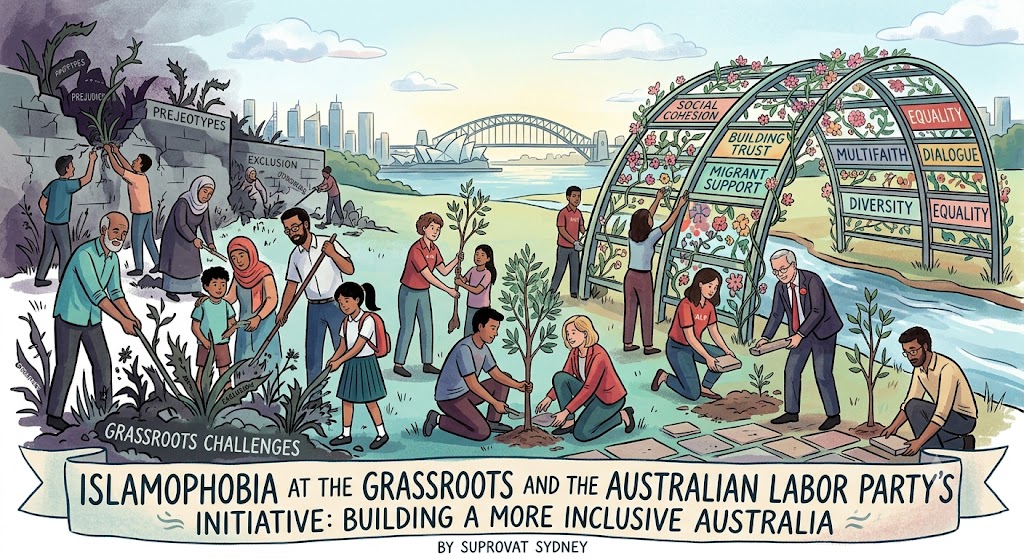
 By Suprovat Sydney: Australia has long been recognised as one of the world’s most successful multicultural nations. People from diverse cultural, religious and linguistic backgrounds have contributed to the country’s prosperity, innovation and social harmony. However, despite this proud tradition, Islamophobia remains a significant challenge affecting many Australian Muslims. From discrimination in workplaces and schools to hate speech online and occasional acts of violence, Islamophobia continues to undermine social cohesion and the values of equality and respect that Australians cherish.
In recent years, concerns about anti-Muslim prejudice have been raised not only by Muslim community organisations but also by academics, human rights advocates, religious leaders and policymakers. These concerns have intensified following periods of international conflict, when tensions overseas have sometimes led to increased hostility towards local Muslim communities. As a result, there has been growing recognition that meaningful action must begin at the grassroots level, where communities interact daily and where trust and understanding are built.
Grassroots organisations have become the driving force behind efforts to combat Islamophobia. Local community groups, multicultural associations, youth organisations, schools, interfaith networks and neighbourhood volunteers have organised educational workshops, cultural exchange programs and public discussions to promote mutual understanding. These initiatives help dispel misconceptions about Islam and create opportunities for Australians from different backgrounds to meet, learn from one another and work together.
One of the most effective approaches has been interfaith dialogue. Churches, mosques, temples and synagogues across Australia have increasingly collaborated on community events, charity projects and educational forums. These partnerships demonstrate that people of different faiths share common values such as compassion, respect, justice and service to others. Such initiatives have helped reduce prejudice by encouraging personal relationships rather than stereotypes.
Education also plays a vital role in addressing Islamophobia. Many schools now incorporate multicultural education into their curriculum, encouraging students to appreciate Australia’s diversity and understand different cultures and religions. Community organisations frequently visit schools to discuss Islamic traditions, cultural practices and the importance of mutual respect. These educational programs help young Australians develop empathy and critical thinking, reducing the likelihood of prejudice taking root.
Social media has become both a challenge and an opportunity. While misinformation and hate speech can spread rapidly online, digital platforms also allow community organisations to share positive stories, celebrate diversity and challenge false narratives. Young Australian Muslims, in particular, have increasingly used social media to share their experiences, explain their faith and highlight their contributions to Australian society in business, healthcare, education, science, sport and public service.
Recognising these challenges, the Australian Labor Party has announced and supported a range of initiatives aimed at strengthening social cohesion and addressing religious discrimination. These efforts reflect the broader principle that every Australian should be able to live free from hatred, discrimination and intimidation, regardless of their faith or cultural background.
Among the significant developments has been the appointment of a Special Envoy to Combat Islamophobia. The role is intended to provide advice to government, engage directly with affected communities and develop practical recommendations to address anti-Muslim discrimination. The establishment of such a position acknowledges that Islamophobia requires focused attention while working alongside broader initiatives to combat all forms of racism and religious intolerance.
The Labor Government has also reaffirmed its commitment to Australia’s multicultural framework by investing in community cohesion programs, supporting multicultural organisations and strengthening partnerships between government agencies and community leaders. These initiatives encourage local organisations to develop projects that foster dialogue, improve understanding and respond to incidents of discrimination through education and community engagement.
Funding for community resilience programs has enabled grassroots organisations to organise forums, leadership training, youth engagement projects and mental health support services. Many Muslim organisations have worked collaboratively with local councils, schools and police to build stronger relationships and improve communication. These partnerships have been particularly valuable in addressing community concerns while promoting confidence in public institutions.
Australian law already provides important protections against discrimination on the basis of race in many areas of public life. Governments at both federal and state levels continue to review policies aimed at strengthening protections against discrimination and hate crimes. Community leaders have consistently emphasised that legislation alone cannot eliminate prejudice; education, dialogue and sustained community engagement remain equally important.
Political leadership also plays a significant role. Public statements by elected representatives condemning racism and religious hatred send a strong message that discrimination has no place in Australian society. Bipartisan support for multiculturalism has historically been one of Australia’s strengths, and maintaining that commitment is essential for preserving national unity.
Australian Muslims continue to make significant contributions across every sector of society. They serve as doctors, nurses, teachers, academics, engineers, entrepreneurs, police officers, emergency service volunteers, members of the Australian Defence Force and elected representatives. Their achievements demonstrate that diversity strengthens Australia economically, socially and culturally.
Nevertheless, challenges remain. Surveys conducted by community organisations indicate that some Muslims continue to experience verbal abuse, workplace discrimination and online harassment. Muslim women who wear visible religious clothing often report being disproportionately targeted. Young Muslims may also face identity challenges as they balance cultural heritage with Australian identity. Addressing these issues requires cooperation between governments, educational institutions, employers, media organisations and local communities.
The media also has an important responsibility. Accurate, balanced and responsible reporting helps reduce stereotypes and promotes informed public discussion. Highlighting positive stories about Muslim Australians and reporting on successful community initiatives can contribute to greater understanding while avoiding the amplification of harmful misinformation.
Ultimately, combating Islamophobia is not solely the responsibility of governments or Muslim communities. It requires the collective effort of every Australian. Neighbours, schools, businesses, sporting clubs, faith communities and local organisations all have a role to play in fostering respect and inclusion. Simple acts of kindness, open conversation and willingness to learn about different cultures can make a meaningful difference.
Australia’s multicultural success has always depended on its ability to embrace diversity while maintaining shared democratic values. Grassroots initiatives, supported by effective public policy and responsible leadership, offer a practical pathway towards reducing prejudice and strengthening social cohesion. The Australian Labor Party’s initiatives represent one part of this broader national effort, but lasting progress will depend on continued collaboration across all levels of society and across political perspectives.
As Australia continues to grow as one of the world’s most culturally diverse nations, promoting understanding, protecting religious freedom and standing firmly against all forms of racism—including Islamophobia, antisemitism and discrimination against any community—will remain essential to ensuring that every Australian can participate fully, safely and equally in the nation’s future.