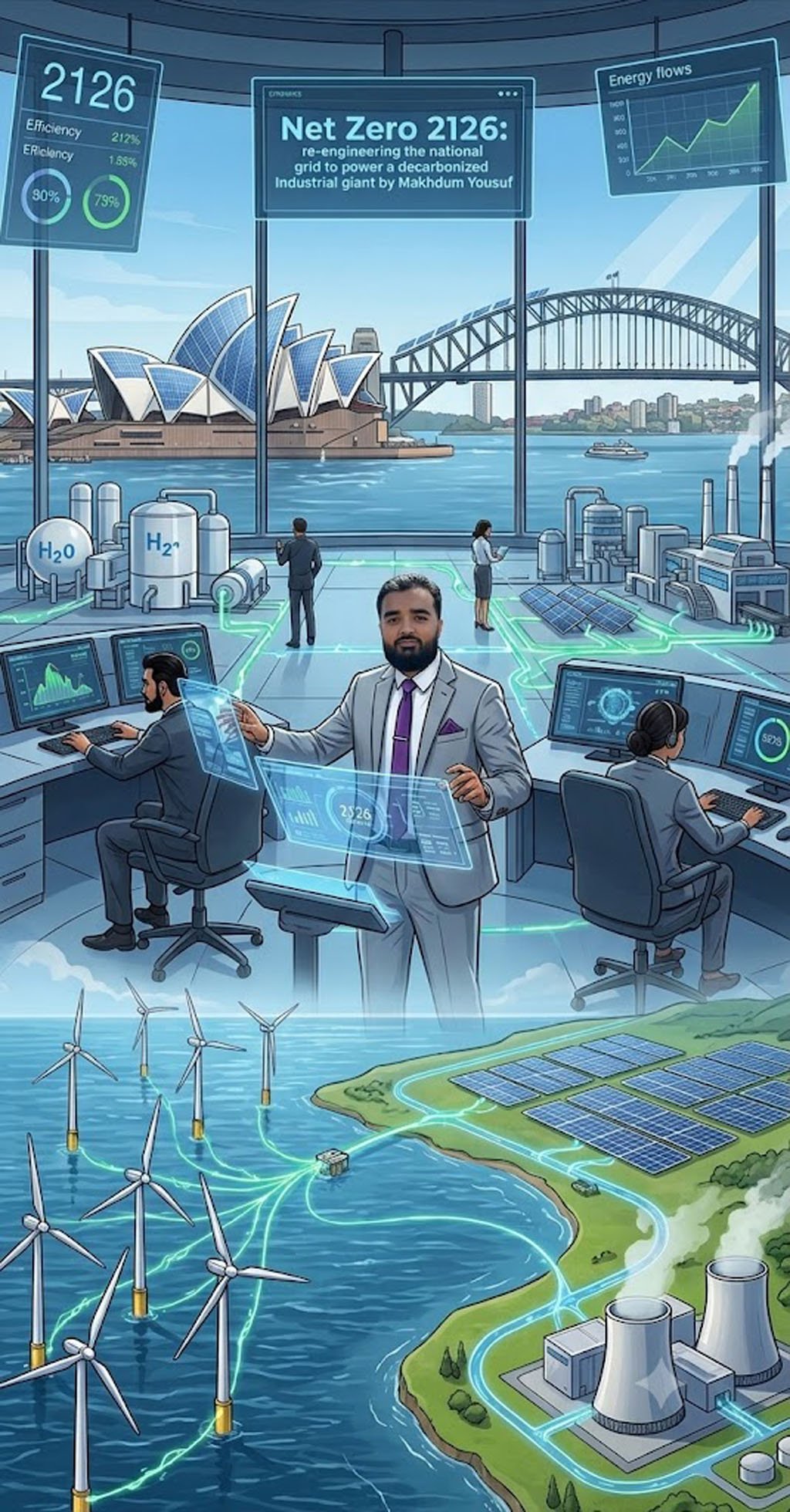
by Makhdum Yousuf: As the dawn breaks over the 22nd century, the scale of global human infrastructure is unrecognizable from the fossil-fueled architectures of the industrial past. By the year 2126, the concept of net-zero is no longer a corporate aspiration or a legislative target; it is the fundamental operating baseline for civilization. At the heart of this epoch-defining transition stands the re-engineered national grid a marvel of quantum computing, high-temperature superconductivity, and decentralized multi-vector energy management.
Powering a fully decarbonized industrial giant requires an unprecedented reimagining of how energy is generated, transmitted, and consumed at a continental scale.
The Industrial Imperative of the 22nd Century
For generations, heavy industries such as green steel smelting, synthetic chemical synthesis, heavy transport manufacturing, and advanced materials processing were deemed “hard-to-abate.” In the early decades of the 21st century, these sectors relied heavily on localized fossil combustion or chemical reduction agents that locked carbon into their core processes.
By 2126, however, the paradigm has completely inverted. Driven by stringent planetary boundaries and circular-economy mandates, industrial heavyweights operate as active nodes within a closed-loop energy ecosystem. They do not merely consume electricity; they act as dynamic load-balancers, thermal storage reservoirs, and flexible demand anchors.
To sustain this heavy industrial output without a single molecule of fossil carbon, the national power grid underwent a century-long metamorphosis. The legacy systems of copper wires and alternating-current bottlenecks have been replaced by a hybrid architecture of ultra-high-voltage direct current (HVDC) corridors and local superconducting loops.
Anatomy of the Re-Engineered Grid
Re-engineering a continental grid to support a decarbonized industrial economy required solving three major engineering hurdles: intermittency, transmission loss, and capacity scaling.
- Superconducting Transmission Corridors
Power loss over long distances historically limited where heavy industry could be located relative to clean energy sources like offshore wind mega clusters and desert solar arrays. By 2126, widespread deployment of room-temperature and liquid-nitrogen-cooled high-temperature superconductors (HTS) has reduced resistance-based line losses to near zero. Energy can now be moved across thousands of miles with 100% efficiency, bridging remote generation hubs with dense industrial corridors seamlessly.
- Autonomous Quantum-AI Load Dispatching
The grid of 2126 is entirely autonomous. Decentralized artificial intelligence models, running on quantum-secured distributed ledgers, manage millions of micro-fluctuations every millisecond. When a massive green-hydrogen electrolysis plant or an electric arc furnace ramps up production, the grid anticipates the surge seconds in advance, instantly shifting power vectors from orbital solar orbital arrays, deep geothermal wells, and next-generation fusion baseloads.
- Multi-Vector Energy Integration
Electricity is no longer the sole currency of the grid. The 2126 network integrates power, hydrogen, synthetic e-fuels, and high-grade industrial heat into a unified distribution matrix. Excess renewable generation during peak production hours is instantly converted into green hydrogen or stored in sub-surface thermal energy repositories, ensuring that industrial operations face zero downtime even during prolonged weather anomalies.
Overcoming the Legacy Bottlenecks
The transition to this futuristic grid was not without friction. In the mid-21st century, grid operators faced massive public resistance over land use, critical mineral supply constraints for battery and superconductor manufacturing, and the monumental task of retrofitting live legacy infrastructure.
The breakthrough came through modular engineering and standardized regulatory frameworks that treated the grid as a public commons rather than a fragmented commercial market. Governments and industrial consortia pooled resources to deploy prefabricated, automated substation modules that could replace aging 20th-century transformers overnight. Furthermore, the mandatory adoption of circular-lifecycle materials ensured that the vast amount of hardware deployed during the mid-century transition could be recycled endlessly without degrading grid performance.
The Resilient Industrial Future
Today, in 2126, the symbiosis between the national grid and heavy industry serves as the backbone of economic prosperity. Decarbonisation has proven to be an engine of efficiency rather than a constraint on growth. Advanced manufacturing facilities operate with unprecedented precision, powered by a clean, resilient, and self-healing energy nervous system.
The journey to net Zero 2126 demonstrates that humanity’s greatest technological achievements are born at the intersection of ecological necessity and bold engineering. The national grid is no longer just a utility delivering power; it is the living circulatory system of a sustainable, thriving industrial civilization.