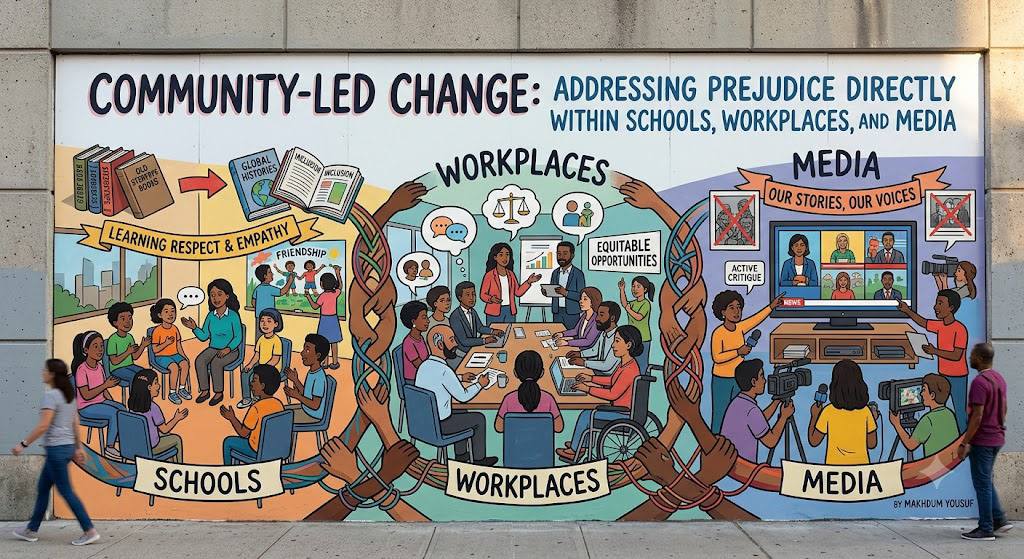
 By Makhdum Yousuf: Prejudice is rarely an abstract, distant threat. More often, it is a quiet, systemic undercurrent shaping the spaces where we spend our lives: the classrooms where we learn, the workplaces where we earn our livelihoods, and the media we consume daily. When left unchecked, bias hardens into institutional barriers.
Historically, efforts to combat prejudice have relied on top-down mandates—legal frameworks, corporate policies, or sweeping PR campaigns. While valuable, these external pressures often fail to shift the underlying culture. True, lasting transformation requires a bottom-up approach: community-led change.
When the individuals who inhabit these spaces collectively decide to confront bias, they possess an intimate understanding of its nuances that an outside consultant or rigid policy manual never could. By organizing at the grassroots level, communities can dismantle prejudice directly within schools, workplaces, and the media.
- Transforming Schools: From Compliance to Empathy
Schools are the foundational architecture of socialization. It is within the classroom and the schoolyard that children first learn how to navigate difference. Unfortunately, it is also where biases—absorbed from the wider world—take root. Addressing prejudice in education cannot merely be about disciplinary policies for overt bullying; it must involve reshaping the entire school culture.
Empowering the Student Voice
Top-down diversity initiatives often feel performative to students. Community-led change in schools shifts the agency to the students themselves. When youth are empowered to lead peer-advocacy groups, radical empathy follows.
- Restorative Justice Circles: Instead of relying solely on suspension or detention, student-led circles allow peers to confront biased behavior directly, explaining the real-world harm caused by slurs or exclusionary practices.
- Student-Led Alliances: Groups like Gender-Sexualities Alliances (GSAs) or multicultural student coalitions give marginalized youth a platform to educate their peers and hold school administrations accountable.
Decolonizing the Curriculum
A community-led approach also targets the structural bias embedded in what we learn. Parents, teachers, and students working together can advocate for an inclusive curriculum that reflects a global community.
| Traditional Approach | Community-Led Approach |
| Passive Toleration: Celebrating “Diversity Day” once a year with ethnic food and music. | Active Integration: Embedding diverse histories, literature, and scientific contributions into the core curriculum year-round. |
| Punitive Discipline: Suspending students for biased language without addressing the root ignorance. | Restorative Practice: Educating the student on the history of the bias, fostering accountability and growth. |
When the community drives educational reform, schools transform from institutions of conformity into incubators of critical thinking and mutual respect.
- Reimagining the Workplace: Moving Beyond the “Tick-Box” Culture
For adults, the workplace is the primary arena where prejudice manifests. Despite decades of mandatory Diversity, Equity, and Inclusion (DEI) training, workplace discrimination persists. The failure of traditional corporate DEI lies in its clinical, risk-mitigation approach. Employees often view corporate modules as a compliance exercise rather than an invitation to grow.
Community-led change in the workplace flips this dynamic by empowering the workforce to lead the conversation.
The Power of Employee Resource Groups (ERGs)
Employee Resource Groups (ERGs) are voluntary, employee-led groups that foster a diverse, inclusive workplace aligned with the organizational mission. When properly funded and given an executive sponsor, ERGs become powerful engines of cultural change. They provide a safe space for marginalized employees to share experiences, but more importantly, they serve as internal advisory boards that can press leadership for structural changes, such as:
- Auditing hiring practices for algorithmic or human bias.
- Rectifying wage gaps across gender and racial lines.
- Redesigning mentorship programs to ensure equitable career advancement.
Key Insight: True inclusion is not about inviting marginalized groups to sit at a broken table; it is about giving them the structural power to help redesign the table entirely.
Normalizing Bystander Intervention
Prejudice in the office frequently manifests as microaggressions—subtle, often unintentional comments that demean a person’s identity. Traditional HR structures are ill-equipped to handle these daily friction points. Community-led cultures train employees in bystander intervention. When coworkers learn to politely but firmly interrupt biased behavior in real-time (e.g., “What did you mean by that comment?”), the burden of education shifts away from the victim, creating a self-regulating environment of accountability.
- Disruption in the Media: Rewriting the Narrative
If schools build the foundation and workplaces dictate the present, the media shapes our collective imagination. Television, news, digital algorithms, and advertising possess an unparalleled ability to reinforce harmful stereotypes or humanize complex realities. For generations, media representation was gatekept by a homogenous elite. Today, grassroots communities are leveraging digital tools to disrupt this monopoly and directly challenge media prejudice.
The Rise of Grassroots Media and Independent Journalism
The democratization of media production means that communities no longer have to wait for mainstream Hollywood or corporate news networks to grant them a voice. Podcasters, independent journalists, and digital creators are building their own platforms to tell authentic stories.
- Nuanced Representation: Rather than reducing marginalized individuals to flat stereotypes (the sidekick, the villain, or the tragic victim), community-led media portrays them with full human complexity.
- Investigative Accountability: Grassroots media organizations frequently expose systemic biases within institutional reporting, forcing mainstream outlets to correct their framing of sensitive social issues.
Holding the Gatekeepers Accountable
Community-led change also operates as a watchdog for corporate media. Through coordinated digital campaigns, collective consumer action, and media literacy advocacy, everyday citizens can demand accountability. When a media outlet relies on biased tropes or sensationalized reporting, community-driven boycotts and public education campaigns hit these corporations where it matters most: their reputation and their revenue. By actively reshaping the media landscape, communities rewrite the narratives that inform how we perceive one another.
- The Blueprint for Effective Community-Led Action
While the strategies differ across schools, workplaces, and media, the core methodology of successful community-led change remains constant. It relies on a three-pronged framework:
[Listen & Amplify] ──> [Educate & Organize] ──> [Institutionalize]
- Listen and Amplify: Center the voices of those most impacted by the prejudice. True community leadership is not about speaking for others, but passing the microphone to those who have been silenced.
- Educate and Organize: Build coalitions. Prejudice thrives on isolation. By bringing dominant and marginalized groups together in shared pursuit of equity, you build a critical mass that cannot be easily ignored.
- Institutionalize the Change: Grassroots energy must eventually be codified into lasting structure. The goal of community action is to turn temporary protests or dialogues into permanent policies, curricula, and bylaws.
Conclusion: The Path Forward
Prejudice is not a force of nature; it is a human invention. Because it was constructed by human choices, it can be dismantled by them.
Top-down regulations will always have a place in securing basic civil rights and legal protections. However, laws cannot mandate empathy, and corporate policies cannot force genuine belonging. That deeper, cultural transformation belongs exclusively to the community.
Whether it is students redefining the culture of their hallways, employees actively restructuring their workplaces, or creators reclaiming their narratives in the digital sphere, community-led change proves that ordinary people possess extraordinary power. By confronting prejudice directly within the institutions of our daily lives, we move closer to a society where diversity is not just tolerated, but structurally woven into the very fabric of our shared humanity.