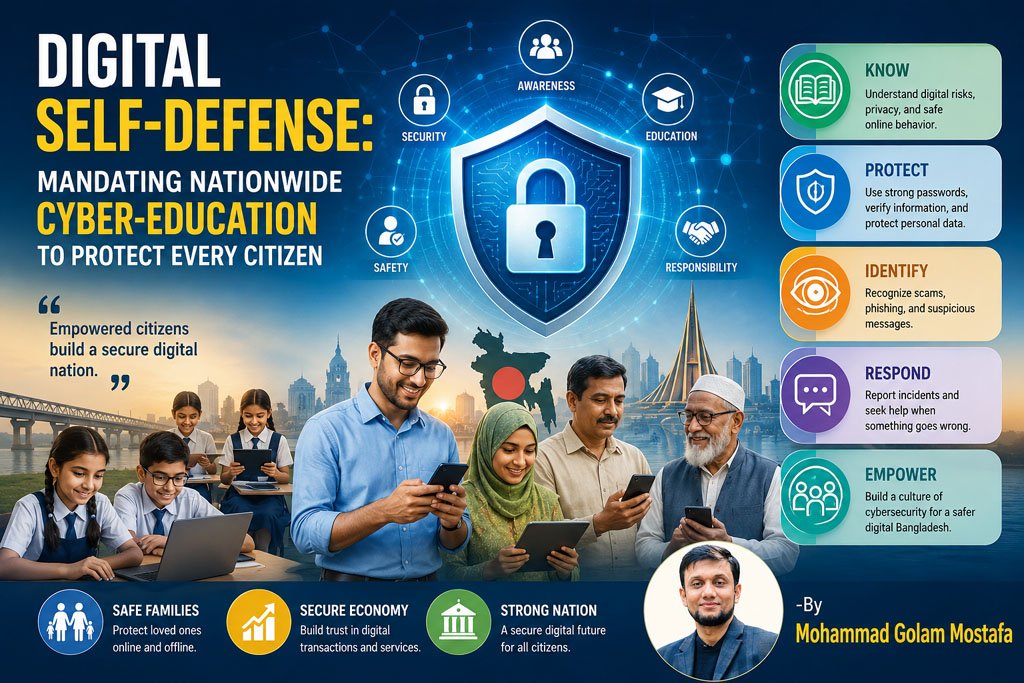
 -By Mohammad Golam Mostafa: We lock our doors before going to bed. We teach children not to speak to strangers. We look both ways before crossing a busy road. These habits are so ordinary that we rarely think of them as forms of self-defense. Yet every day, millions of people enter another potentially dangerous space the digital world without knowing even the most basic rules of protection.
Our phones now hold our photographs, private conversations, financial information, passwords, contacts and, increasingly, our identities. We use the internet for banking, shopping, education, healthcare, government services, employment and social communication. But while digital dependence has grown rapidly, public knowledge of cybersecurity has not kept pace.
This gap has become a national vulnerability.
Cybersecurity is often discussed as if it belongs only to governments, banks, technology companies and IT professionals. That understanding is outdated. Today, cybersecurity begins with the ordinary citizen. A single careless click, reused password or fraudulent phone call can result in financial loss, identity theft, blackmail, harassment or the compromise of an entire organisation. For this reason, cyber-education should no longer be optional. It should become a nationwide programme of digital self-defense available to every citizen.
The Human Being Is Often the Target
Modern cybercriminals do not always need sophisticated hacking tools. Sometimes, they simply need to persuade someone to trust them.
A message arrives claiming that a bank account has been suspended. A caller pretends to represent a government agency. A fake online shop offers an unbelievable discount. Someone receives a link supposedly sent by a friend. A job advertisement asks an applicant to pay a registration fee. An elderly person is told that a family member urgently needs money. The technology may vary, but the strategy is remarkably similar: create fear, excitement, trust or urgency, and convince the victim to act before thinking.
This is why technology alone cannot protect society. Banks can strengthen their systems. Governments can improve cyber infrastructure. Companies can install advanced security software. But criminals will continue targeting the human being whenever people remain easier to manipulate than machines. Cyber-education therefore needs to be treated as a form of public safety. Start Cyber-Education in Schools
Digital self-defense should begin at school.
Children are introduced to smartphones, tablets, social media and online games at increasingly young ages. Yet many receive little structured education about privacy, scams, cyberbullying, password security, misinformation or the permanent consequences of sharing personal material online.
Schools should teach practical cybersecurity from an early age. Students do not need to become computer programmers. They need habits that protect them throughout life.
They should learn how to create strong and unique passwords, use multi-factor authentication, recognise suspicious links, protect personal information, adjust privacy settings and verify unusual requests. They should understand that photographs, videos and messages shared online can be copied and distributed beyond their control. They must also learn that cybersecurity is not only about protecting devices. It is about protecting dignity, reputation, relationships and mental wellbeing.
These lessons should develop as students grow older. Teenagers, for example, need education about impersonation, account theft, online financial scams, intimate-image abuse, artificial intelligence-generated deception and manipulation on social platforms. Digital citizenship without digital safety education is incomplete education.
Adults Need Training Too
A nationwide programme cannot stop at schools because the people most exposed to some forms of cybercrime may already be outside the classroom.
Workers need training because compromised accounts can expose employers and customers. Small business owners need practical guidance on protecting payment systems, customer records and business communications. Parents need to understand the online environments their children use. Older citizens need support in identifying impersonation, investment and payment scams.
Governments, universities, banks, telecommunications providers, community organisations and employers should cooperate to deliver short, understandable cybersecurity courses. Such education should not be filled with technical jargon. Telling people about encryption protocols and network architecture will achieve little if they cannot recognise a fraudulent message.
A useful national curriculum could revolve around a few simple questions: Who is contacting me? Why do they need this information? Is this request unusually urgent? Can I verify it independently? What could happen if I click this link or send this money? The purpose should be to create a national instinct of verification. Cybersecurity Must Reach Everyone
One danger of digital transformation is that it can widen inequality.
People with strong digital literacy are better positioned to recognise scams and protect themselves. Those with limited education, language barriers, disabilities or little experience with technology may be more vulnerable.
Cyber-education must therefore be inclusive.
Training should be available in major community languages and presented through television, radio, schools, workplaces, libraries, community centres and mobile platforms. Materials should be designed for people with different levels of literacy and technological confidence.
Governments should consider a free national cyber-safety programme that citizens can complete online or through community institutions. Short refresher campaigns could be conducted regularly, especially when new forms of fraud emerge. Cyber threats evolve quickly. Public education must evolve with them. The Age of Artificial Intelligence Raises the Stakes
Artificial intelligence makes nationwide cyber-education even more urgent.
For years, people were advised to identify scams by looking for poor grammar, strange wording or obviously fake photographs. Those warning signs are becoming less reliable. AI can produce professional emails, realistic images and convincing conversations within seconds.
Voice cloning and manipulated video can make fraud even more personal. Imagine receiving a call that appears to contain the frightened voice of a family member asking urgently for money. The instinct to help could easily overpower suspicion.
The defensive habit in the AI era must therefore be verification rather than appearance.
Citizens should be encouraged to verify urgent financial or personal requests through a separate communication channel. Families can establish simple procedures for emergencies. Businesses should introduce confirmation systems for unusual payments or requests to change banking information. The central lesson is simple: seeing and hearing can no longer automatically mean believing.
Shared Responsibility
Cybersecurity cannot be placed entirely on individuals. Institutions that design and operate digital services also have responsibilities.
Banks should make suspicious transactions easier to report. Technology companies should provide understandable privacy and security controls. Telecommunications providers should strengthen systems against fraudulent communications. Social media platforms should respond rapidly to impersonation and harmful content. Governments should maintain effective cybercrime reporting and investigation mechanisms. But institutional protection works best when citizens themselves understand the risks.
The goal of nationwide cyber-education is not to make people frightened of technology. Fear would defeat the purpose of digital progress. The goal is confidence—the confidence to use digital services while recognising danger and responding intelligently.
A New Form of Civic Literacy
There was a time when literacy primarily meant being able to read and write. In the modern world, literacy has expanded. Financial literacy helps people manage money. Media literacy helps them evaluate information. Digital literacy helps them use technology. Cybersecurity literacy must now join that list.
A society cannot become genuinely digital if its citizens are connected but unprotected.
Governments spend enormous resources building digital infrastructure, expanding online public services and encouraging cashless transactions. A small portion of that effort devoted systematically to cyber-education could prevent enormous financial and social harm.
Every citizen does not need to understand how a computer network works. But every citizen should know how to protect an account, question an unexpected request, recognise common scams, preserve personal privacy and seek help after a cyber incident.
We taught generations how to protect themselves on roads, in workplaces and during emergencies. The digital environment deserves the same seriousness. Cyber-education is no longer merely a technology policy. It is consumer protection, financial protection, child protection, national security and civic education combined.
The safest digital nation will not necessarily be the one with the most sophisticated technology. It will be the one whose people know when not to click, when not to trust, when to verify—and what to do when something goes wrong. That is digital self-defense. And in a connected society, everyone deserves to learn it.
-Mohammad Golam Mostafa