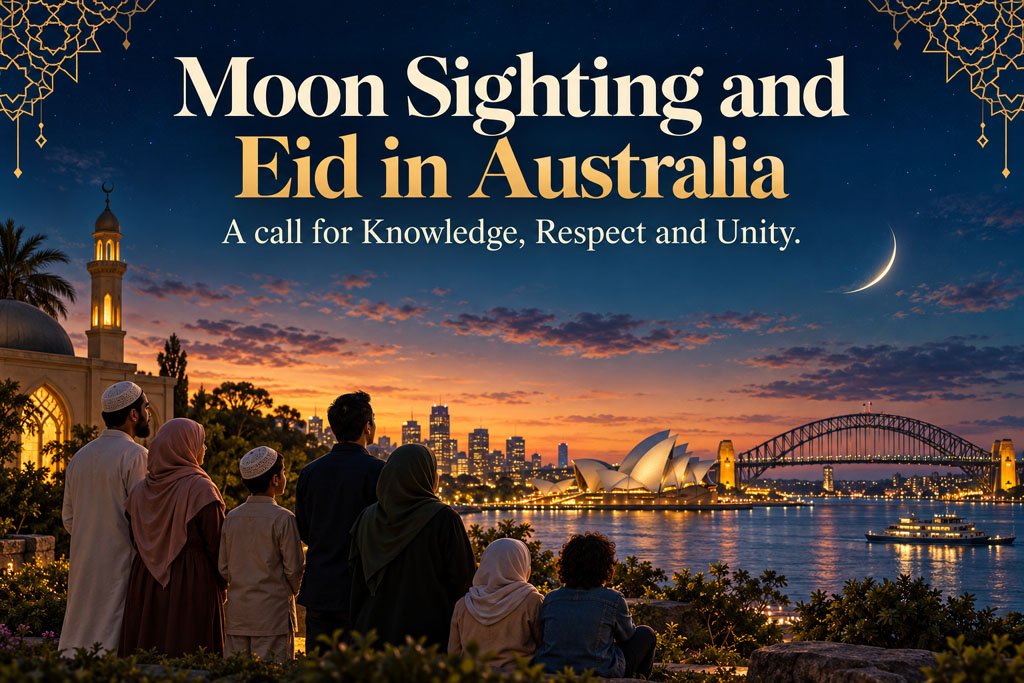
Suprovat Sydney: Celebrating Eid on different days can be disappointing for families and communities. However, our response should be guided by the Holy Qur’an, the authentic Sunnah and respectful discussion. We can uphold the Sunnah of moon sighting while respecting scholars and Muslims who follow another recognised scholarly interpretation. Australia’s Muslim community brings together people from many countries and scholarly traditions. Communities may follow different religious authorities, moon-sighting committees or jurisprudential approaches, resulting in different announcements. Understanding these differences requires knowledge, patience and a commitment to preserving Muslim brotherhood.
The Qur’an: Crescents Mark Religious Time
Allah swt سبحانه وتعالى says: يَسْأَلُونَكَ عَنِ الْأَهِلَّةِ ۖ قُلْ هِيَ مَوَاقِيتُ لِلنَّاسِ وَالْحَجِّ
The meaning of this passage is that people ask about the crescents, and Allah identifies them as markers of time for humanity and Hajj. Surah Al-Baqarah, 2:189 this verse establishes the importance of the lunar calendar. The specific instruction to begin and end Ramadan through crescent sighting is given explicitly in the Sunnah.
The Prophet’s ﷺ clear Instruction: The Messenger of Allah ﷺ said: صُومُوا لِرُؤْيَتِهِ، وَأَفْطِرُوا لِرُؤْيَتِهِ Translation is: “Fast upon sighting it, and end fasting upon sighting it.” The narration continues by instructing Muslims to complete thirty days of Sha‘ban when the crescent is obscured. Sahih al-Bukhari, 1909 authentic.
Moon sighting therefore has a direct foundation in the Prophet’s ﷺ teaching. Completing thirty days when the crescent cannot be established is also obedience to that teaching. It should not be regarded as a failure or a cause for embarrassment.
Why Do Eid Dates Differ?
Scholars differ over the geographical scope of moon-sighting reports: whether a sighting should apply locally, regionally or more widely. They also differ over the role of astronomical calculation in establishing the beginning of a lunar month. For Eid Ul-Adha, there is an additional disagreement over whether Muslims outside Saudi Arabia should follow Saudi Arabia’s Hajj calendar or establish Dhul-Hijjah according to the moon-sighting approach followed in their own region. These differences should be understood through their evidence and scholarly reasoning, rather than reduced to accusations against individuals or communities.
Regional Sightings Have Evidence in the Sunnah
In the authentic narration of Kuraib, the Ramadan crescent was seen in Syria on Friday night, while it was seen in Madinah on Saturday night.
When informed of Syria’s earlier sighting, Ibn Abbas RA. رضي الله عنهما maintained Madinah’s observance until its own sighting of the Shawwal crescent or completion of thirty days. He explained that this followed the Messenger’s ﷺ instruction. Sahih Muslim, 1087 authentic.
This narration provides important evidence for scholars supporting regional moon sighting. Different dates cannot automatically be treated as proof of ignorance or disregard for the Sunnah.
Respect the Ulama and Discuss Their Evidence Courteously
A common reaction to different Eid announcements is frustration directed at the Ulama. Some people resort to insults and blame scholars for the division. Such language undermines the respectful discussion needed to address the issue.
The Prophet ﷺ described scholars as: وَإِنَّ الْعُلَمَاءَ وَرَثَةُ الْأَنْبِيَاءِ meaning is: “The Ulama (scholars) are the inheritors of the Prophets.” The narration explains that their inheritance is knowledge. Sunan Abi Dawud, 3641.
Scholars deserve respect for their responsibility in preserving and explaining the Deen. Many work within consultative bodies, assessing testimony and participating in collective decisions. Others directly formulate the relevant rulings. Their roles should be understood accurately before criticism is directed at them.
Respect for the Ulama does not mean they cannot be questioned. Scholars remain human. Asking courteously for evidence, clarification or an explanation of a committee’s process is appropriate. Insults, humiliation and personal attacks are not allowed in Islam at all.
Allah swt prohibits ridicule, defamation and offensive name-calling in, Surah Al-Hujurat, 49:11. This guidance applies to our treatment of both scholars and ordinary Muslims.
Following the Sunnah and Using Technology
Some critics ask sarcastically: “If we follow the Sunnah strictly, why don’t we ride camels or return to the desert?” This comparison confuses ordinary worldly means with prescribed acts of worship. Following the Prophet ﷺ does not require using every form of transport available in seventh-century Arabia. Cars, phones and scientific instruments can serve permissible and beneficial purposes.
The relevant moon-sighting question is whether astronomical calculation assists the prescribed method or can replace physical sighting. That question requires evidence and scholarly discussion; mockery does not resolve it.
The Foundation of Unity: Revelation and sound scholarship
Our unity must be grounded in the Holy Qur’an and the authentic Sunnah of the Messenger of Allah ﷺ, understood through sound scholarship.
Ijma and Qiyas should be understood within this framework. In mainstream Sunni jurisprudence, Ijma refers to qualified scholarly consensus, while Qiyas refers to disciplined legal analogy. They are not independent replacements for revelation.
A local committee’s majority vote is not automatically Ijma, and Qiyas is not simply personal opinion. These principles should be discussed accurately and respectfully.
Allah swt سبحانه وتعالى commands: وَاعْتَصِمُوا بِحَبْلِ اللَّهِ جَمِيعًا وَلَا تَفَرَّقُوا
Meaning: “Hold firmly together to Allah’s rope, and do not become divided.” Surah Ali ‘Imran, 3:103.
We should work towards celebrating together while preserving brotherhood when dates differ. Following another recognised scholarly position should not become a reason to insult or belittle a fellow Muslim.
Let Knowledge Strengthen Our Brotherhood
A calendar difference alone does not prove a lack of Islamic knowledge. However, insufficient understanding can turn a scholarly disagreement into hostility. The Prophet ﷺ taught that Allah eases the way to Paradise for someone who follows a path seeking knowledge. Sahih Muslim, 2699a — authentic.
Every Muslim, male and female, should acquire the religious knowledge necessary to fulfil their obligations. This does not mean everyone must become a specialist in astronomy or jurisprudence.
Better Islamic education can help communities understand legitimate differences without treating them as a licence for division. Qualified, sincere and God-fearing Ulama can take the initiative by explaining the evidence, encouraging dialogue and working towards clear testimony standards, verification procedures and coordinated announcements.
The work begins in our homes, mosques and community centres: studying the Deen sincerely, asking questions respectfully and protecting one another’s dignity.
Let us uphold the Sunnah of moon sighting with sincerity, seek knowledge with humility, respect our Ulama, and preserve the brotherhood of the Ummah.
May Allah unite our hearts upon truth, grant us beneficial knowledge, and guide us to worship Him with sincerity and mutual respect. Ameen.