 By Abdullah Yousuf: In recent years, religious minorities in India have faced increasingly severe and extrajudicial forms of punishment. Critics argue that these measures are often arbitrary and inhumane, bypassing due process. Specifically, Muslim communities frequently find themselves targeted by state mechanisms, facing systemic violence and the destruction of property under various administrative pretexts.
A stark example of this trend occurred in the Sipajhar region of Assam. On May 20, approximately 400 Muslim families were forcibly evicted from their homes. These families reported receiving no prior legal warning or formal eviction notices. Following the forced removals, state authorities utilized bulldozers to demolish their residences, leaving thousands without shelter.
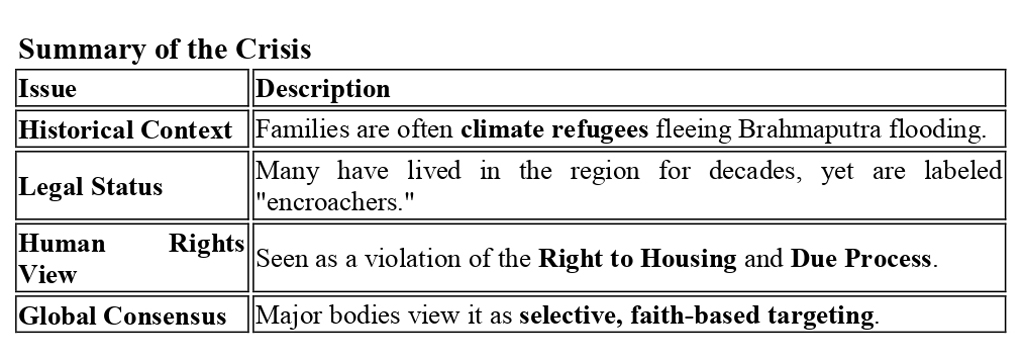
For many families in the Sipajhar region, the recent demolitions are not an isolated tragedy, but a recurring nightmare. This marks the second time in less than three years that many of these residents have been forcibly displaced by the state.
The 2021 Dhalpur-Sipajhar Violence
The precedent for these actions was set in September 2021 during a massive eviction drive in the same area. The scale of that operation remains one of the most documented instances of state-led displacement in recent Indian history:
- Property Loss: More than 1,000 homes were razed to the ground.
- Human Toll: Over 7,000 individuals were left homeless overnight.
- Casualties: The drive turned violent when police opened fire, resulting in the deaths of two Muslim residents, including a 12-year-old boy.
- Lack of Recourse: Rights organizations and local residents emphasize that these actions were carried out without due process or a comprehensive rehabilitation plan, leaving thousands in makeshift camps.
Political Rhetoric and Selective Enforcement
The 2021 evictions were a cornerstone policy of the current Chief Minister of Assam, a prominent leader of the Bharatiya Janata Party (BJP). Since taking office in May 2021, the administration has doubled down on campaign promises to “reclaim” land from what they term “illegal encroachers.”
In the socio-political context of Assam, “encroacher” is widely understood as a coded reference to Bengali-origin Muslims. This group has long been marginalized and targeted through citizenship verification processes (such as the NRC) and now, through the increasing use of “bulldozer justice” as a tool of governance. This selective enforcement has raised international alarms regarding the erosion of minority rights and the weaponization of land laws against a specific religious community.
When the initial evictions began, the Assam government justified the displacement of thousands by announcing the Gorukhuti Agriculture Project. This experimental initiative was ostensibly designed to “reclaim” land for indigenous farming across 23,000 acres in Dhalpur Char.
However, nearly three years later, the gap between policy and practice is undeniable:
- Stagnant Development: Despite the massive scale of the clearance, there is virtually no evidence of the promised large-scale agricultural infrastructure or productivity.
- Broken Promises: The state government’s pledge to relocate the displaced families to Dalgaon remains unfulfilled.
- State of Limbo: Thousands of families continue to languish in Dhalpur Char, living in “makeshift” shelters—essentially plastic tents and bamboo huts—with no access to clean water, electricity, or permanent sanitation.
A Community Under Siege
The human cost of this policy is best articulated by those living in the ruins. One resident, who requested anonymity due to fears of state retaliation, offered a harrowing perspective on the selective nature of these drives:
“Why are only Muslim-dominated areas being targeted? Why are only Muslim families being evicted? This has nothing to do with an agricultural project. The project is just a mask. They simply want to get rid of us because of our faith.”
From “Climate Refugees” to Targeted Minorities
The Muslim families targeted in these drives are primarily of Bengali origin and have been integral to the region’s social fabric for decades. Their presence in the Sipajhar area is often a matter of survival rather than “encroachment.” Many are internal migrants who were forced to move from the banks of the Brahmaputra River—a region plagued by extreme flooding and riverbank erosion. Having lost their ancestral lands to the river, they now find their secondary homes lost to state policy.
A National Pattern of “Erasure and Exclusion”
What is happening in Assam is no longer an isolated incident. Across Indian urban and rural landscapes, the bulldozer has evolved from a tool of construction into a symbol of extrajudicial punishment. While the government frames these actions as “development” or “security” measures, the demographic data suggests a deeper agenda:
- Selective Enforcement: Demolitions frequently follow communal protests or political dissent, specifically targeting Muslim neighborhoods.
- Systemic Erasure: By destroying homes and businesses, the state effectively removes the economic and social foundations of minority communities.
International Outcry
The global community has taken notice of this shift away from the rule of law. Prominent human rights organizations and international media have issued stern warnings to the Indian government:
United Nations Human Rights: “India must halt arbitrary demolitions targeting minorities and marginalized communities.”
Amnesty International: “Indian authorities must immediately stop the unjust, targeted demolition of Muslim properties.”
The media narrative has also shifted to reflect this grim reality:
- BBC: “How bulldozers became a vehicle of injustice in India.”
- ABC News: “What is ‘bulldozer justice’? Why Indian authorities are demolishing homes.”
 The Beef Export Paradox: Vigilantism vs. Commerce
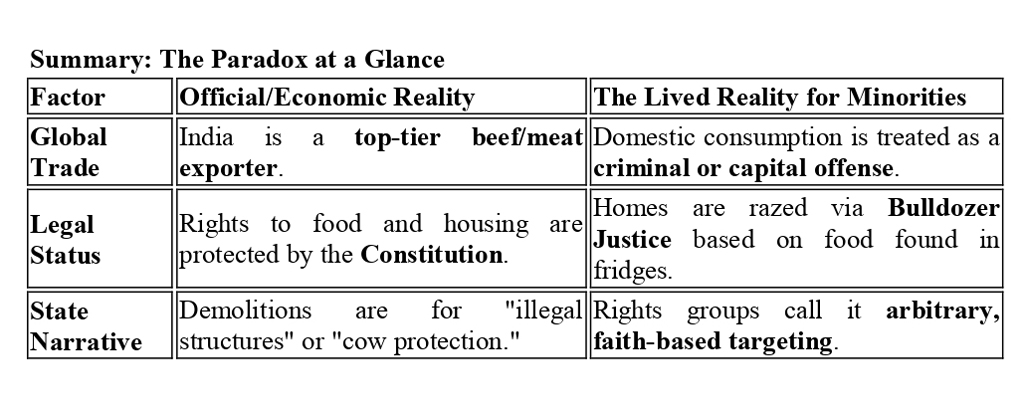
One of the most tragic ironies of “Bulldozer Justice” lies in the pretext often used for these attacks. In recent years, Muslim communities have been targeted by extremist groups—and in some cases, state authorities—under the guise of “cow protection.”
The Mandla Case Study
In June 2024, authorities in Mandla, Madhya Pradesh, demolished 11 Muslim homes after claiming to have found beef in the residents’ refrigerators. Human rights monitors categorized this as a clear instance of “collective punishment,” where the demolition served as an extrajudicial sentence before any legal guilt was established in a court of law.
A Stark Economic Contradiction
The violence surrounding beef consumption stands in direct opposition to India’s position in the global market. The “hatred” cited by victims and rights groups is framed by a confusing economic reality:
- Global Ranking: India consistently ranks as one of the top three largest exporters of beef (specifically carabeef/water buffalo) in the world.
- Economic Scale: The industry generates billions in revenue for the Indian economy annually.
- The Human Toll: According to Human Rights Watch, between June and August 2024 alone, there was a significant surge in “cow vigilantism,” where Muslim men and even children were assaulted or killed on mere suspicion of transporting or consuming meat.
Al Jazeera asked a poignant question that sums up the international mood: “Why is Amnesty urging India to halt the bulldozing of Muslim properties?” The answer, according to global monitors, is that these demolitions have become a weapon of selective persecution, where faith-based animosity overrides constitutional protections and economic logic.
They may forgotten that, Muslims was ruled India over 300 years, Osman ruled around 750 years in the world. If they killed minority what Indian doing now then no non-Muslim can exist in this world.
India must address and end the current cycle of brutality violence immediately. History shows us that during the centuries of Muslim king Mughal rule in India and the long reign of the Ottoman Empire, diverse populations coexisted. If past empires had practiced the same level of intolerance or attack or kill minority we see today, the global demographic landscape would look very different. Protecting minorities is not just a legal duty; it is a lesson from history.