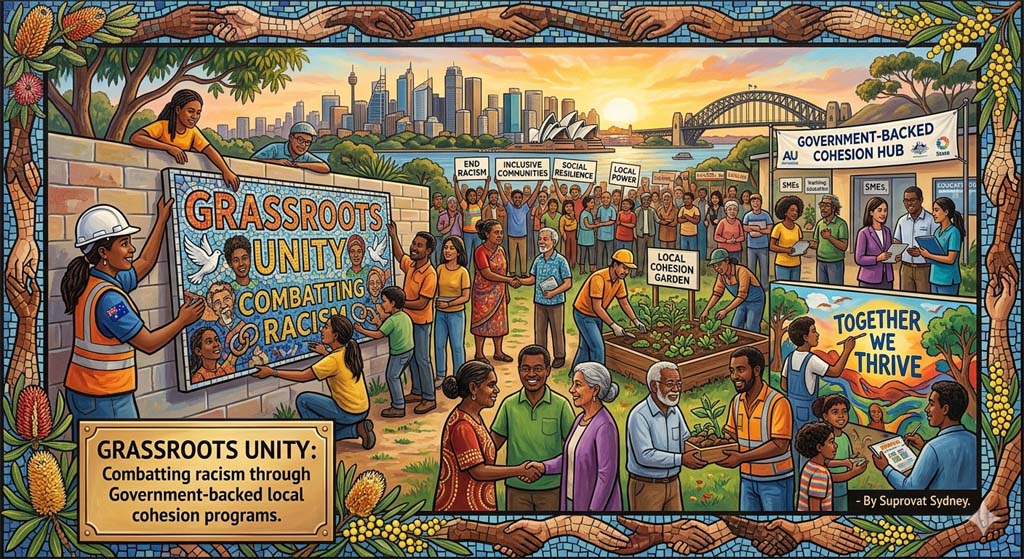
 By Suprovat Sydney: The global social landscape of 2026 is at a critical crossroads. While digital connectivity has never been higher, social fragmentation and the resurgence of exclusionary ideologies have created profound fractures within local communities. Addressing systemic racism is no longer seen as a peripheral social issue but as a core requirement for national stability and economic prosperity. The emerging consensus among policymakers is that top-down mandates are insufficient; true progress requires grassroots unity a model where government-backed programs empower local actors to build social cohesion from the bottom up.
The Shift from Rhetoric to Resilient Infrastructure
For decades, anti-racism efforts often stalled at the level of public awareness campaigns or high-level legislative changes that failed to penetrate the daily lived experiences of marginalized groups. Today, the focus has shifted toward building “social infrastructure” the physical and institutional spaces where diverse groups interact, build trust, and develop a shared sense of belonging.
Government-backed local cohesion programs are designed to provide the resources, framework, and legitimacy needed for these interactions to occur organically. By moving the battle against racism into the neighbourhoods, schools, and local workplaces, states are attempting to replace abstract conflict with humanized connection.
Strategic Pillars of Local Cohesion
Building a cohesive, anti-racist society requires a multi-faceted approach that addresses both the psychological and structural elements of prejudice.
- Collaborative Governance and Funding
The most effective programs are those where the government acts as a “partner-investor” rather than a sole director.
- Targeted Assistance: Local councils and community groups receive specific grants to develop programs tailored to their unique demographics.
- Policy Coherence: Integrating anti-racism goals into broader industrial and economic policies ensures that social cohesion is not treated as an afterthought, but as a prerequisite for a productive workforce.
- Industry 4.0 and Digital Inclusion
In 2026, the digital divide is often a racialized divide. Modern cohesion programs leverage technology to bridge gaps rather than widen them.
- Adaptive Resilience: Programs utilize digital platforms to sense social tension signals early, allowing for rapid reconfiguration of community resources to de-escalate potential conflicts.
- Capability Development: Governments are investing in digital literacy for marginalized communities, ensuring that the shift toward automated manufacturing does not lead to further economic displacement along racial lines.
- The Role of Small and Medium Enterprises (SMEs)
SMEs are the primary engines of local employment and social interaction. By fostering “inclusive entrepreneurship,” government programs encourage diverse hiring and local supply chain integration.
- Strategic Thinking: SMEs that adopt a “global mindset” locally—valuing diverse perspectives and cultural intelligence demonstrate higher resilience during economic shocks.
- Workforce Integration: Targeted subsidies help local businesses hire and train individuals from underrepresented backgrounds, turning the workplace into a hub for cross-cultural collaboration.
Managing the “Sovereignty” of Identity
A significant challenge in modern cohesion programs is balancing national identity with cultural diversity. This is often referred to as managing the sovereignty gap ensuring that individuals feel their cultural heritage is respected (sovereignty) while maintaining a commitment to the collective national project (resilience).
| Strategy | Focus | Outcome |
| Cultural Reciprocity | Shared celebrations and education | Reduces “fear of the other” through exposure. |
| Structural Equity | Access to housing, health, and capital | Eliminates the material basis for racial resentment. |
| Joint Problem-Solving | Task-based community projects | Builds “functional trust” across racial lines. |
Export to Sheets
The Economic Argument for Unity
While the moral imperative for ending racism is clear, the economic data from the mid-2020s has added a layer of pragmatic urgency.
- Productivity Gains: Communities with high social cohesion report higher levels of innovation and lower turnover rates in local industries.
- Reducing the Cost of Friction: Social unrest and systemic exclusion lead to significant GDP losses. Conversely, “de-risking” the social environment through cohesion programs can prevent the hollowing out of local economies that often follows periods of civil tension.
- Investment Attraction: Investors increasingly look for “social stability” as a key metric. Regions that demonstrate a strong, unified social fabric are seen as safer bets for long-term capital placement.
Overcoming Obstacles to Integration
Despite the benefits, government-backed cohesion programs face several hurdles:
- The “Quality Downgrade” Perception: There is often a persistent, albeit incorrect, belief that prioritizing diversity in hiring or procurement leads to lower standards. Overcoming this requires transparent data showcasing that diverse teams actually perform better in complex environments.
- Weaponization of Grievance: Political actors may frame cohesion programs as a threat to the majority’s culture. Countering this requires framing these programs as a “national security asset” protecting the country from internal division that foreign adversaries can exploit.
- Resource Constraints: Maintaining high-touch local programs is expensive. This necessitates a “circular social economy” where successful local leaders are trained to mentor the next generation, reducing the long-term reliance on central government funding.
Conclusion: A New Social Contract for 2026
The era of viewing racism as a “personal failing” is ending. In its place is a more sophisticated understanding of racism as a structural and systemic vulnerability that threatens national resilience. By investing in Grassroots Unity, governments are not just performing a moral duty; they are reinforcing the foundations of the state.
Ending dependence on fragmented, globalized ideologies that promote division requires a return to the local. When people work together to build their own industries, manage their own borders, and solve their own community problems, the abstract barriers of race begin to dissolve. The future belongs to nations that can turn their diversity into a strategic advantage, ensuring that every citizen regardless of their background—has a vested interest in the collective success of the whole.
References
[1] APM, M. O. (2026). Beyond the checkpoint – Managing Australia’s border as a strategic economic and national security asset. Australian National University (ANU) National Security College.
[2] Blanchard, E., Bown, C., & Johnson, R. (2016). Global supply chains and trade policy. National Bureau of Economic Research.
[3] Buckley, A. (2025). Deterrence and the case for Australian Industry Policy. Future Forge – Defence.
[4] Cerdeiro, D. (2024). The price of de-risking: Reshoring, friend-shoring, and quality downgrading. IMF Working Papers.
[5] Laffourcade, R. (2026). Technological sovereignty in healthcare innovation and production for defence: Proposal for an evaluation index to guide European policies. Taylor & Francis.
[6] Nakandala, D. (2026). Recharging SME manufacturing in NSW. Australian Public Policy Institute.
[7] Ongesa Nyamboga, T. (2026). Strategic thinking and entrepreneurial orientation as drivers of adaptive resilience in global manufacturing SMEs. F1000Research.
How do you think we could better measure the “social stability” of a neighborhood to ensure these programs are reaching the areas that need them most?