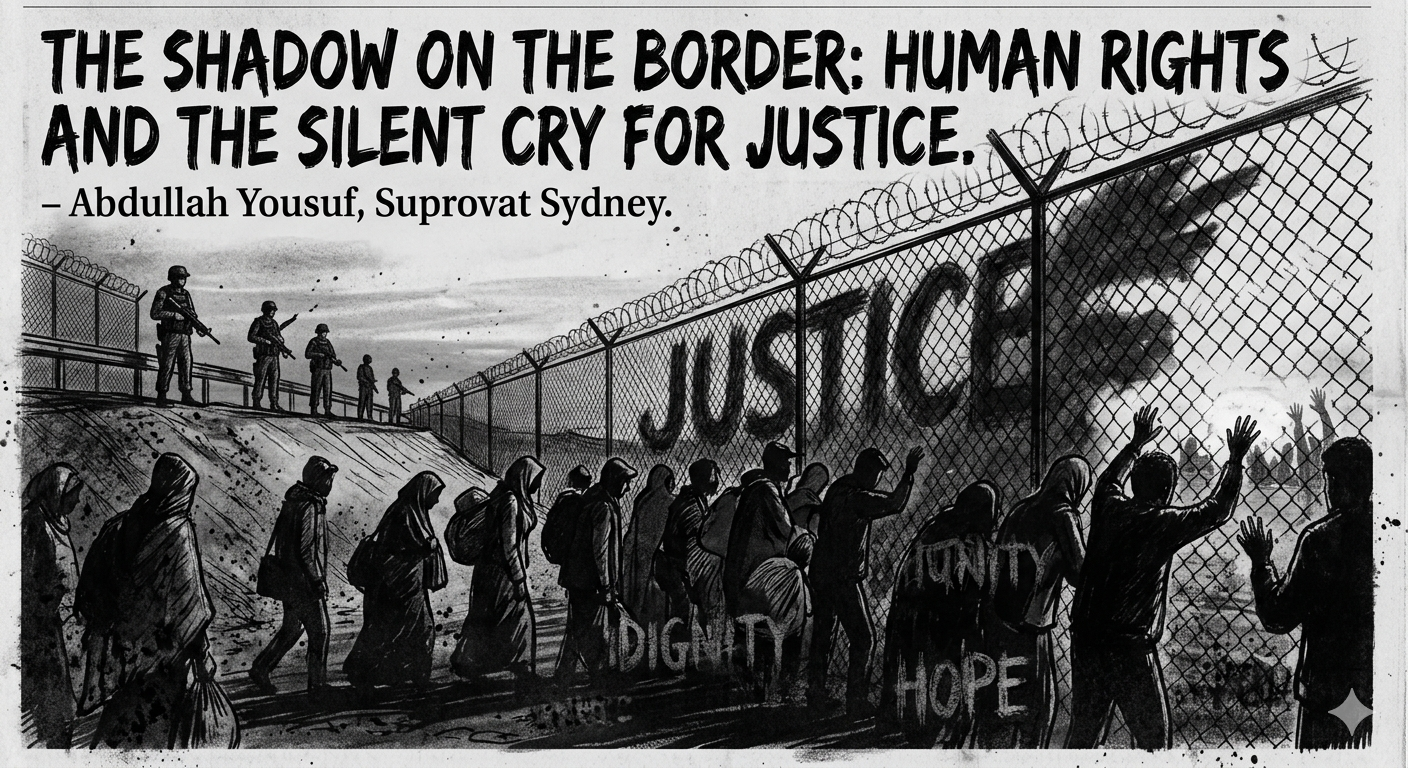
Abdullah Yousuf, Suprovat Sydney: The 4,096-kilometer stretch of land separating India and Bangladesh is often called the “Green Border,” but for the millions living in its shadow, it has become a landscape of fear and mourning. Despite decades of diplomatic pledges to achieve a “zero-killing” border, the reality remains a grim cycle of violence, where impoverished civilians find themselves caught between survival and the barrel of a gun.
A Border of Bullets
The most pervasive issue is the use of lethal force by the Indian Border Security Force (BSF). Human rights organizations, including Odhikar and Human Rights Watch, have documented nearly 2,000 deaths of Bangladeshi civilians at the hands of the BSF over the last decades.
While official reports often categorize these victims as “smugglers” or “infiltrators” to justify the use of force as self-defense, independent investigations tell a different story. Many of the deceased are found to be:
- Unarmed Farmers: Working fields that the border haphazardly bisects.
- Marginalized Laborers: Driven by extreme poverty to engage in small-scale cattle or goods transport.
- The Inadvertent: Children or villagers who cross the often poorly marked boundary by mistake.
The case of Felani Khatun, the 15-year-old girl whose body was left hanging on a barbed-wire fence for hours in 2011, remains a haunting symbol of this brutality. Even in such clear-cut cases of excessive force, the perpetrators are rarely held accountable in civilian courts.
The Unspoken Horror: Violence Against Women
Beyond the fatal shootings lies a darker, often underreported reality: the sexual exploitation and assault of women in border villages. Human rights monitors have noted that the isolated nature of these villages, combined with a heavy military presence and the “shoot-on-sight” atmosphere, creates a breeding ground for abuse.
For many poor Bangladeshi women, the border is a place of absolute vulnerability. Accusations of rape and harassment by security personnel are frequently met with silence or intimidation. Fear of social stigma, combined with a lack of legal recourse across an international boundary, ensures that most of these crimes are never reported, leaving the victims with no path to justice.
A System of Impunity
The core of the crisis is the lack of accountability. BSF personnel are governed by the BSF Act, which largely shields them from prosecution in civilian courts. Cases are typically handled by internal “General Boundary Security Force Courts.” These proceedings are closed to the public and rarely result in significant punishment, even when evidence of wrongdoing is overwhelming.
This legal vacuum sends a dangerous message: that the lives of those on the periphery are expendable. For the “innocent poor,” there is no lawyer to call and no court that will listen. The border operates as a “no-man’s-land” where constitutional rights are suspended, and the rule of law is replaced by the rule of the rifle.
The Need for a Humanitarian Shift
The violence on the India-Bangladesh border is not just a security issue; it is a humanitarian catastrophe.
- Non-Lethal Alternatives: There must be a strict, enforceable mandate to use non-lethal weapons (rubber bullets, stun grenades) rather than live ammunition.
- Civilian Oversight: Allegations of murder and sexual assault must be investigated by independent judicial bodies, not the military branches themselves.
- Joint Accountability: Both governments must move beyond “flag meetings” and diplomatic pleasantries to establish a joint commission that prioritizes human life over political optics.
Until the lives of the villagers living near the fence are valued as much as the border itself, the “Green Border” will remain stained with the blood of the innocent. Justice should not stop where the fence begins.