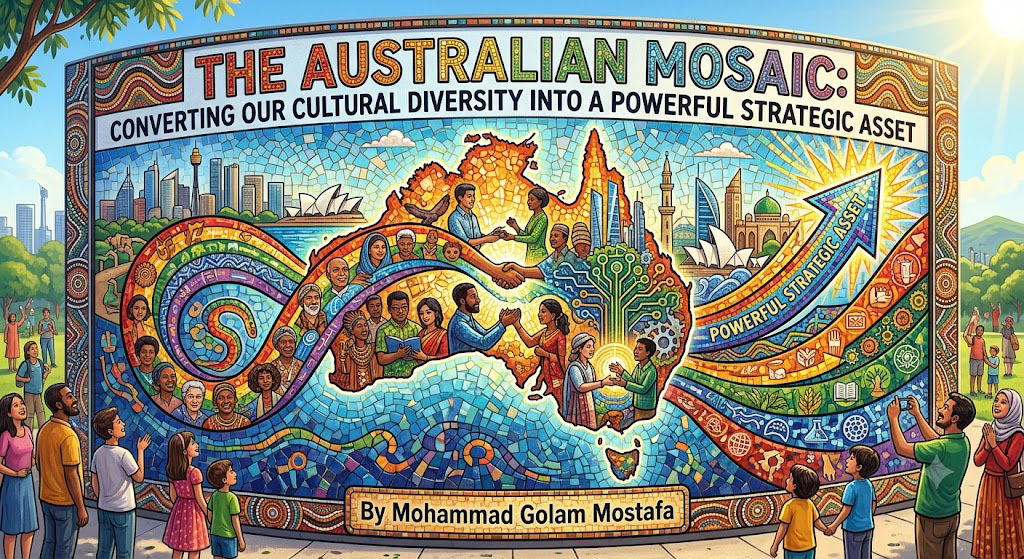
 By Mohammad Golam Mostafa
Walk down any main thoroughfare in Sydney, Melbourne, Brisbane, or Perth, and you will hear it before you see it: a quiet symphony of global human experience. A phone conversation in Mandarin near a bus stop, a lively debate in Vietnamese over coffee, the rhythm of Arabic, Italian, Punjabi, or Greek weaving through the background hum of modern Australian life.
For decades, we have celebrated this reality through a comfortable, postcard-friendly lens. We point to our vibrant food districts, light up our public squares for multicultural festivals, and put on Harmony Week events. It is a warm, feel-good narrative.
However, treating our cultural diversity merely as a feel-good social feature misses the bigger picture.
Australia does not simply happen to have a diverse population; our multicultural makeup is one of the most underutilized strategic assets in the Western world. In an era marked by shifting geopolitical alliances, economic uncertainty, and rapid technological disruption, it is time to move beyond the superficial aesthetics of diversity. We must transform our cultural mosaic into a dynamic engine of economic growth, diplomatic leverage, and national resilience.
The reality of the mosaic
To understand the strategic potential of Australia’s multiculturalism, we must first appreciate its scale. More than half of all Australians were either born overseas or have at least one parent born overseas. More than 300 languages are spoken in Australian homes every night, and our citizens maintain living, personal ties to virtually every nation on Earth.
┌─────────────────────────────────────────┐
│ THE AUSTRALIAN MOSAIC │
└───────────────────┬─────────────────────┘
│
┌──────────────────────────────┼──────────────────────────────┐
▼ ▼ ▼
┌───────────────┐ ┌───────────────┐ ┌───────────────┐
│ Deep Indo- │ │ Cognitive │ │ Grassroots │
│ Pacific Ties │ │ Innovation │ │ Resilience │
└───────┬───────┘ └───────┬───────┘ └───────┬───────┘
│ │ │
└──────────────────────────────┼──────────────────────────────┘
▼
┌─────────────────────────────────────────┐
│ SOVEREIGN STRATEGIC CAPABILITY │
└─────────────────────────────────────────┘
Historically, older models of nation-building favored the idea of the “melting pot”—a mechanism designed to blend every nuance away until everyone looked, spoke, and thought alike. But a mosaic operates on a fundamentally different logic. In a mosaic, each tile retains its distinct color, texture, and origin. When arranged with purpose, those individual tiles create a picture far stronger, more intricate, and more vibrant than any single monochrome background could ever achieve.
Yet, for too long, Australian policy and corporate leadership have treated diversity as a soft Human Resources metric—a box to be checked for compliance—rather than a core capability to be deployed.
Unlocking the strategic dimensions
- The Indo-Pacific Diplomatic Advantage
Australia sits at the heart of the most economically dynamic and geopolitically sensitive region on the planet: the Indo-Pacific. While traditional diplomacy relies on official government channels, our diaspora communities represent a living web of grassroots relationships.
When Australian businesses want to expand into South-East Asia or South Asia, they do not need to start from scratch. Within our own borders live hundreds of thousands of professionals who understand the subtle nuances of business etiquette, regulatory environments, dialect variations, and implicit trust networks in those target markets.
Key Insight: Cultural fluency is not just about translating words; it is about translating context. A country that speaks the languages of its neighbors from within its own home population possesses an unmatched soft-power superpower.
- Cognitive diversity as an engine of Innovation
In business and technology, the greatest threat to long-term survival is institutional groupthink. When teams are drawn from identical socio-cultural backgrounds, they tend to approach problems with identical toolkits and shared blind spots.
Cognitive diversity—the varied ways people process information, assess risk, and imagine solutions—is directly linked to cultural diversity. A workforce built from a mosaic of global experiences approaches challenges with a broader set of perspectives. This leads to more resilient risk management, more inventive product design, and a deeper capacity to serve global consumer bases.
- Entrepreneurial energy and economic resilience
Statistically, migrants and first-generation citizens display a remarkably high propensity for entrepreneurship. The very act of moving across the globe requires grit, adaptability, and an appetite for calculated risk—the exact qualities that define successful innovators and business builders.
By actively fostering business networks that connect diaspora entrepreneurs with capital, incubators, and trade missions, Australia can turn local small businesses into international trade bridges.
Overcoming the structural friction
If the strategic value of our diversity is so compelling, why haven’t we fully realized it? The answer lies in structural friction—the systemic hurdles that prevent individuals from contributing at their full potential.
+————————————+—————————————————+
| Systemic Challenge | Strategic Remedy |
+————————————+————————————-
| Overseas Credential Bottlenecks | Modernized, competency-based recognition pathways |
| The “Bamboo & Cultural Ceilings” | Active sponsorship and merit-based succession |
| Fragmented Multicultural Policy | National Sovereign Capability Framework integration|
| First Nations Disconnect | Dual-pillar policy connecting ancient & modern |
+————————————+————————————-
The credential trap
Every year, highly qualified doctors, engineers, IT specialists, and researchers arrive in Australia only to find their credentials buried under bureaucratic red tape. When a foreign-trained civil engineer drives a rideshare vehicle because our accreditation pathways are convoluted, it isn’t just an individual hardship—it is an economic leak for our country.
The “cultural ceiling”
While Australian entry-level workforces are richly diverse, our boardrooms, executive suites, and parliament often fail to reflect that same richness. This drop-off at the leadership level means strategic decisions are frequently made without the full benefit of our nation’s broader perspective.
Anchoring in first nations truths
Crucially, any modern vision of Australian multiculturalism must be anchored in deep respect for and alignment with First Nations Australians. Indigenous Australians represent the oldest continuing cultures on Earth. A truly powerful Australian mosaic does not replace or obscure First Nations heritage; it builds upon that foundational bedrock. True national strength requires a clear, respectful synthesis between our ancient origins, our Anglo-Celtic institutions, and our modern multicultural reality.
A roadmap for the future
Converting our cultural diversity from a passive demographic reality into an active strategic asset requires intentional policy and corporate courage. Here is where we must start:
- Treat diversity as a sovereign capability: Integrate cultural and linguistic mapping into national trade, defense, and economic planning. When trade delegations travel abroad, diaspora leaders should be co-designing the strategy.
- Streamline Skills Recognition: Overhaul regulatory bodies to create fast-tracked, rigorous, competency-based assessment models that allow skilled migrants to enter their fields swiftly.
- Elevate Diverse Leadership: Measure leadership pipelines not just by gender, but by cultural origin and lived experience. Mentorship must evolve into active sponsorship.
- Build the Bridge with First Nations Knowledge: Ensure that multicultural communities are educated on First Nations history, fostering genuine solidarity between migrant populations and Indigenous custodians.
Conclusion: designing the masterpiece
A mosaic is not created by accident. Left unattended, loose tiles remain separate, fragile, and easily displaced. They require careful design, strong binding material, and a shared structure to hold them together.
Australia’s multicultural story is ready for its next chapter. We have successfully built one of the most peaceful, harmonious multi-ethnic societies on the planet. Now, our task is to transform that domestic harmony into international strength.
When we view our people not through the lens of identity politics or shallow celebration, but as a vast, interconnected network of knowledge, capability, and global goodwill, Australia’s path forward becomes clear. We are not just an island continent at the bottom of the map; we are a microcosm of the world itself, uniquely positioned to lead, innovate, and thrive in the century ahead.