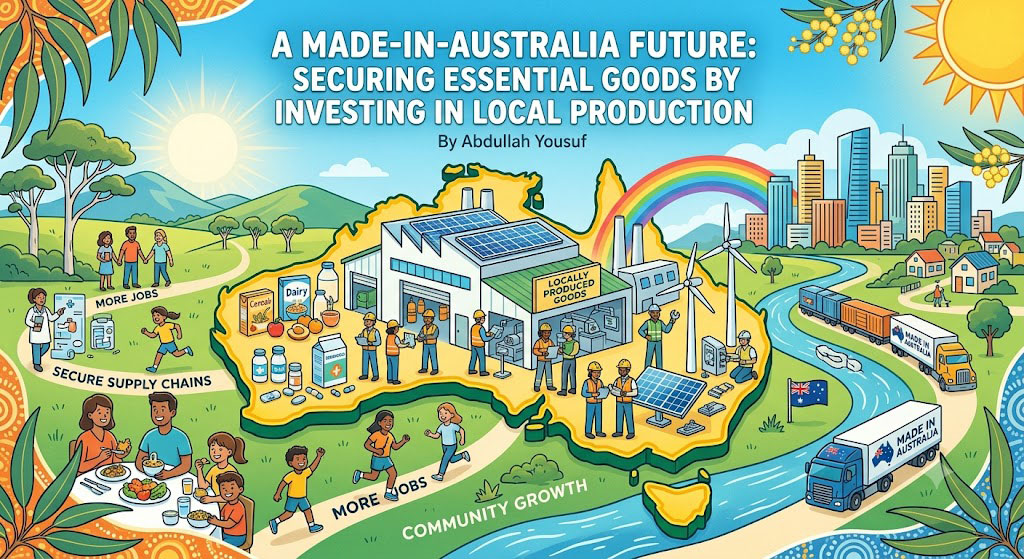
 By Abdullah Yousuf: If the past few years taught Australians anything, it’s that our global supply chains are a lot more fragile than we thought. For decades, the quiet consensus was simple: offload manufacturing to wherever labour is cheapest, import the finished goods on container ships, and enjoy low shelf prices. It worked seamlessly—until it didn’t.
When international shipping lanes ground to a halt, freight rates skyrocketed, and global competition left us scrambling for basic medical supplies, rapid antigen tests, and industrial inputs, the reality hit home. Australia—a nation blessed with vast natural resources, world-class researchers, and an enviable quality of life—found itself vulnerable. We realised that relying entirely on the rest of the world for the things we need to survive and thrive is a risk we can no longer afford to run.
Building a “Made-in-Australia” future isn’t about wrapping ourselves in protectionism or pretending we can make every single widget onshore. It is about strategic sovereign capability: ensuring that when global shocks hit, Australians have direct access to essential goods, powered by home-grown innovation and local grit.
The price of shipping our potential offshore
How did we get here? For much of the late 20th and early 21st centuries, Australia experienced a steady decline in domestic manufacturing. As a percentage of GDP, our manufacturing footprint shrank as companies moved operations overseas to cut overheads. We became world experts at digging raw materials out of the ground—iron ore, lithium, bauxite, critical minerals—and shipping them straight out of our ports.
In return, we bought back refined metals, batteries, electronics, and pharmaceuticals at a premium.
While that model delivered short-term economic efficiency, it created deep systemic risks. When you ship raw lithium out to be refined overseas, only to import the finished lithium-ion batteries back, you don’t just lose out on the economic value-add—you surrender control over your own energy security. The same goes for critical pharmaceuticals and agricultural inputs like fertilizers. In times of global stress, supply chains don’t just slow down; they collapse into national self-preservation.
Modern manufacturing: More than just steel & stitches
When people hear “local manufacturing,” it’s easy to picture 1970s assembly lines or heavy industrial chimneys. But a modern Made-in-Australia future looks fundamentally different. It’s clean, high-tech, highly automated, and driven by advanced engineering.
Securing our essential goods means focusing on strategic sectors where domestic capability is a matter of national resilience:
- Pharmaceuticals and medical tech: From RNA vaccines and essential therapeutics to medical devices, local bio-manufacturing ensures our healthcare system isn’t left at the back of a global queue during the next health crisis.
- Critical minerals and clean energy componentry: Australia holds some of the world’s richest deposits of critical minerals needed for the net-zero transition. Value-adding onshore processing lithium, nickel, and cobalt into battery precursors and renewable energy hardware keeps economic value local while building energy self-reliance.
- Green metals: With our abundant sunshine and wind, Australia has a natural advantage in renewable energy. Turning our raw iron ore into green steel using green hydrogen can transform our industrial base into a global decarbonisation powerhouse.
- Advanced food and agtech: We produce some of the highest-quality food on the planet, but modernising our downstream food processing and packaging ensures our food supply chains remain secure through droughts, floods, and global shocks.
The human Impact: high-paid jobs & thriving regions
Investing in domestic production isn’t just an exercise in risk management; it’s an economic engine.
When we build industrial capability at home, we create high-skilled, well-paid jobs. These aren’t low-wage manual assembly jobs; they are roles for software engineers, robotics technicians, advanced machinists, chemists, and logisticians.
Crucially, manufacturing doesn’t just happen in capital city CBDs. It happens in regional hubs—in the Hunter Valley, the Latrobe Valley, Gladstone, the Pilbara, and regional Victoria and South Australia. Rebuilding domestic production revitalises regional economies, offering young Australians meaningful career pathways in their hometowns without forcing them to move to major capitals.
Every dollar invested in local manufacturing creates a powerful multiplier effect across the economy. Local factories buy goods from local suppliers, hire local tradespeople, and support surrounding small businesses—from the local bakery to engineering consultancies.
Bridging the gap: strategy meets Private grit
Rebuilding an industrial base after decades of decline doesn’t happen overnight, nor can it be achieved by government mandate alone. It requires a deliberate, disciplined alignment between public policy and private enterprise.
Initiatives like the Commonwealth’s Future Made in Australia framework signal a growing recognition that targeted public investment can crowd in the private capital needed to de-risk ambitious industrial projects. By focusing on areas where Australia holds a natural comparative advantage or where sovereign security demands a baseline level of domestic production, government co-investment helps bridge the early-stage cost gap.
However, policy support must be matched by a relentless focus on competitiveness:
- Energy Reliability and Cost: Advanced manufacturing relies heavily on affordable, predictable power. Accelerating our transition to cheap, abundant renewable energy—backed by firming and storage—is vital to making local factories competitive globally.
- Skills and TAFE Training: We must equip our workforce with the skills required for Industry 4.0. That means strengthening TAFE pathways, university research partnerships, and trade apprenticeships.
- Cutting Red Tape: Streamlining planning approvals and commercialisation pathways ensures that world-class Australian research actually turns into Australian-made products, rather than being licensed overseas.
A future worth building
A “Made-in-Australia” future is not about nostalgia or closing our doors to global trade. Australia will always be a proud trading nation. Rather, it is about balance, self-respect, and strategic security.
When the unexpected happens—whether it’s a global pandemic, geopolitical conflict, or climate shock—a nation’s strength is measured by its capacity to stand on its own two feet. By backing Australian innovation, refining our own resources, and manufacturing essential goods on our own soil, we secure our supply chains, safeguard our economic future, and ensure that the next generation inherits a resilient, self-reliant nation.
It’s time to stop simply exporting our raw capability and start building our own future—right here at home.