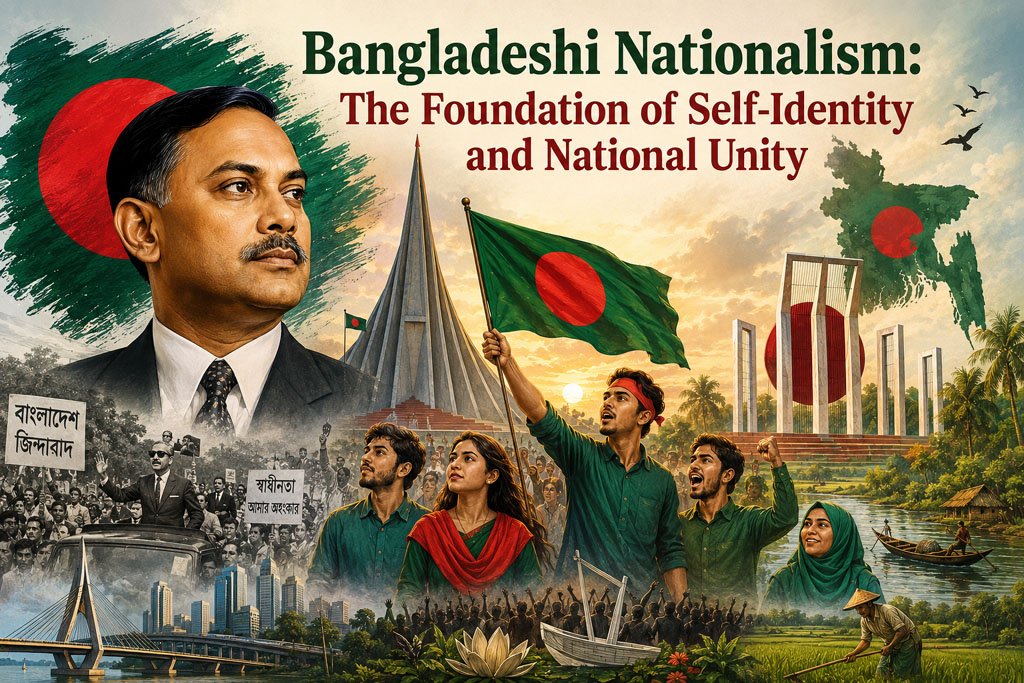
Ohidul Islam: When writing about Bangladeshi nationalism, the first person who comes to mind is Ziaur Rahman. On March 26, 1971, via the radio—the mass medium of the time—Ziaur Rahman declared Bangladesh’s independence from Pakistan and called upon the public, as well as pro-Bangladesh elements within all the armed forces, to join the war of independence. From March 26, 1971, until the formation of the Government of Bangladesh on April 10, 1971, Major Ziaur Rahman served as the President of Bangladesh. During the Liberation War, alongside his duties as a Sector Commander, he played a key role in organizing the resistance and participated in direct combat. In recognition of his extraordinary courage and contributions to the war of independence, the Government of Bangladesh awarded him the “Bir Protik” title—the country’s second-highest gallantry award—in 1972.
Following the famine of 1974 and the political vacuum, economic decline, and deterioration of law and order in 1975, the ordinary people and soldiers of Bangladesh brought Ziaur Rahman to the presidency. His initiative to excavate canals—aimed at achieving food self-sufficiency—was a decision as timely and significant as the current Teesta Barrage project. Upon assuming the responsibility of governing the state, Ziaur Rahman took two major political decisions to transform Bangladesh into a successful nation. The first was the introduction of multiparty democracy, and the second was the establishment of a political party based on ‘Bangladeshi nationalism’—which forms the central theme of this article.
After the formation of the state of Bangladesh on December 16, 1971, a need arose to forge a national identity encompassing all the ethnic groups within the country’s borders. In response, President Ziaur Rahman put forward the concept of ‘Bangladeshi Nationalism’ in 1976 after becoming the President of the Republic of Bangladesh. He established the ‘Bangladesh Nationalist Party’ to embody, uphold, and propagate this ideology.
A state is an independent entity. It is a territory where inhabitants live based on a mutual agreement. The inhabitants of a state are its citizens. The agreement reached by citizens among themselves is the ‘constitution.’ The constitution reflects the citizens’ ultimate consensus regarding the fundamental aspects of the state. In a kingdom, people are subjects of the monarch. A state has no subjects. In matters of politics, governance, and the administration of justice, the state grants equal rights to every citizen, irrespective of religion, belief, gender, or race. Bangladesh is a state. There are no subjects in Bangladesh; there are citizens. It is the citizens of Bangladesh who, through the parliament, frame the state’s constitution. The citizens of Bangladesh are the owners of the Bangladesh state. Therefore, the existence of discrimination among the owners of the Bangladesh state runs counter to the fundamental basis of the state’s very identity.
Nationalism is not a new concept in this region; it was present in the politics of Emperor Ashoka and Emperor Akbar. It also permeates the poetry of the rebel poet Kazi Nazrul Islam. Historically, the people of the Bengal region have maintained social bonds with one another, setting aside differences in religion, caste, custom, and language. Bangladeshi nationalism never believes in violence, terrorism, and oppression against the ethnic community. Instead, Bangladeshi nationalism advocates peaceful solutions to social and political differences. Bangladeshi nationalism upholds the rule of law and the enlightenment of humanity, which is the Bangladesh Nationalist Party’s belief.
In short, ‘Bangladeshi nationalism’ entails the absence of any form of discrimination among the citizens of Bangladesh, serving as the foundation of the nation’s unity.