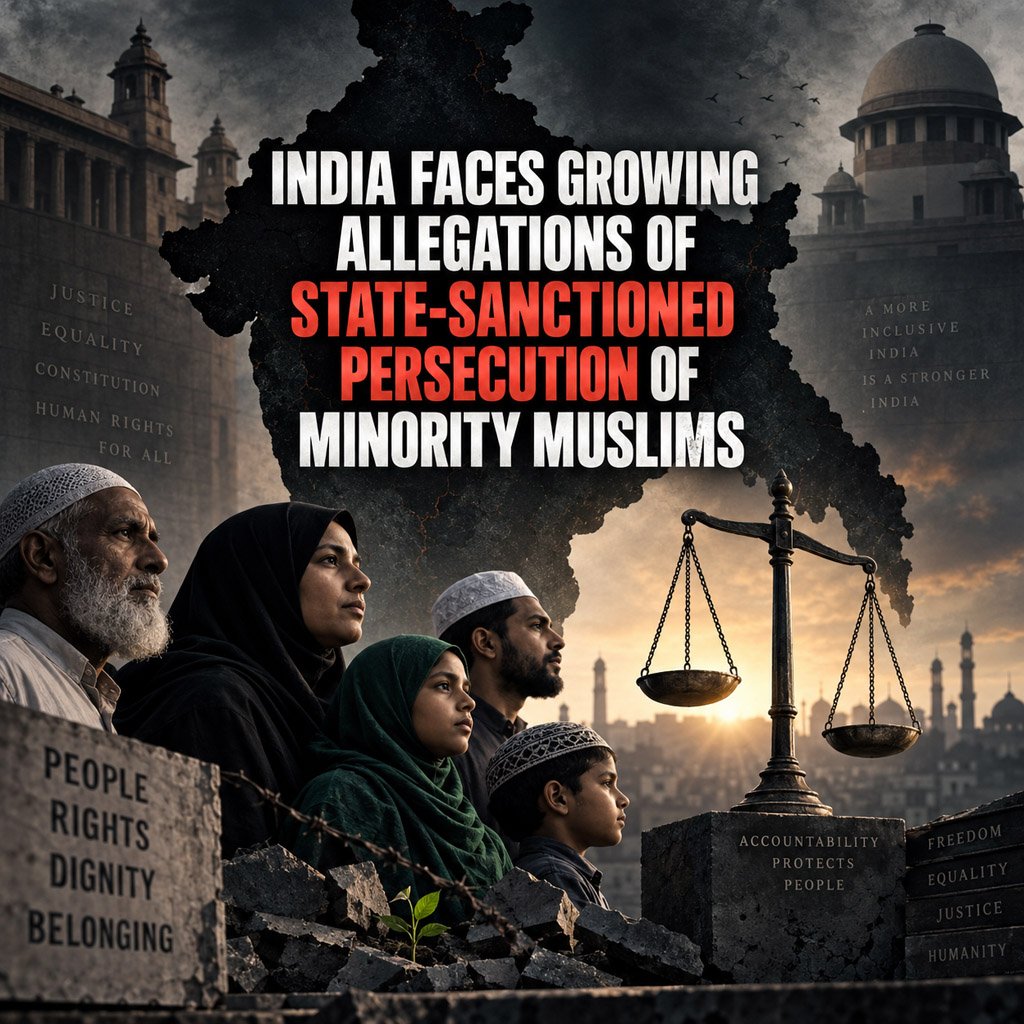
 Suprovat Sydney: India proudly describes itself as the world’s largest democracy a country founded on constitutional equality, religious freedom and respect for its extraordinary diversity. Yet disturbing reports from West Bengal have raised an urgent question: are some Indian minority Muslims being treated as foreigners in their own country simply because of their names, religion, language or poverty?
A recent investigation reported that, since June 2026, at least nine minority Muslim men and two children were taken from their homes by West Bengal police on suspicion of being Bangladeshi nationals. Most reportedly came from Murshidabad. Family members alleged that several people were removed during late-night raids without warrants, arrest records or an immediate opportunity to challenge the allegations before a court.
These are serious allegations, not yet final judicial findings. Police officials have defended their actions, saying that the detentions followed government guidelines and that those concerned were suspected foreign nationals. Nevertheless, the reported circumstances demand an immediate, transparent and independent investigation. No democratic government should expect the public to accept secretive detention merely on the assurance that “guidelines” were followed.
Taken away in the darkness
Among those detained was reportedly 61-year-old Ibrahim Sheikh of Murshidabad. His family said that men in civilian clothing arrived shortly after midnight, examined his Aadhaar and voter cards, questioned whether he was Indian or Bangladeshi, and then took him away. His relatives later presented pension records, land documents and electoral identification, yet allegedly struggled to discover where he had been detained.
Another reported case involved Abdul Jabbar and his two sons, aged eight and six. His family said that Jabbar possessed an Indian passport, voter card and other records. Police reportedly relied upon a disputed Bangladeshi birth certificate. If the family’s account is correct, the detention of two young children alongside their father raises particularly grave humanitarian concerns.
In another case, police records reportedly showed that the Border Security Force returned 67-year-old Jalil Akhtar to police custody after he insisted that he was an Indian citizen. His relatives said that their family held land records dating back decades. Police reportedly considered his inability to speak Bengali among the surrounding circumstances, although his family speaks Surjapuri a recognised regional language used near the Bihar West Bengal border.
Language, clothing, accent and religion cannot determine citizenship. India is home to hundreds of languages and countless regional identities. An Indian citizen does not become a foreigner because an officer considers that person’s speech, appearance or family history unfamiliar.
Citizenship questions must follow the law
Every country has the right to manage its borders and investigate unlawful migration. India is entitled to verify the status of someone reasonably suspected of entering without permission. But border security does not cancel constitutional rights.
Articles 14 and 21 of the Indian Constitution protect equality before the law and safeguard life and personal liberty. Article 22 provides protections relating to arrest and detention. At a minimum, a person taken into custody should be told the grounds, given access to legal assistance, produced before the proper judicial authority and allowed to present evidence.
Citizenship cannot be decided by unidentified officers arriving at midnight. Nor should an Aadhaar card, passport, voter registration, school record or land document be dismissed without proper examination. If the authorities believe documents are false, they must prove that through a lawful and transparent process. The burden cannot simply be placed upon a frightened family searching from police station to police station for a missing relative.
The situation is especially concerning because some detainees had reportedly passed recent electoral-roll scrutiny. Their inclusion on a voter list may not, by itself, conclusively settle every citizenship dispute, but it plainly deserves serious consideration. A government cannot casually allow someone to vote one day and treat that person as an undocumented foreigner the next.
A wider climate of fear
These incidents cannot be viewed entirely in isolation. Human Rights Watch reported in January 2025 that violence and harassment against Muslim religious minorities had increased in India and accused the Modi-led Bharatiya Janata Party BJP) government of pursuing discriminatory policies and rhetoric affecting Muslims and other minorities. In August 2026, experts from a United Nations committee also raised questions concerning anti-Muslim hate speech and religious freedom during their examination of India.
The Indian government and BJP reject accusations that they persecute Muslims. They commonly argue that citizenship, security and criminal laws are applied to protect the country and that welfare programs serve Indians without religious discrimination. Such explanations must be acknowledged. However, a government’s stated intention cannot replace scrutiny of what its laws, political language and enforcement practices produce in ordinary people’s lives.
Responsibility must also be identified accurately. The reported West Bengal raids involved state police and therefore require answers from the West Bengal government and its police leadership. The national government is nevertheless responsible for the broader citizenship and immigration framework, the conduct of federal forces and the political climate created by national leaders. Accountability should not be reduced to party rivalry. Every public authority involved must answer for its own actions.
History should teach coexistence: not revenge
Some people respond to present-day injustice by arguing that Muslim rulers governed large parts of the Indian subcontinent for centuries and could have eliminated the Hindu population had they wished. That argument expresses anger, but it is historically oversimplified and morally unhelpful.
South Asian history contains cooperation, cultural exchange and shared achievement, but also wars, discrimination and injustices committed by rulers belonging to different dynasties and faiths. Many Muslim rulers employed Hindu administrators, generals, scholars and artisans; Hindu and Muslim communities together shaped India’s languages, music, architecture, cuisine and economy. Yet modern citizens should not be judged by the conduct of medieval emperors whether good or bad.
The strongest response to injustice is not to imagine what one community could have done to another. It is to insist upon a universal principle: no Hindu, Muslim, Christian, Sikh, Buddhist or person of any other belief should be persecuted, collectively blamed or deprived of legal protection.
India does not belong exclusively to one religion. Its Muslims are not guests who must continually prove their loyalty. They are citizens, workers, teachers, farmers, soldiers, artists and public servants whose ancestors helped build the country.
What must happen now?
The West Bengal authorities should immediately publish accurate information about every detainee’s location and legal status. Families must receive arrest records and access to lawyers. Children should not be held in punitive detention, and no person should be deported until citizenship claims and documents have been independently examined.
Courts should urgently hear habeas corpus applications and review whether the detentions complied with constitutional requirements. Any officer found to have used violence, concealed a detention or made communal remarks should face appropriate investigation and disciplinary action. Those wrongly detained must be released and compensated.
Prime Minister Narendra Modi and India’s national leadership must also make an unambiguous commitment that no Muslim will be targeted because of religion. Political leaders should stop using expressions that equate Bengali-speaking Muslims with “infiltrators.” Such language can give prejudice the appearance of official permission.
Protecting Muslims does not weaken India; it strengthens India’s democracy. Human rights have meaning only when they apply to everyone.
Governments and political fortunes change, but the damage caused by injustice can endure for generations. India must therefore choose the authority of its Constitution over the politics of fear. Innocent citizens should never be pushed into alienation or resistance through humiliation and arbitrary treatment. Justice, transparency and equal citizenship not midnight raids are the foundations of a secure and united nation.
The persecution of minority Muslims is not confined to West Bengal; disturbing allegations of discrimination, harassment and violence have emerged across India over many years.
Muslim families have reported arbitrary detention, communal attacks, unlawful demolition of homes and businesses, and discrimination linked to citizenship. Human-rights organisations have repeatedly raised concerns about hate speech and the unequal treatment of Muslims by authorities. In some cases, ordinary citizens have allegedly been labelled “foreigners” or “infiltrators” despite possessing identity documents and having lived in India for generations.
When political leaders use divisive language, it can normalise prejudice and encourage further hostility. Every genuine security or immigration matter must be investigated lawfully, transparently and without religious profiling. No innocent person should be detained, punished or humiliated merely because of their Muslim name, clothing, language or place of residence. India’s Constitution promises equality, religious freedom and protection of personal liberty to every citizen. The national and state governments must investigate alleged abuses, hold responsible officials accountable and provide justice to victims.
India can preserve its democracy and unity only by ensuring that Muslims and every other religious community are treated with dignity, fairness and equal protection under the law.
World leaders must not remain silent in the face of longstanding allegations of violence, persecution and discrimination against India’s Muslim minority. The international community should urgently call for an independent investigation, accountability for proven abuses, and immediate protection of the fundamental rights and safety of every minority community in India.