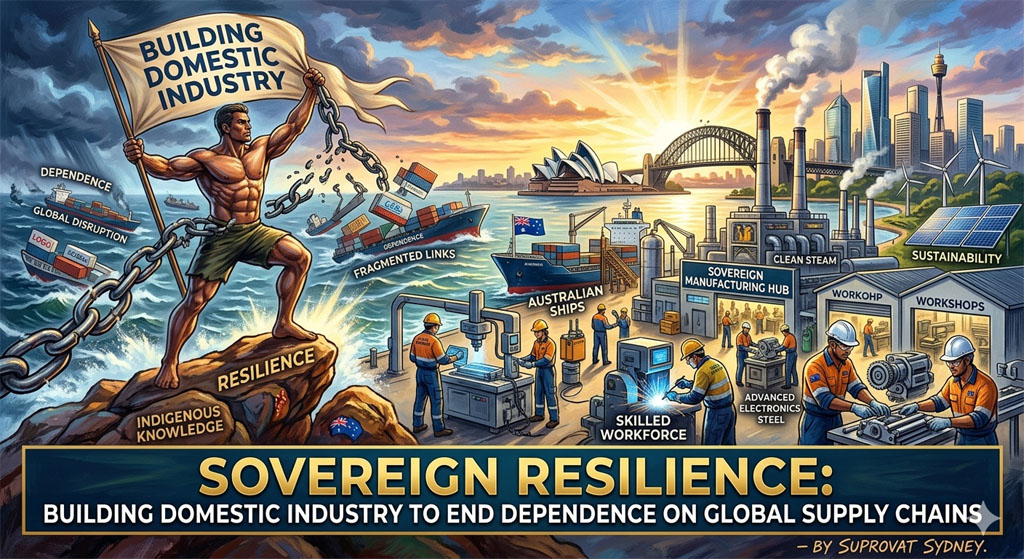
 by Suprovat Sydney: The global economic landscape of 2026 is defined by a fundamental shift from the unbridled globalization of the early 21st century to a new era of sovereign resilience. Recent geopolitical tensions, the lingering lessons of the COVID-19 pandemic, and the weaponization of trade have exposed the profound vulnerabilities inherent in hyper-extended global supply chains (Laffourcade, 2026). For decades, nations prioritized “just-in-time” efficiency and cost-minimization; today, they are pivoting toward “just-in-case” security and domestic industrial autonomy (Buckley, 2025).
Building domestic industry is no longer merely an economic policy, it is a strategic imperative for national survival. As nations seek to decouple from unreliable partners and re-shore critical manufacturing, they are redefining what it means to be a sovereign state in a volatile, contested world.
The Fragility of Interdependence
The traditional model of Global Value Chains (GVCs) relied on the assumption that economic interdependence would act as a bulwark against conflict. However, recent disruptions, from the semiconductor shortage to energy instability, have proven that interdependence can be transformed into a liability (Opuala-Charles, 2026).
- Geopolitical Weaponization: Major powers now use industrial policy and trade restrictions as tools of statecraft. For instance, the use of subsidies and vertical integration in green technology has allowed some nations to create structural overcapacities that undercut foreign competitors, effectively “hollowing out” the domestic industries of their rivals (Laffourcade, 2026).
- The Cost of De-risking: While necessary for security, the transition is not without expense. Research suggests that reverting trade integration to earlier levels (reshoring) could result in long-term global GDP losses of up to 4.5% (Cerdeiro, 2024). Smaller, open economies face even steeper losses, potentially exceeding 10% of their GDP, as they lose access to the efficiency gains of specialization (Cerdeiro, 2024).
Despite these costs, the “sovereignty gap” has become too large to ignore. Sovereign resilience requires a state’s ability to develop, manufacture, and sustain critical innovations such as vaccines, defense materials, and energy infrastructure within its own borders (Laffourcade, 2026).
Pillars of Domestic Industrial Resilience
Ending dependence on global supply chains requires more than just building factories; it requires an integrated ecosystem of technology, policy, and human capital.
- Technological Sovereignty and Industry 4.0
The cornerstone of modern domestic manufacturing is the adoption of Industry 4.0 technologies. Digitalization, automation, and AI allow domestic firms to offset higher labor costs through extreme efficiency (Nakandala, 2026).
- Robotics: Domestic robotization can paradoxically boost foreign direct investment by creating demand for local complementary inputs and specialized labor (Blanchard et al., 2016).
- SME Integration: Small and Medium Enterprises (SMEs) are the backbone of industrial resilience. By utilizing “adaptive resilience” mechanisms sensing market signals and rapidly reconfiguring resources SMEs can sustain performance even when external shocks occur (Ongesa Nyamboga, 2026).
- Strategic Border and Resource Management
Nations are beginning to treat their borders as strategic assets rather than mere checkpoints. By managing borders as a sovereign capability, governments can unlock investment pathways for modernizing trade infrastructure and defending against “cyber-physical” threats embedded in global cargo (APM, 2026).
- Policy Coherence and Government Procurement
The revival of industrial policy is central to this shift. Governments are no longer passive observers of the market; they are active architects.
- Targeted Assistance: Modern industry policy uses targeted assistance to address challenges where market forces alone are insufficient, such as the green energy transition (Buckley, 2025).
- Procurement Levers: Using government procurement to favor domestic manufacturers ensures a steady demand “floor,” allowing local industries to scale without being immediately crushed by lower-cost international competitors (Nakandala, 2026).
Strategic Re-shoring vs. Friend-Shoring
The path to resilience generally follows two trajectories: reshoring (bringing production home) and friend-shoring (sourcing from trusted allies).
| Strategy | Focus | Economic Impact | Security Level |
| Reshoring | Domestic production | Higher costs; significant GDP impact (up to 4.5% loss) | Highest; full control over supply |
| Friend-Shoring | Trusted trade partners | Moderate costs; lower GDP impact (0.4% – 1.8% loss) | High; relies on political stability of allies |
Export to Sheets
While friend-shoring offers a middle ground, true sovereign resilience prioritizes domestic capacity for “dual-use” technologies those essential for both civilian life and national defense (Laffourcade, 2026).
Challenges to Industrial Autonomy
Transitioning away from global dependence is a multi-decade project fraught with obstacles:
- Skills Shortages: A move toward advanced manufacturing requires a highly tech-savvy workforce. Governments must invest in capability development programs to bridge the gap between traditional labor and digital manufacturing (Nakandala, 2026).
- Resource Constraints: Not every nation possesses the raw materials such as rare earth elements required for high-tech industry. This necessitates “circular economy” strategies where materials are recycled and reused within the domestic loop to minimize external reliance (Nakandala, 2026).
- Input Quality: Rapidly shifting to domestic sources can lead to a temporary drop in input quality (estimated at roughly 8%), which can reduce the overall quality of high-tech exports (Cerdeiro, 2024).
Conclusion: The New Social Contract
Sovereign resilience is not an attempt to return to 20th-century isolationism; it is an evolution toward a more sustainable and secure form of global engagement. By anchoring modernization in national priorities productivity, sovereignty, and resilience states can protect themselves from the “geopolitical weaponization” of trade (APM, 2026; Laffourcade, 2026).
The goal of ending dependence on global supply chains is to ensure that, in times of crisis, a nation is not a victim of geography or diplomacy, but a master of its own industrial destiny. As we look toward the 2030s, the strongest nations will not be those with the cheapest goods, but those with the most resilient domestic foundations.
References
APM, M. O. (2026). Beyond the checkpoint – Managing Australia’s border as a strategic economic and national security asset. Australian National University (ANU) National Security College. https://nsc.anu.edu.au/sites/default/files/2026-01/Web_NSC_OP_Beyond%20the%20checkpoint_mapping%20Australia%27s%20border.pdf
Blanchard, E., Bown, C., & Johnson, R. (2016). Global supply chains and trade policy. National Bureau of Economic Research. https://doi.org/10.3386/w21883 Cited by: 276
Buckley, A. (2025). Deterrence and the case for Australian Industry Policy. Future Forge – Defence. https://theforge.defence.gov.au/article/deterrence-and-case-australian-industry-policy
Cerdeiro, D. (2024). The price of de-risking: Reshoring, friend-shoring, and quality downgrading. IMF Working Papers, 2024(122), 1. https://doi.org/10.5089/9798400269646.001 Cited by: 25
Laffourcade, R. (2026). Technological sovereignty in healthcare innovation and production for defence: Proposal for an evaluation index to guide European policies. Taylor & Francis. https://doi.org/10.1080/23779497.2026.2645265
Nakandala, D. (2026). Recharging SME manufacturing in NSW. Australian Public Policy Institute. https://appi.org.au/wp-content/uploads/2025/05/APPI-Recharging-SME-manufacturing-in-NSW.pdf
Ongesa Nyamboga, T. (2026). Strategic thinking and entrepreneurial orientation as drivers of adaptive resilience in global manufacturing SMEs. F1000Research, 15(344). https://f1000research.com/articles/15-344/pdf Cited by: 1
Opuala-Charles, S. (2026). Global strategies for enhancing logistics resilience in the face of supply chain disruptions. ISAR Journal of Economics and Business Management, 4(1). https://isarpublisher.com/backend/public/assets/articles/1768400192-ISARJEBM-3552026–Gallery-Script.pdf