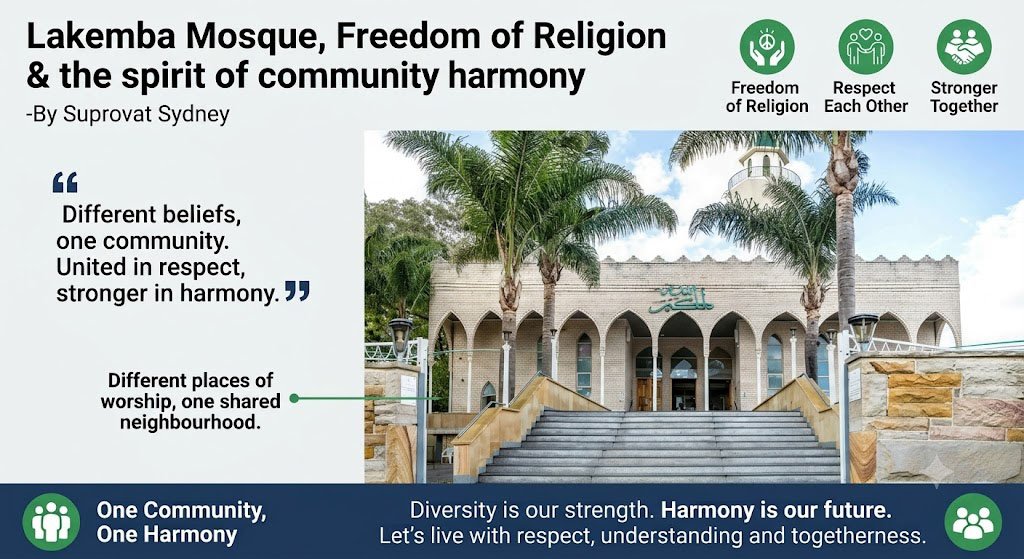
By Suprovat Sydney: The recent debate over the proposed use of loudspeakers for the Islamic call to prayer, or Adhan, at a Lakemba mosque has raised important questions about freedom of religion, freedom of expression, community harmony and the role of local government.
Canterbury-Bankstown City Council has a long history of representing one of Australia’s most culturally and religiously diverse communities. Lakemba- Sydney, in particular, is home to people from many different cultural and religious backgrounds who have lived alongside one another for generations. The issue deserves to be considered carefully, respectfully and without unnecessarily dividing the community.
A diverse community living side by side
Lakemba is perhaps one of the best-known examples in Australia of different faith communities living side by side. Mosques, churches, businesses and community organisations operate within close proximity to one another.
For many years, Muslim and Christian communities in Lakemba have shared a friendly relationship. Muslim community organisations have regularly hired church halls for meetings, social programs and community events. These interactions demonstrate that religious diversity does not necessarily create division; when approached with mutual respect, it can strengthen the social fabric of a community.
This is an important part of Lakemba’s identity and should not be forgotten during the current debate.
The proposed mosque loudspeakers
The Imam Ali bin Abi Taleb Mosque in Lakemba has been part of the local community for many years, having opened in 1977. The mosque has lodged amended plans with Canterbury-Bankstown Council seeking approval to install four speakers on its minaret tower. The proposal has generated considerable public discussion.
Less than a year ago, an earlier application was rejected by the local planning panel, reportedly on planning and amenity grounds, including concerns about noise.
However, the current discussion raises a reasonable question: Could a limited and carefully controlled use of the loudspeaker for the Friday Adhan be accommodated without causing unreasonable disturbance to neighbouring residents?
The proposal, as understood by the community, is not for continuous broadcasting throughout the day. Rather, it concerns a short religious announcement associated with Friday prayers.
A practical compromise may therefore be possible one that respects both the religious freedom of the Muslim community and the legitimate expectations of nearby residents regarding noise and amenity.
What about the 1,600 objections?
Reports that approximately 1,600 submissions were lodged against the proposal should certainly be taken seriously. At the same time, it is worth examining where those submissions came from and whether all represent residents living immediately around the mosque.
Public consultation is important, but numbers alone should not determine the entire debate. The substance of the submissions, the location of affected residents, the actual measured noise impact and the proposed operating conditions should also be considered. There is also another side of the community that deserves to be heard.
Suprovat Sydney, Australia’s long-running (18 years) Bangladeshi community only newspaper, has previously conducted community engagement and found that some non-Muslim residents are supportive of allowing a limited Friday Adhan. This suggests that the community is not necessarily divided along a simple Muslim-versus-non-Muslim line.
We should therefore avoid labelling an entire council, community or group as racist because of a planning disagreement. Instead, the focus should remain on finding a fair and workable solution.
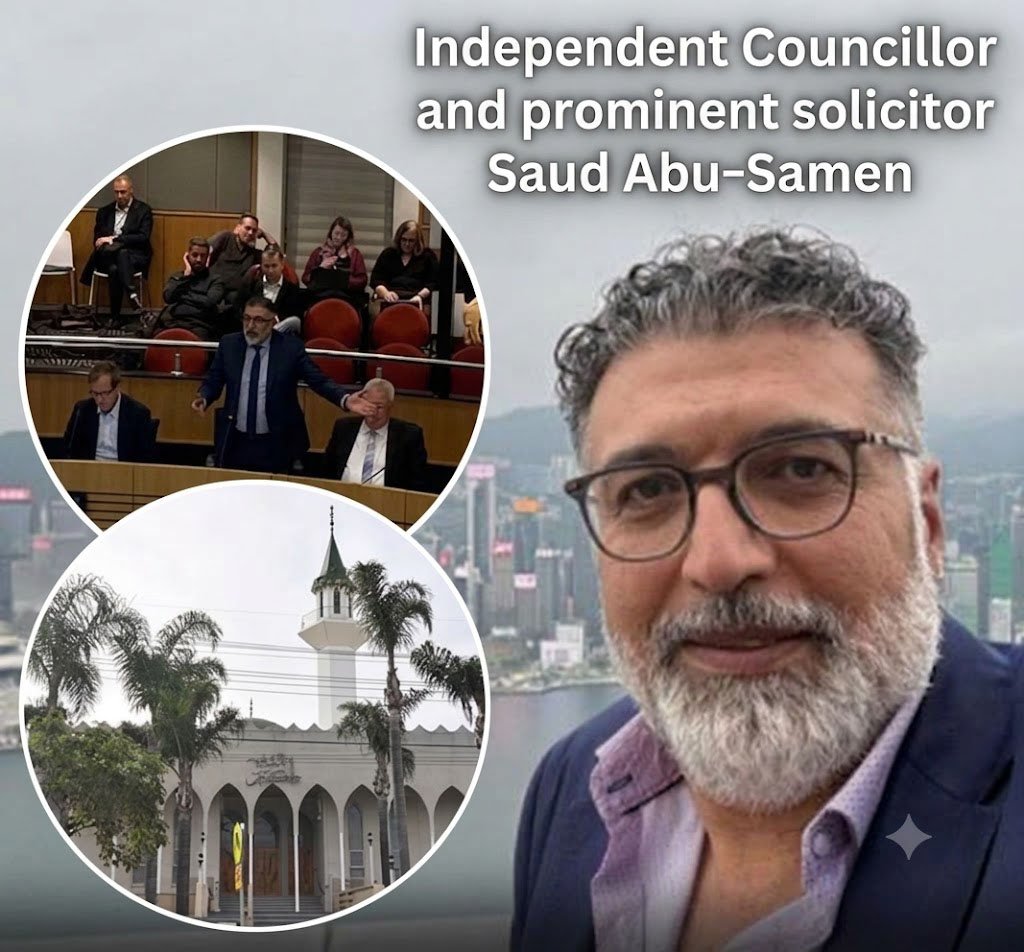
Independent Councillor and prominent solicitor Saud Abu-Samen offered concerned residents a simple and practical suggestion: “If you’re really annoyed by the bell or the sound, close your windows.”
Religious freedom should be applied consistently
The principle of religious freedom is fundamental to Australia’s multicultural society. Religious announcements, ceremonies and traditions are part of the public life of many communities. Around the world, churches, cathedrals, mosques and other places of worship have developed ways of expressing their faith while operating within local laws and noise regulations.
Examples include the use of bells by churches and the broadcasting of the Adhan from mosques in a number of countries.
The important question should therefore not simply be whether the religious practice is Muslim or Christian. The question should be whether it can be conducted reasonably, safely and within appropriate environmental and noise standards. That principle of equal treatment is essential in a multicultural society.
A history of cooperation in Canterbury-Bankstown
There are also positive examples within the Canterbury-Bankstown community itself.
Some respected councillors have consistently emphasised multiculturalism, religious tolerance and social cohesion. Former Mayor Khal Asfour, for example, has been associated with initiatives promoting diversity and community inclusion. The broader principle is simple: places of worship should help bring people together rather than become symbols of division.
From St Paul’s Cathedral in London and St Mary’s Cathedral in Sydney to St Peter’s Basilica in Vatican City, major religious institutions are not merely buildings; they are places where communities gather, worship and engage with society.
Lakemba’s religious institutions can similarly play an important role in bringing people together.
Suprovat Sydney’s previous submission to Council
This is not the first time Suprovat Sydney has raised community issues with Canterbury-Bankstown City Council.
On 7 November 2023, Suprovat Sydney formally submitted a request to Mr Matthew Stewart, Chief Executive Officer of Canterbury-Bankstown City Council, concerning a number of issues affecting the local community.
Among the issues raised were traffic and pedestrian safety concerns, including a request for a speed hump near the Lakemba Musallah on Haldon Street, as well as concerns about alcohol-related harm and trading hours.
These matters were raised because local government decisions can have a direct impact on community safety, family life and social wellbeing.
The Adhan proposal should likewise be considered as part of the broader discussion about how Council can accommodate the needs of a diverse and rapidly changing community.
The Adhan is not a new practice
The use of loudspeakers for the Adhan is not unique to Australia. Mosques in different parts of the world have been permitted, under various conditions, to broadcast the call to prayer. Examples have been reported in the United States, United Kingdom, Canada, Italy and Germany.
For example, New York City has permitted certain mosques to broadcast the Friday call to prayer under specified conditions. Similar arrangements have been reported in parts of Canada and Europe.
These international examples do not mean that Australian councils must automatically approve the same arrangements. Australian planning, environmental and noise regulations must still be followed. However, they demonstrate that a carefully regulated Adhan can coexist with modern urban life.
A reasonable compromise is possible
The Muslim community already participates in the local regulatory framework. During Friday prayers, significant numbers of worshippers attend mosques in Lakemba. At certain times, roads such as Wangee Road and Haldon Street have been subject to traffic management arrangements to accommodate large congregations.
During Ramadan, the community also holds major religious activities that attract thousands of people including lots of Non-Muslims.
These arrangements demonstrate that Council and the community can work together when there is goodwill and a willingness to find practical solutions.
If roads can be managed, traffic can be controlled and large community events can be accommodated under appropriate conditions, then surely a limited Friday Adhan could also be examined on its merits.
The solution could include strict conditions relating to duration, volume, operating times, speaker direction and noise monitoring.
Such conditions would protect residents while allowing the Muslim community to practise an important aspect of its faith.
Time for dialogue, not division
This debate should not become a contest between “Muslims” and “non-Muslims”.
It should be about how a multicultural Australian community can accommodate religious freedom while respecting the reasonable expectations of all residents.
Council should carefully review the proposal, consider the evidence from both supporters and objectors, assess the actual noise impact and explore whether reasonable conditions could allow a limited Friday Adhan.
The Muslim community should also listen respectfully to residents if anyone have genuine concerns about noise and amenity. Both sides have a responsibility to contribute to a constructive solution.
Our appeal to Canterbury-Bankstown Council
Suprovat Sydney respectfully urges Canterbury-Bankstown City Council to reconsider the issue through the principles of religious freedom, equality, multiculturalism and community harmony.
We do not believe that every planning application should automatically be approved because it relates to religion. Equally, religious practices should not be rejected simply because they are unfamiliar to some residents.
The fairest approach is to examine the evidence, apply the same standards to everyone and seek a practical compromise.
Lakemba has demonstrated for generations that Muslims, Christians and people of many other backgrounds can live together peacefully.
The current debate should not destroy that tradition.
Instead, it should be an opportunity for Canterbury-Bankstown to demonstrate once again that Australia’s multicultural communities can find solutions through dialogue, respect and mutual understanding.
The question is not whether one community should win and another should lose. The real question is whether we can find a reasonable way for everyone to live together with dignity, respect and harmony.