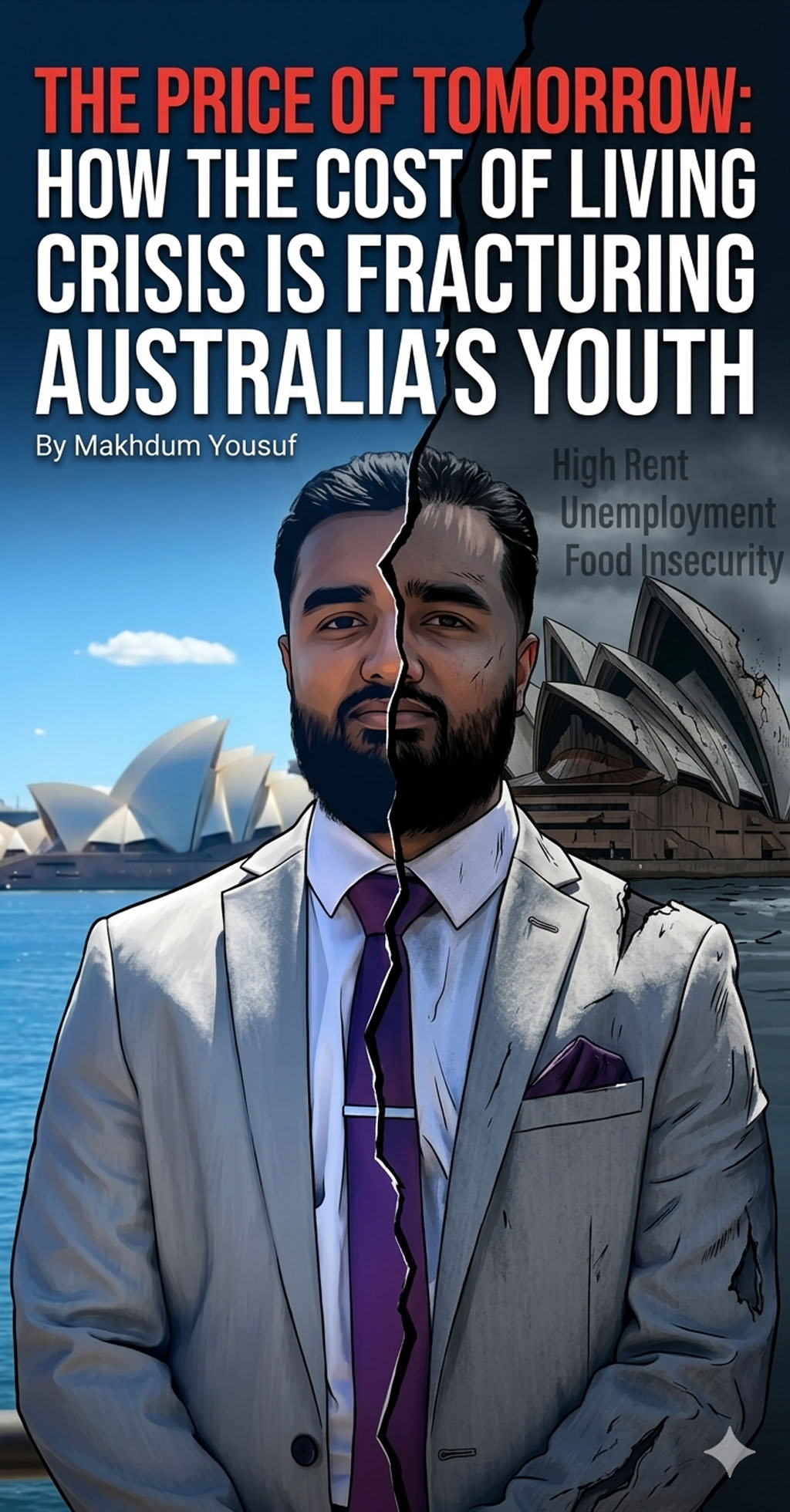
 By Makhdum Yousuf: A quiet, systemic crisis is unfolding across Australia’s major cities and regional towns. It does not announce itself with a sudden macroeconomic shock or a visible collapse of major institutions. Instead, it manifests in the soft click of a calculator at a supermarket checkout, the persistent dread of an upcoming rent review, and the forced cancellation of a GP appointment to keep the lights on.
For young Australians specifically Gen Z and younger Millennials aged 15 to 29 financial stress has mutated from a temporary rite of passage into a defining public health emergency. Recent data paints a bleak picture of a generation under unprecedented economic duress. The 2025 Australian Youth Barometer, published by Monash University, revealed that a staggering 85% of young Australians experienced financial insecurity over the past year, with more than a quarter reporting that it happens “often or very often.”
Far from being a transient phase of “starving artistry” or youthful budgeting, the contemporary cost of living crisis is fundamentally reshaping the psychological, biological, and social fabric of the nation’s youth.
The Triple Whammy: Rent, Inflation, and Insecure Work
To understand why young Australians are uniquely vulnerable to the current economic climate, one must look at the structural intersection of the housing market, inflation, and the modern labor force. Young people are overrepresented in casual, gig-economy, and insecure employment sectors such as retail, hospitality, and entry-level services. They lack the financial buffers, accumulated assets, and institutional safety nets enjoyed by older generations.
- The Rental Trap
Housing has shifted from a launchpad for independence into a primary source of trauma. With capital city vacancy rates hovering near historic lows, rental prices have skyrocketed. A national poll conducted by YouGov on behalf of youth mental health organization Orygen revealed that young people are facing compounding barriers to basic survival. For those aged 18 to 24, finding an affordable place to live is no longer an exercise in compromise; it is a statistical near-impossibility.
According to the Youth Barometer, a mere 30% of young people believe it is likely or extremely likely they will be able to afford a comfortable place to live in the next 12 months. The dream of homeownership has evaporated for the vast majority, with 79% of young Australians stating they believe they will be financially worse off than their parents.
- Wage Stagnation vs. Everyday Inflation
While the Reserve Bank of Australia’s cash rate hikes aimed to cool the economy, the trailing effect on young people has been brutal. Everyday essentials groceries, fuel, utilities, and insurance have surged well beyond the trajectory of award wages.
The National Centre for Vocational Education Research (NCVER) tracked 23-year-olds in their Generation Z: Life at 23 report, noting a sharp uptick in severe financial deprivation:
- Skipping Meals: 19% of 23-year-olds reported skipping meals due to a shortage of money.
- Healthcare Foregone: 22% went without necessary medical care because they simply could not afford the out-of-pocket costs.
- Underemployment and “Placement Poverty”
While headline unemployment figures remain relatively low, underemployment tells the true story of the youth workforce. Two in three young Australians report being underemployed—desperately seeking more hours but trapped in volatile, casual shifts.
Furthermore, university and TAFE students undertaking mandatory, unpaid practical placements—such as nursing, teaching, and social work students face what advocacy groups call “placement poverty.” Forced to work 40 hours a week for zero pay to earn their degrees, many are left with no time for paid work, driving them deeper into debt and credit reliance.
From Economic Metric to Mental Health Crisis
The most alarming aspect of the current financial crunch is its direct, unyielding toll on youth mental health. For decades, economic discussions focused on GDP, CPI, and interest rates. Today, psychiatrists and youth workers view financial stress as a core clinical issue.
+————————————————————–+
| THE VICIOUS CYCLE OF YOUTH FINANCIAL STRESS |
+————————————————————–+
| |
| Rising Living Costs (Rent, Groceries, Energy) |
| │ |
| ▼ |
| Financial Anxiety & Psychological Distress |
| │ |
| ▼ |
| Forced Austerity (Skipping meals, delaying healthcare) |
| │ |
| ▼ |
| Erosion of Social Support & Long-Term Hope |
| |
+————————————————————–+
Data from the headspace National Youth Mental Health Survey shows that nearly half (49%) of young people rank the cost of living as their number one concern impacting their mental health—outranking study pressure, climate change, and future job opportunities. Similarly, a Mission Australia Youth Survey of over 17,000 teenagers aged 14 to 19 found that 64% cited the cost of living as the top national issue, the highest level recorded since the metric was introduced in 2010.
“Young people are telling us that the strain of rising prices and not having money for basic essentials is taking a toll on their mental health and their outlook on life,” says Sharon Callister, CEO of Mission Australia. “They are watching their families and friends struggle to pay bills or afford stable housing, and it’s creating a persistent undercurrent of dread.”
Crucially, the financial crisis acts as a double-edged sword: it causes psychological distress while simultaneously cutting off the avenues for help. Orygen’s polling indicated that 57% of Australians identify cost as a primary barrier preventing young people from accessing mental health care. When a standard psychological consultation requires a significant out-of-pocket gap fee, mental health care becomes an unaffordable luxury.
Changing Milestones and Generational Pessimism
The compounding weight of financial stress is fundamentally altering the traditional milestones of adulthood. The conventional timeline finishing education, securing a stable career, moving out, finding a partner, buying a home, and starting a family has been fractured.
Delayed Independence
Young Australians are staying in the family home far longer out of necessity rather than choice. NCVER data indicates that 55% of 23-year-olds still live with their parents, a marked increase from a decade prior. For those without a supportive family network to fall back on, the alternative is increasingly grim: overcrowding, substandard share-housing, or couch-surfing.
Rethinking the Future
The financial anxiety is so acute that it is altering demographic projections. In the headspace survey, 42% of young people stated they felt hesitant to have children in the future due to financial pressures. When nearly half of a generation feels economically disqualified from parenthood, the crisis transitions from an individual hardship to a demographic threat.
Furthermore, a sense of “normalised panic” has set in. Young people are adjusting their expectations downward, experiencing what researchers call “future fatigue”—a state of chronic exhaustion where planning for a career or a life five years down the line feels futile because the immediate present is so volatile.
Policy Interventions: Is it enough?
The federal government’s recent budgets have acknowledged the pain felt by younger cohorts, rolling out several targeted measures aimed at structural relief:
| Policy Measure | Impact on Young Australians |
| HECS/HELP Debt Reform | A 20% cut to accumulated student loan debts and a shift to a fairer “marginal repayment system” with a higher threshold ($67,000), providing breathing room for graduates. |
| Phasing Out Junior Pay Rates | The Fair Work Commission’s move to phase out lower “junior” wage rates for 18-to-20-year-olds in retail, fast food, and pharmacy sectors to ensure equal pay for equal work. |
| Tax Cuts & Deductions | Income tax cuts targeting low-and-middle earners alongside a $1,000 instant tax deduction to simplify tax returns and boost take-home pay. |
| Commonwealth Prac Payments | Introduction of modest financial support for students completing mandatory placements in critical sectors like nursing and teaching. |
While youth advocacy groups, including the Australian Youth Affairs Coalition (AYAC), have welcomed these interventions, the consensus remains that these measures are band-aids on a deep structural wound. Peak bodies argue that youth allowance and income support payments remain below the poverty line, and the modest increases to Commonwealth Rent Assistance fail to match the aggressive realities of the private rental market.
The Path Forward
Australia risks creating an intergenerational divide that will take decades to heal. When 85% of a generation experiences financial insecurity before they reach their 30s, the social contract is compromised.
Addressing this crisis requires moving past short-term cost-of-living handouts toward systemic, structural reform. This includes:
- Bold Housing Strategies: Shifting tax incentives away from speculative property investment toward massive investments in social, affordable, and high-density youth housing.
- Re-evaluating the Social Safety Net: Indexing youth allowance and student support payments to real-world living costs so that studying or looking for work does not necessitate starving.
- Universal Healthcare Protection: Strengthening Medicare to ensure mental health services and basic dental/medical check-ups are completely bulk-billed for young people under 30.
The resilience of young Australians is frequently lauded, but resilience should not be a prerequisite for survival. If Australia wishes to secure its economic and social future, it must first ensure that the young people tasked with building that future can afford to live in the present.